Aruh Ganal Ceremony (The Thanksgiving of Dayak Society)
1. Background
Bahuma or farming for Dayak society in Kalimantan is not merely an economic activity, but also religious activity to build relationship with The Giver of blessing. Some say that the farming activity in Dayak is part of huma religion. The top ritual of bahuma is Aruh Ganal (great feast), a party held after the great harvest as a thanksgiving to God for all the blessings. Besides, Aruh Ganal is also a prayer to wish for a better harvest for the next season and a free of plant disease.
It is called Aruh Ganal because the ceremony is held on a large scale in five, seven, and or twelve days by the whole villagers; inviting people from other villages. Even sometimes they invite the government officials. The splendor of Aruh Ganal completely depends on the success of the harvest. If it is good harvest, a merry ceremony is held, otherwise, there will be only AruhKecil (small ceremony) or even there wouldnt’be ceremony at all.
Aruh Ganal is also called bawanang banih halin or mahanyari banih barat ceremony, a ceremony held because the harvest is great and during the bahuma there was no plant disease. The rice that is celebrated is the last harvested rice or the second harvest. Rice from this harvest is not to be eaten before the ceremony is held. In other words, the Dayak society can have their rice after giving thanks to God.
Because Aruh Ganal is a sacred and magical ceremony, it is led by a Balian. He is a local public figure (local leader) who has a wide knowledge about Dayak tradition. This knowledge is gained by studying from a Balian Tuha (Old Shaman) and doing Balampah (some kind of meditation to build relationship with kinds of spirits for a magical power).
Balian involved in Aruh Ganal consists of a few of people who are led by Pangulu Adat. In doing his duty, a Balian is always assisted by a Panjulang. She is a woman who pays attention to the Balian’s instruction, and at the same time can deliver the wish of the society. Every requirement from the Balian is served by the Panjulang.
2. Time and Place
Aruh Ganal is held once a year in Balai Adat, after harvest time which usually comes in July or August. But if the society meeting considers that the harvest is not good enough, Aruh Ganal is not held that year. The duration of the celebration could last until five or twelve days, depends on the success of the harvest.
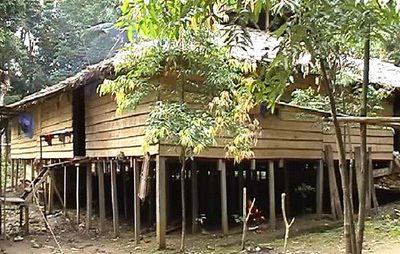
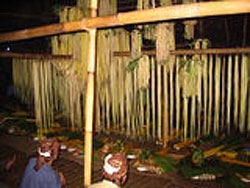
In this Balai Adat, Aruh Ganal ceremony is held.
To decide the day and date of the ceremony, they hold a meeting led by a Kepala Adat (the chief of local tradition) helped by Kepala Kampung (chief of the village). Aruh Ganal is always held in the beggining of the month, from 1st to 15th. it is believed that if a ceremony is held on those dates, the harvest for the next season will be better.
3. Materials and Equipments
To hold the ceremony, there are a few equipments that are needed:
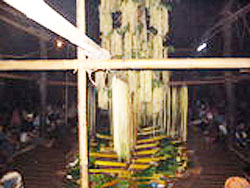
- Langgatan. It includes induk ancak (bamboo stand) and sesaji (offerrings). Langgatan is decorated after the opening night. Langgatan is made five levels, the biggest ancak is put at the bottom, and above it is the smaller one, and it goes on like that. Langgatan has various names, depending on the stuff in it and the purpose of it. There is a Ancak ka Gunung (has no levels), Ancak Balai Raden (boat shaped).
- Rattan Rope, is used to tie the four angles of langgatan and hang it in the middle of Balai Adat.
- Kelangkung, is made three. The first one is Kelangkung Mantit (the name of the bird’s ancestor), Kelangkung Nyaru (God of Thunder), Kelangkung Uria (God who takes care of all pests that ruin the plant).
4. Procedure
Aruh Ganal is a very special day for Dayak society. That is why, they prepare the ceremony very carefully, starting from preparing the supporting equipments to the time of the celebration. On the celebration day, people of Dayak take a leave from their occupations, wear new clothes, eat delicious food, etc, to express their joy. The following is the procedure of the ceremony:
a. Preparation
The preparation for Aruh Ganal starts from the meeting and the making of the supporting equipments.
- After the harvest is finished, the villagers hold a meeting led by the main Pangulu Adat. The meeting talks about the harvest and the possibility to hold the ceremony of Aruh Ganal. If the harvest is good, a ceremony will be held. If it is not, there will be no ceremony.
The members of Balai Adat
are preparing Aruh Ganal Ceremony
- If the meeting decides that Aruh Ganal is held, then the time of the ceremony and the invitation are to be decided as well. While the place, automatically, is in the Dayak society’s Balai Adat.
- A day approaching the ceremony, the villagers are very busy preparing all the needs to support the ceremony. This day is called batarah day, a day to start a work, preparing stuff, making equipments, and preparing the offerings. All the preparations have to be done in one day.
Seconds to the ceremony
b. The Process of The Ceremony
After all the preparations are done, the Aruh Ganal ceremony is begun. The ceremony that is usually held for 5, 7 or 12 days, is opened with a few processions dominated with the pronouncing of spells (bamamang) followed with dancing (batandik) around the center of the Balai Adat.
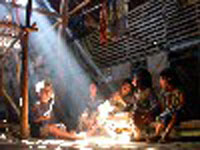
Balian and the villagers sit around the altar
- Around 21.00 WITA (9 p.m local time), the ceremony is begun. Damang (a leader of balai adat) and the villagers sit around the altar while reading spells to call the ancestors spirits (bamamang).
- After the spirit calling phase, the ceremony is continued with Dayak Meratus traditional entertainment: babangsai, basarunai, and barbarian. The entire villager, young and old, women and men, do their traditional dancing movements. The monoton music comes from antelope skin cover small drums played by four women at the four corners all night. There are only two notes played to accompany the batandik (dancing) along with the sound of hiang bracelet held by each Kepala Suku. This activity lasts until 8 a.m. in the morning local time. For Balian, it lasts until 4 p.m. non-stop.
- The batandik lasts for five, seven, or even 12 days non-stop. The Kepala Suku holds gelang hiang (hiang bracelet) and a chain of flowers and yellow janur (young coconut tree) called ringgitan, dancing around the ceremony place while pronouncing spells that are understood by no one but themselves. Batandik is the top of the Aruh Ganal ceremony. There are other rituals before batandik, namely bamamang (praying and pronouncing spells), bakanjar (the youth dance in flying eagle movement), and bakapur (chewing coconut oil and betel).
- Then the ceremony is completed with donating a part of the harvest (rice) to another balai/ village.
- The donating activity is a sign for the end of the ceremony.
- Five, seven, or twelve days (depends on how long the ceremony lasted) after the opening ceremony, outsiders are not allowed to come to Balai Adat unless the outsiders have spent the night there, the night before.
The detailed Ritual Procession Aruh Ganal ceremony is the process of data gathering.
5. Prayers and Spells
In the process of data gathering
6. Values
Aruh Ganal ceremony is the manifestation of belief, social, and political values of Dayak people. First, belief value. Aruh Ganal is a part of sacred bahuma (farming) process. The harvest is not merely decided by the ability to farm, but also by God’s mercy. They believe that by having a thanksgiving ceremony, the harvest for the next season will be better and free from pest and plant disease. Beside that, the value can also be seen through the pronouncing of the spells to invite the ancestors’ spirits. This is to ask them protect the villagers.
Second, social value. The Aruh Ganal ceremony is a place to strengthen the solidarity between people from different villages (balai) and communities. Dayak people from other villages come to see the ceremony, so that the solidarity comes up. The social value can also be seen by donating their harvest to people from other village.
Third, political value. Beside those values above, Aruh Ganal also has political value. The coming of outsiders in Aruh Ganal ceremony is an honor and acknowledgement of their existence. Dayak people are the citizens of Indonesia who have rights as well, who do their obligations just like the rest of the other citizens, but they are abandoned. Through Aruh Ganal ceremony, they maintain their identity and perform themselves to the wider society.
(DW/ter/04-08)
Sources
- Anak Sultan, Upacara Aruh Ganal, in http://kerajaanbanjar.wordpress.com/2007/04/24/upacara-aruh-ganal/
- Amir Sodikin, ”Aruh Ganal, Pesta Adat Terbesar Kalimantan Selatan yang Terlupakan” in Kompas, Tuesday, October 7, 2003.
- Warga Dayak Meratus Gelar Aruh Ganal, in Radar Banjarmasin, July 4, 2006.
- Menikmati Aruh Ganal Loksado, in http://www.indomedia.com/bpost/092006/24/ragam/ragam14.htm
- Kemandirian Dayak Meratus, in http://www.ychi.org/index.php?option=com_content&task=view&id=71&Itemid=1
- Abdurrahim, Kearifan Tadisional Masyarakat Adat Dayak Loksado Dalam PSDA, in http://www.ychi.org/index.php?option=com_content&task=
Read : 22.941 time(s).
Insert your comment here :


 aujourd hui
  Hier
Hier  La semaine dernière,
  Le mois dernier