Maleman Qunut and Maleman Likuran Ceremonies in Lombok, West Nusa Tenggara, Indonesia
1. The Origin
Ramadan is a month of worship and blessing for Muslims. In Indonesia, Muslims have many ways to seek the blessing of Allah (God) during Ramadan. In Lombok Island, Muslims have a unique way in seeking of God‘s blessing. According to many writers of Islam, there are two big groups of Islam in Lombok: Islam Wetu Telu and Islam Wetu Lima. Both of them have different ways to express their Islamic teachings.
The different expressions of their religious teachings can be seen, for instance, on the performing of tarawih prayer. For the Wetu Lima Muslims, the tarawih prayer is done by men and women, young and old people, and ordinary people and religious leader. Hence, every Muslim here may perform the tarawih prayer together (berjama‘ah) after Isya prayer in the mosque. According to them, the tarawih prayer is a sunnah prayer (suggested prayer), and therefore, they will not get sin when they leave it. If some of Wetu Lima Muslims could not go to the mosque, they will perform the tarawih prayer by themselves in their houses. This is done by means to obtain the promised reward of Allah.
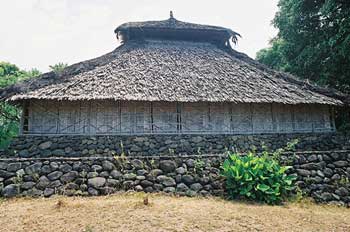
Unlike the Wetu Lima Muslims, the Wetu Telu Muslims have different views on seeing the performing of the tarawih prayer. In fact, the Wetu Telu Muslims perform the tarawih prayer from the beginning until the end of Ramadan, but this prayer is only for their Kiais and has to be done in ancient mosque. The ancient mosque is an exclusive worshiping place for their Kiais. Therefore, according to the Wetu Telu Muslims, ordinary people, pemangku, and women are not permitted to perform the tarawih prayer. And women are strongly prohibited to enter the ancient mosque, because their menstruation‘s blood will pollute the place. Because of these reasons, the ordinary people of the Wetu Telu Muslims do not perform the tarawih prayer. In addition, no one of them, except penyilak (master of ceremony), is permitted to enter the ancient mosque.
Besides performing the tarawih prayer, the Wetu Telu Muslims also perform Maleman Qunut and Maleman Likuran ceremonies. The way to perform both ceremonies differs from one to another. In the Wetu Telu community, the ceremonies are always completed by eating together. While the Wetu Lima Muslims focus more on sunnah worships, i‘tikaf, for instance, at the last tenth of Ramadan and etc. In other words, it can be assumed that Wetu Lima Muslims have similar rituals to other Muslims in Indonesia. Based on the mentioned reason, this writing will focus on Maleman Qunut and Maleman Likuran rituals that are performed by the Wetu Telu Muslims.
2. The Equipments and the Places
The Wetu Telu Muslims will exclusively perform Maleman Qunut and Maleman Likuran ceremonies in the ancient mosque, while Wetu Lima Muslims perform these ceremonies in every mosque.
The required equipments in the performing of Maleman Qunut and Maleman Likuran are:
- Ancak. Ancak is a plaited bamboo which is covered by banana‘s leaf. The amount number of ancak is based on time of performing. For example, at the night of 21st, the amount number of ancak will be 21, and etc.
- Banana‘s leaf as the cover of ancak
- Lelukon (lekesan: offerings) is placed on the leaf of ancak‘s cover and stringed by bamboo.
- Sampak is a dish that made of earth.
- Rice with its side dish
- Sticky rice
- Coconut milk
- Sugar coconut or sugar palm.
3. The Way of Performing the Ceremony
Indeed, the performing Maleman Qunut and Maleman Likuran ceremonies have similar intention. Its intention is to eat together. Therefore, this writing will focus on Maleman Likuran rite in order to avoid rewriting both rituals. To provide comprehensive description about these ceremonials, the tarawih prayer will previously be described as following:
- After Magrib time is over, the Kiais of Wetu Telu will gather in the ancient mosque.
- After all Kiais were present in the ancient mosque, tarawih prayer will be started. Tarawih prayer will be delayed if there are some Kiais who come from remote country are late. But, penghulu will begin tarawih prayer without waiting all Kiais. This is done by means to elude from delaying tarawih prayer.
- On the night of 16th of Ramadan, Wetu Telu Muslims will hold Maleman Qunut ceremony. It means that witir prayer will be added by qunut prayer. Afterward, the prayer will be closed by eating together.
On the night of 21st of Ramadan, Wetu Telu Muslims will accomplish Maleman Likuran and Sedekah Maleman Likuran ceremonies. The way of performing of these rites will be described as below:
a. Maleman Likuran
On the night of 21st of Ramadan, the Wetu Telu Muslims will perform Maleman Likuran. This ritual is held on the odd nights of Ramadan, for instance, at the night of 21st (Maleman Selikur), 23rd (Maleman Telulikur), 25th (Maleman Selae), 27th (Maleman Pitulikur), and 29th (Maleman Siwak Likur). In every odd night of Ramadan, every adat‘s leader will serially bring ancak to the ancient mosque.
- Penghulu is the first man who will bring 21 ancak. The amount number of ancak resembles the date of Ramadan, for instance, 21 ancak is referring to night of 21st of Ramadan. Subsequently, every pemangku will bring ancak that in accordance with Maleman Likuran.
- The Kiais will perform Isya prayer before the tarawih prayer.
- After praying, the carrier will bring these ancaks into the ancient mosque.
- Penyilak then gives a speech to explain the existence of these ancaks.
- The Kiais then start eating the dish service which is placed on the ancaks.
- The remained food will be brought as berkat to their home.
The ceremony will be closed by going home together.
b. Sedekah Maleman Likuran
The even nights of Likuran Ramadan (22, 24, 26, and 28) will also be celebrated by eating together with all Kiais. This celebration is named as Sedekah Maleman Likuran. A dish service, sampak, is provided serially by adat‘s leader. Sampak contains any sweet foods made from sticky rice, coconut milk, and palm sugar. The performing of Sedekah Maleman Likuran is similar to Maleman Likuran ceremony, and this ceremony is marked by eating together.
4. The Cultural Values
During Ramadan, the Wetu Telu Muslims perform at least two rituals: the Maleman Qunut and the Maleman Likuran. If these rituals are observed, we will find that the influences of the local tradition are strong enough, for instance, the existence of Lelukon in the ceremony. Therefore, it may be assumed that the rituals during Ramadan have many aims that not only to enliven Ramadan, but also to preserve ancestor‘s tradition.
These rituals are the important tradition in the Wetu Telu Muslims of Lombok. In addition, these rites are the evidence that there is assimilation between local tradition and Islamic tradition. In other words, the form of Maleman Qunut and Maleman Likuran rituals is a result of the mixture between Islamic values and local views.
In addition, the performing of Meleman Qunut rite is signed of their success in running the half of Ramadan. They thank to Allah with their social harmony. Therefore, it is strongly assumed that there is a close relationship between Maleman Qunut and Nuzulul Qur‘an which are held by other religious groups.
Finally, the performing of Maleman Likuran is an effort of the Wetu Telu Muslims to get Lailatul qodar (positive energy) as the Wetu Lima Muslims believe in this night. At least one week before the end of the fasting month, every Muslims are suggested to do many good activities, and this suggestion is also the main goal of the Wetu Telu Muslims. Therefore, the Maleman Qunut and Maleman Likuran rituals are another kind of religious understanding toward Ramadan.
(TN/trj/15/9-07)
References:
- Erni Budiwanti, 2000, Islam Sasak, Wetu Telu versus Waktu Lima, LKIS, Yogyakarta.
- Wetu Telu, Kearifan Tradisional di Lereng Utara Rinjani, from http://impalaunibraw.or.id/dat/detail.php?id=12_0_1_0_M, retrieved at September 21, 2007.
Credit photo : http://impalaunibraw.or.id/dat/detail.php?id=12_0_1_0_M
Read : 16.579 time(s).
Insert your comment here :


 aujourd hui
  Hier
Hier  La semaine dernière,
  Le mois dernier