Vous êtes le visiteur numéro 105.216.314 Sejak 01 Muharam 1428 ( 20 Januari 2007 )
AGENDA
No data available
News
11 januari 2011 07:13
Laskar Pelangi Holds Its Tune
Jakarta, Indonesia - Musicals are generally thought of as a Western invention, but the latest stage show by producer Mira Lesmana offers something “very Indonesian.”
Mira found great success in adapting “Laskar Pelangi” (“The Rainbow Troops”) — the best-selling novel about children struggling for an education in an isolated village on BelitongIsland in Sumatra — for the big screen in 2008.
Now her musical adaptation of the novel — currently in its final week at Teater Jakarta in Cikini, Central Jakarta — has indeed lived up to her promise of a uniquely Indonesian performance.
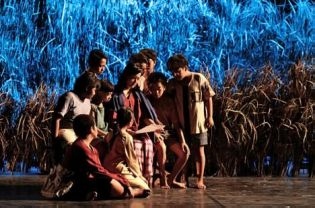
It’s a large, impressive production. To put it together, Mira assembled a group of prominent artists. The musical is directed by Riri Riza, who also directed the film version. The music was composed and arranged by Erwin Gutawa, with choreography by Hartati. Jay Subyakto, a well-known music video director, did the production design. And Mira, besides serving as the producer, also wrote all of the show’s lyrics.
The main protagonist is Muslimah, a teacher at a small Muhammadiyah primary school in Gantong village in the 1970s. At the beginning of the show, she is a confident woman who believes that education has the power to change lives.
She is mocked for her enthusiasm, but she perseveres. As the show begins, the local education office is threatening to close down the school because it only has nine students, and 10 is the minimum required for a school to receive government support.
Riri shows he knows how to get the most out of the theatrical medium by cleverly revealing the 10th student sitting in the audience before he is pulled on stage by his fellow students. It’s a crowd-pleasing moment that quickly breaks the ice and sets the tone for the rest of the show.
The poor, shoeless Muhammadiyah students introduce themselves to the audience in a charming song, “Anak Pelangi” (“Rainbow Children”). The song also introduces the rich kids, who go to the best school in the village, to illustrate the extreme gap between the rich and the poor in the Belitong area.
The first half of the musical focuses on the happy and carefree lives of the students. Audience members familiar with the book or the movie will still find much to enjoy in seeing their favorite moments interpreted on stage, such as Kucai’s childish behavior when he objects to Muslimah appointing him as the class monitor; Ikal’s crush on a girl at the stationery store; or Mahar’s brilliant ideas to win a school competition. Lintang also has a moment in the spotlight when he sings a song about his life, “Anak Pesisir” (“A Child of the Coast”).
The children playing the students are impressively natural and charismatic in their performances, further testament to the director’s skills.
One of the few questionable decisions in the productions involves Bakri, one of Muslimah’s fellow teachers. He leaves the school for a better job on another island. After his departure, Bakri does not appear again, making his role feel rather unnecessary and detached from the rest of the story.
The second half of the show tackles much heavier emotions than the first, as Muslimah has to deal with the death of the school’s principal and her only remaining colleague, Harfan. This is also the part of the show where Lintang has to quit school after his father’s death.
Riri said he cast students from performing-arts schools in Jakarta and Bogor so they could still attend classes during the day and perform at night. Every role is actually played by a rotating group of two or three children. Muslimah’s role also rotates between three talented singers — Lea Simanjuntak, Dira Sugandi and Eka Deli.
Lea, who performed during the musical’s opening in December, said the difference between singing for her jazz group, Bandanaira, and the musical was is in the phrasing.
“In the musical, you have to break words in the same way you speak, not in the way you sing, otherwise it won’t make sense,” she said.
Lea easily steals the show as Muslimah, able to sway the audience’s emotions with a well-timed gesture or pitch-perfect note. Her strong singing voice makes it a joy to watch, and hear, her performance as the beleaguered Muslimah, who is constantly having to deal with the consequences of teaching in a poor rural backwater.
Production designer Jay has done an outstanding job handling the show’s set. He has used special screens, imported just for the show, to deliver a special experience for the audience. For example, the alligator dance in the show’s first half is performed using silhouettes on the white screen, while in teaching scenes, a black gauze screen acts as a transparent board, so Muslimah can face the audience and still let them see what she is writing on the board.
“Musikal Laskar Pelangi” is certainly well worth seeing, whether or not you were a fan of the book or movie. And it’s success points to a bright future for Indonesian musicals.


 aujourd hui
  Hier
Hier  La semaine dernière,
  Le mois dernier