Monday, 2 November 2026 |Monday, 21 Jum. Awal 1448 H
Visiteurs en ligne : 1.094
aujourd hui
:
25.358
Hier
:
40.758
La semaine dernière,
:
51.501
Le mois dernier
:
11.429.130
Vous êtes le visiteur numéro 105.216.314 Sejak 01 Muharam 1428 ( 20 Januari 2007 )
AGENDA
No data available
News
05 juni 2009 07:32
Reviving The Glory Of Malay Civilization
Ketapang, MelayuOnline.com - The Malay people scatter over the globe and reach the hearts of other civilizations by passing through any geo-political boundaries. Such dissemination then results in the development of Malay areas, which are no longer in the Malay Peninsula and the Archipelago only, but likewise, to the “outside” world like South Africa and Sri Lanka. One logic consequence of such dissemination is the very heterogenic Malay culture with diverse political interests.
For the diverse political interest, an aftermath comes out. The Malay grows up partially and locally instead of becoming a big civilization. Malay people were divided into the smaller groups based on religious and political interests. In charge of reviving the Malay civilization, the Malay people should now consider working and endeavouring together in politics, economics, and culture. To underpin the mission, there is a need of constructing a bridge that might be able to break through geo-political boundaries dividing the Malay people into the smaller groups.
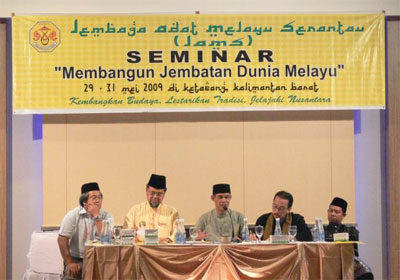
Based on those aims, the seminar “Membangun Jembatan Dunia Melayu” (Constructing A Bridge of the Malay World) was held at Aston Ketapang Hotel on Friday (26/5/2009) by Lembaga Adat Melayu Serantau-LAMS (Serantau Malay Adat Assembly). The seminar was attended by some Malay prominent figures from Indonesia, Singapore, and Malaysia. Come as keynote speakers at the seminar were H. Huzrin Hood, SH., Riau Islands Malay figure;Prof. Dr. Awang Hasmadi, Brunei Darussalam; Drs. Jumadi, M.Si., University of Tanjung Pura; and Mahyudin Al Mudra, the Head of Center for Research and Development of Malay Culture and the Director of MelayuOnline.com.
Huzrin Hood argues that the Malay civilization found its heyday when the Malay Peninsula was still a busy trading port, thus it connected the Malay world with the “outside” world. From such economic link, the Malay people gradually adopted the outside civilization, and employed it a capital to develop the Malay civilization.
“The Malay peninsula is a bridge linking the outside world‘s civilization with the Malay civilization alone. And that was the time when the Malay civilization found its golden age. And now we still have a burden, that of how do we revive the role of Malay as the bridge of the world?” Huzrin Hood‘s remarks.
Awang Hasmadi, who came to appear as the second speaker, said that the Malay Archipelago, in the past, encompassed areas from Indonesia, Malaysia, Brunei Darussalam, Singapore, the Philippines, and southern Thailand. No matter what, it found its ruin, before finally it became countries as now, along the coming of colonialism in the Malay Archipelago. To him, this is the onset of why the Malay is being underestimated by other civilizations. It is sure what the Malay people need to do now is flourishing the sense of unity and togetherness among Malays settling in those countries, especially in the Malay Archipelago such as Indonesia, Brunei, Singapore, the Philippines, Thailand, and Malaysia.
To achieve that goal, according to the third speaker Jumadi, people need to know that those countries share the same historical roots. Historical understanding that they share a same root, indeed, is the best way of establishing the sense of unity and togetherness among the people who live in those countries. From this, the understanding that Malay is only Islam has been automatically tackled because the historical notes found that some other religions like Hinduism and Buddhism once had existed in those countries. So, he concluded that people ought not to cut off the chain of history linking the countries as a big unit of Malay Archipelago.
Mahyudin Al Mudra, the last speaker, suggested a savvy way of linking the Malay people around the globe; that of through the internet. According to Mahyudin, the only internet can break through geo-political boundaries separating Malay people scattering over the world. It enables them to establish communication among one another easily and cheaply.
“Where do the Malay people get the information and knowledge about the Malay world? In the more globalized world, the internet is the best way to heighten and uphold the Malay civilization. Likewise, internet is capable of passing through geo-political and religious boundaries dividing the Malay people into smaller civilization,” Mahyudin said.
MelayuOnline.com is the real endeavour of the Center for Research and Development of Malay Culture to achieve that goal. It is the bridge for all people, especially for Malay people, from the entire parts of the world. It documents the information and knowledge of the Malayness and the Malay world either those that had happened in the past, or those happening in the present. “People who are in need of knowing the information about either the Malayness or the Malay world, simply just turn their heads to the internet and click http://www.melayuonline.com,” Mahyudin said.
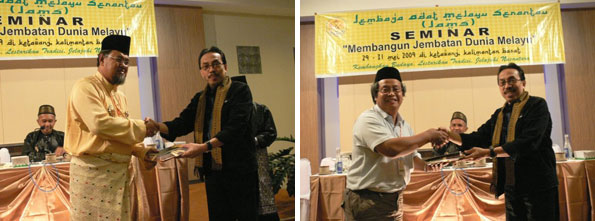
The seminar ended by a closing remark by Tan Sri Dato‘ (DR) Ismail Hussein. He states that the use of online media, such as MelayuOnline.com, is a savvy and effective way of introducing the Malayness to the world. MelayuOnline.com, he added, is also a bridge that connects the Malay people from various countries. Before it ended, Mahyudin Al Mudra presented souvenirs to the speakers.
Ahmad Salehudin (brt/1/06-2009) Irfan Nugroho (ter/123/06-09) Photo: Aa Ito Tistomo


 aujourd hui
 Hier
 La semaine dernière,
 Le mois dernier


 Mahyudin Al Mudra, the last speaker, suggested a savvy way of linking the Malay people around the globe; that of through the internet. According to Mahyudin, the only internet can break through geo-political boundaries separating Malay people scattering over the world. It enables them to establish communication among one another easily and cheaply.