Minggu, 16 Agustus 2026 |Isnain, 2 Rab. Awal 1448 H
Pengunjung Online : 973
Hari ini
:
16.026
Kemarin
:
43.662
Minggu kemarin
:
179.363
Bulan kemarin
:
11.454.048
Anda pengunjung ke 105.216.314 Sejak 01 Muharam 1428 ( 20 Januari 2007 )
AGENDA
Belum ada data - dalam proses
Berita
20 januari 2010 05:16
Inter-culturalism versus Colonialism in the Study of Malayness
Malay Diaspora Workshop, BKPBM, Day Two, First Session
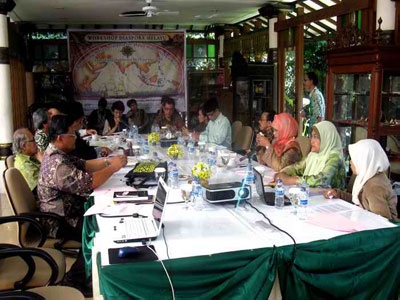
Yogyakarta, MelayuOnline – The first session in the second day of Malay Diaspora Workshop “Revisiting Malay Diaspora for Malay World Networking” saw two speakers presenting their working papers: Prof. Dr. Awang Hasmadi Mois of the Department of Sociology-Anthropology of Brunei Darussalam University (UBD) and Dr. Aris Arif Mundayat, director of Center for South East Asian Social Studies, Gadjah Mada University (PSSAT, UGM) and consultant of BKPBM and www.MelayuOnline.com. Working as the moderator was a redactor of the site, An Ismanto. The workshop was held on 18-19 January 2010 at Balai Kajian dan Pengembangan Budaya Melayu (BKPBM), Jalan Gambiran, No. 85 A, Yogyakarta
Prof. Dr. Awang Hasmadi Mois set off the workshop with his paper entitled “Malaysia dan Indonesia: Di Sebalik Metafora Saudara Serumpun dan Sebangsa (Malaysia and Indonesia: Behind the Metaphor of Brothers of One Race and Ethnic)”. According to him, Malay cannot deny the fact of its historical relationship with the European. Malay, here, refers to the concept of Malay in political point of view, concerning especially the births of several Malay nations, particularly, Indonesia and Malaysia. Indonesia became an independent nation after declaring its freedom from the Dutch colonial and likewise, Malaysia gained its independence from the English.
Prof. Awang said that not all colonial legacies are bad. Some inheritances are in fact proved to be beneficial for both Malaysia and Indonesia, such as systems of education, politic, bureaucracy and most importantly, he added, the border that separates the countries. Nevertheless, like it or not, colonialism has formed and affected the Malaysian and Indonesian’s way of thinking of themselves.
Prof. Awang concluded even though Malaysia and Indonesia are two distinct countries, former-colonies of and educated by two European colonial nations in different treatments and with different purposes, the leaders and people of both nations remain thinking and seeing themselves as brothers and of one ethnic group.
Interculturalism in Malayness
The second speaker was Dr. Aris Arif Mundayat. Slightly different from Prof. Awang’s opinion, he sees that the main cause of all the false ideas in the study of Malayness was the colonial dogma that turns out to be prevailing these days.
In Dr. Aris’ opinion, Malay diaspora had in fact formed the concept of plural Malay in the past. However, as it evolved the imagination of modern world of Malay, which are actually “post-colonial” nations, becomes split and polycentric, based on political interests of identity, either of religion, political territory, or ethnicity. As to why there are different imaginations about Malayness, he explained, is absolutely rooted in the historicity of each nation that further affects the Malay world today.
Dr. Aris drew a conclusion that Malay is basically a nation with hybrid culture, explaining the reason of plurality in the ethnic group. In the perspective of cultural studies, hybridity refers to a wide definition of identity concerning plurality, crossbreeding, mixture, cross-borders experience, and responsive attitude correlated with the pattern of diaspora, or migration of people to be intensively living in the world in which there are active communication among various cultures, multiculturalism, and vagueness of social and cultural borders. “In a positive way, we can say that hybridity is lubrication in the friction of various cultures so as to there won’t be too much suspicion,” said Dr. Aris.
“In some cases, the colonial nations’ polycentricism often brings us into discourses about aspects of Malayness in the Malay world that would lead to defining whether Malay must be Islam or not, Malay are those people living in the Malay Peninsula or can be those living in other places, or whether the Javanese are Malay—these have all been abiding disputes since Hang Tuah’s time until today,” asserted Dr. Aris. In such situation, he added, the meaning of the term “Malay” is often argued by many parties that it becomes unstable and never certain. “In the middle of interpretative uncertainty, imagination about Malay world splits in a polycentric order, meaning that the interpretation of Malayness diverges, varies, and is compartmentalized, it depends on how people define it based on their politic of primordialism,” said he.
The “slicing-off” politic of the colonial nations apparently left traces in today’s world. Its most obvious bad effect is of course the people’s way of seeing Malayness—something that often causes dispute between Malaysia and Indonesia, two countries that saw themselves being colonized for a long time. Dr. Aris sees that both countries has post-colonial syndrome. Indonesia experiences heroism syndrome as a nation that just freed itself from colonialism, trying to build an identity through confrontation, while Malaysia encounters cultural crisis when Islam, that used to be a symbol of resistance against colonialism, turns out to be wiping out the local culture. “This is the face of Malay people that have been separated by the borders of two post-colonial nations, they develop their own notion (of what Malay is) that actually moves away from the frame of true Malayness, getting themselves into unnecessary conflicts,” Dr. Aris regretfully said, finishing his presentation.


 Hari ini
  Kemarin
  Minggu kemarin
  Bulan kemarin