Kamis, 27 Agustus 2026 |Jum'ah, 13 Rab. Awal 1448 H
Pengunjung Online : 345
Hari ini
:
12.353
Kemarin
:
41.861
Minggu kemarin
:
178.006
Bulan kemarin
:
11.454.048
Anda pengunjung ke 105.216.314 Sejak 01 Muharam 1428 ( 20 Januari 2007 )
AGENDA
Belum ada data - dalam proses
Berita
08 april 2010 02:35
The Invention and Reorientation of Banjar Culture
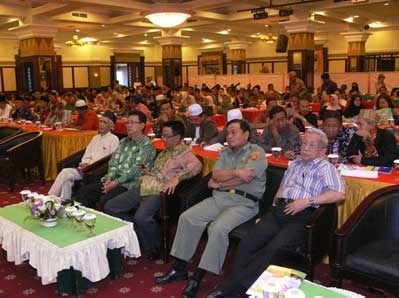
The participants of Banjar Cultural Congress II
Banjarmasin, MelayuOnline.com—Monday (04/05), was the cultural discussion stage of Banjar Cultural Congress II. In this discussion, such issues as Banjar cultural invention and reorientation came up and opened up a new perspective for the congress participants.
The first stage of the discussion took place in the Convention Hall of Banjarmasin International Hotel and was divided into two sessions. Both sessions were opened with the explanation of a paper entitled “Dinamika Budaya Lokal Dalam Globalisasi” (The Dynamic of Local Culture within Globalization) presented by the keynote speaker, Prof. Yasmine Zaki Shahab from The Center of Malay Research of the University of Indonesia, Jakarta.
In her exposure, Prof. Yasmine elaborated the processes of cultural identification, revitalization and invention. This expert in Betawi-Malay culture exemplified the ongoing processes by explaining the cultural dynamic that occurs in Betawi-Malay culture.
“Betawi is an example of local culture which is successful in coping with the dynamic,” said Prof. Yasmine.
In the 70s decade, Prof. Yasmine added, Betawi suffered from the identity depression which caused some Betawi people to feel ashamed with their own culture. However, the synergy of Betawi community, bureaucracy and the creativity of Betawi art works managed to fix it. Through these processes, it can be said that Betawi culture “underwent a positive cultural invention”.
The invention ran positively since Betawi culture was able to identify Betawi values and made them the basis to direct Betawi culture as a pride of Betawi people themselves.
“We are doing the right thing when directing a certain culture, especially when we find that the culture grows well,” explained Prof. Yasmine. The cultural directing, according to Prof. Yasmine becomes something authomatic because without being changed, a culture will surely undergo a change through inovation and diffusion which occur in the cultural constellation.
Prof. Yasmine Zaki Zhahab
“Precaution to prevent a culture from being eliminated has been done since 200 years ago. It happened universally, in which it was experienced by the entire culture in particular context of space and time. It is what happen now to Banjar culture and becomes the essence of this congress,” explained Prof. Yasmine.
In fact, she added, the processes of cultural directing and invention are in accordance with the nationalism and multiculturalism policies.
Identification, Reorientation and Invention
Then, does Banjar culture currently need the invention? This topic came up and was discussed in the first session. There were four speakers with Banjar genealogy, namely Prof. Dr. H. Mahdini, M.A. from Riau, Dr. Faruk Tripoli from UGM Yogyakarta, Ahmad Lutfi from Ikatan Keluarga Papadaan (Papadaan Community Association) of Jambi and Dr. Majiburrahman from IAIN Antasari Banjarmasin Postgraduate School.
Left to right: Ahmad Lutfi, Dr. Faruk Tripoli, Dr. Majiburrahman, Rifkynizami K, S.H.LLM (moderator) and Prof. Dr. H. Mahdini, M.A
The four speakers presented the explanation on the identity of Banjar culture, either those which still exist or those which had faded. Prof. Mahdini, a bureaucrat of MUI Riau, delivered his remark on the pattern and behavior of Banjar people which are shifting into hedonism and materialism.
“This cultural shift is due to the incapability of Banjar people to preserve the caltural values they embraced since long time ago,” said Prof. Mahdini.
Likewise, Ahmad Lutfi from IKP Jambi questioned about the shifting cultural values. Lutfi stated that the shift was caused by elimination of Islamic aspects in the daily life of Banjar people.
The situation is made worse by the negative effects of information technology such as television, internet and means of cellular communication. “The acces to information technology is hard to filter,” explained Lutfi.
Different explanation was delivered by Dr. Faruk Tripoli in which he critically exposed the habits and cultural traditions of Banjar which have culturally been approved yet made urang baruna (Banjar people) live their lives like a dream. He took the case of Lihan in 2009 as an example. He explained that the approval on that tradition made Banjar people neglect the reality.
“Banjar people are literate, particularly in Arabic script. However, script in the perspective of Banjar people functions as a magical power more than information technology. Arabic script turns into talisman and charm, Koran is read without understanding the meaning, the holy inscription are highly respected, placed in such a high position that made them even far from being life guidance. It makes sense then when a Banjar people of Dayak descendant is unable or unwilling to recall his origin,” said Dr. Faruk.
These tradition, according to Dr. Faruk who also teaches in the Faculty of Cultural Science of UGM, is the reflection of the oral tradition which dominates the life of Banjar people. “Since oral tradition will be gone in time, Banjar people do not have the ability to document what happen in their cultural dynamic,” Dr. Faruk added. Therefore, with the domination of oral language, it is difficult for Banjar people to organize a large community.
Islam, according to Dr. Faruk, introduces Banjar people to experience, knowledge and the way of life in Arabia, where life is full of tales of the prophets and Islam heroes. It is now understandable why Banjar people perform the haj many times.
The oral tradition, if not realized soon, will take Banjar people to several shifts, one of them was deliverd by Prof. Mahdini and Ahmad Lutfi.
In the mean time, Dr. Mujiburrahman, a lecturer in IAINAntasariPostgraduateSchool, explained the role of Banjar figures in the development of Banjar culture. In his sociological and historical explanation he stated that fame is still the magnet in the development of Banjar culture. These figures have certain roles and territory according to their expertise. He also said that fame explains the development of Banjar culture identity.
“No wonder that it was not until the 40s decade that Banjar figures like Idham Khalid and Johan Efendi became national. It was the period where Banjar education opened up the door for western fundamental general education,” explained Dr. Mujibburrahman.
Fame, according to Dr. Mujibburrahman, can be a significant effort in making the invention of Banjar culture better without having to leave off certain cultural element of it.
In the discussion session, the Head of BKPBM, Mahyudin Al Mudra, opened the dialogue with a question on the migration (diaspora) of Banjar people to many migration areas.
Head of BKPBM, Mahyudin Al Mudra in the discussion session
In addition, Bang MAM urged the congress to become not only a ceremonial but also to have continuity in the form of progress report of Banjar ethnic groups in migration areas. “Ulun (I) really hope that, later in the third congress, Banjar communities in the migration areas are prepared to deliver what have happened in their community. Thus we can take note on the impact of Banjar culture dynamic,” asked Bang MAM.
Orientation and the Application of the Congress Result
Beginning the second half of the discussion session were such themes as the orientation and the application of the result of Banjar Cultural Congress I. The speakers in this session were Drs. H. Syafruddin from Banjarmasin and Ir. Hj. Suriatinah, M.S., Head of Regional Research and Development of South Kalimantan Province.
“A lot of Banjar people in the migration areas, domestic or abroad, are successful in their own fields. But, is it enough?” said Hj. Suriatinah.
Through this question, Suriatinah wanted to emphasized that Banjar culture still needs particular feature and orientation as the guidance for Banjar people. This orientation is going to be the basis for the government in policy making.
Meanwhile, Drs. Syafruddin emphasized on the practical application of the congress. He took the existence of Badan Kontak Madam as an example of the application of the result of Banjar Cultural Congress I. (ATP/brt/21/04-10)


 Hari ini
  Kemarin
  Minggu kemarin
  Bulan kemarin