Minggu, 6 September 2026 |Isnain, 23 Rab. Awal 1448 H
Pengunjung Online : 974
Hari ini
:
14.452
Kemarin
:
26.946
Minggu kemarin
:
32.264.566
Bulan kemarin
:
43.463.948
Anda pengunjung ke 105.216.314 Sejak 01 Muharam 1428 ( 20 Januari 2007 )
AGENDA
Belum ada data - dalam proses
Berita
20 april 2010 01:00
Cultural Symbols Dominate Banjar Culture
Banjarmasin, MelayuOnline.com - In the discussion session on the second day of Banjar Cultural Congress II (10/07/2010), the speakers viewed that Banjar culture is trapped in symbols hitherto.
On one side, cultural symbols are able to integrate the understanding of Banjar, particularly for Banjar people who lived in the migration areas. On the other side, these cultural symbols make Banjar culture difficult to accept other cultural identities. One of the symbols is Banjar language.
“Banjar language is the unifier language for Banjar people. In this context, Banjar language acts as the communicative language for various ethnic groups who settle alongside BaritoRiver and NagaraRiver and their tributaries,” explained Dr. Muhammad Rafiek, S.Pd., M.Pd.
Despite being one of cultural symbols, according to Dr. Rafiek, Banjar language is currently difficult to use, especially by people with inadequate mastery of Banjar language vocabularies.
“Nowadays, not many Banjar people understand Banjar language, either the vocabularies or the pronunciation. There is also an assumption that if someone speaks in Banjar language, he is considered a rustic,” said Dr. Rafiek.
In big cities in Kalimantan whose major language is Banjar, the tendency to leave Banjar language as the mother tongue is apparent. This occurs due, some, to the unlimited access for information technology.
“Many parents worry when their children speak in Banjar language mixed with Bahasa Indonesia. Sometimes they speak Malay language in Betawi dialect. It is believed that this situation is due to the increasing use of Bahasa Indonesia and foreign language,” Dr. Rafiek added.
He also said that this symptom is influenced very much by the environment. In addition, Dr. Rafiek found that the decreasing number of native speakers of Banjar language gave effects on the emergence of these symptoms.
“This is in contradiction with the condition in the neighboring countries such as Malaysia and Brunei Darussalam. In fact, Malaysia intended to have a deeper analysis on Banjar language particularly among the scholars,” Dr. Rafiek added.
Distortion of Cultural Symbols
The next session was the analysis on the development of Banjar language in literature and culture presented by Dr. H. Zulkifli Musaba and Drs. Ahmad Fauzi, M. Msi. Both speakers elaborated that the values of Banjar culture contained in Banjar language serve as the reflection or part of the identity and character of Banjar language.
“If these cultural values are related to the identity of Banjar people, it will be obvious that most of them are in accordance with the plurality of Banjar people,” said Dr. Zulkifli Masaba.
The topic on language as a symbol of Banjar culture has gone through a distortion of meaning. Because, on one side, Banjar language is the unifier language for its speakers. Yet on the other side, the speakers in the first session of the discussion were seemingly in doubt to accept that the speakers of Banjar language also experienced cultural acculturation, particularly the speakers in the migration areas. The diaspora of Banjar people gives effect on the use of Banjar language as the mother tongue.
The essence of this topic is that the cultural symbols should be integratively understood by the participants and the speakers of Banjar Cultural Congress II. This means that the symbols of Banjar culture that need restoration should be whether the original culture in the form of original language, art and other artworks. Or, is it possible for the restoration to present the cultural acculturation that occurs due to the diaspora of urang banua (Banjar people)?
Perspective on Cultural Symbols
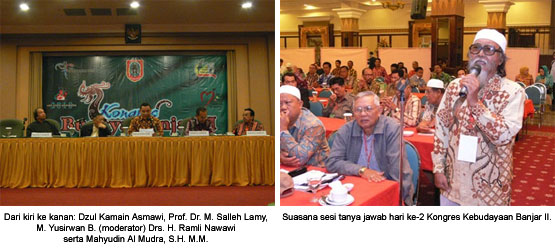
The perspective of the above question was explained in the second and third sessions of the discussion on the second day of Banjar Cultural Congress II. The speakers were Prof. Dr. M. Salleh Lamy (Malaysia), Drs. H. Ramli Nawawi, Dzul Kamain Asmawi (Johor Bahru) and Mahyudin Al Mudra, S.H. M.M. The discussion was led to compare the perspectives of the definition of cultural symbols.
Left to right: Dzul Kamain Asmawi, Prof. Dr. M. Salleh Lamy, M. Yusirwan B. (moderator), Drs. H. Ramli Nawawi, and Mahyudin Al Mudra, S.H. M.M.
In his explanation, Dzul Kamain Asmawi justified what Dr. Rafiek stated about the active research on the culture of Malay ethnic groups (including Banjar -red), one of which is by Yayasan Warisan Johor (YWJ). YWJ was authorized to perform research, investigation and inquiry on Malay archaeological remains.
“YWJ is assigned to collect, research, maintain and preserve Malay historical heritages,” said Dzul Karnain.
Accoring to Dzul, it was the check point which enabled YWJ to find which phenomenon deserves to be called Banjar cultural symbol.
“Banjar people migrated outside South Kalimantan in a large number at the end of the 19th century. Attracted by the wide open economic opportunity, particularly in land possession, they became the lost migrators and chose not to return to South Kalimantan. In Malaysia, they opened up kampong Banjar, passing on and preserving Banjar culture they brought from South Kalimantan,” explained Prof. Salleh Lamy.
However, Prof. Salleh Lamy continued, their descendants become Malay as well as Malaysia citizens who went through various changes. Thus, there are some elements of Banjar culture which they want to leave behind. The significant one is the use of Banjar language and the preservation of Banjar arts.
“However, their identity as Banjar people is still obvious and they identify themselves as Banjar people. Therefore, it is important for them to preserve Banjar culture brought by their ancestor more than 100 years ago,” said Prof. Salleh Lamy.
Concluding the discussion session was Head of Center of Malay Research and Development Mahyudin Al Mudra, speaking about the cultural heritage and the values of preserving them. Bang MAM stated that the process of preserving Banjar culture means every action and effort to preserve the existence and circumstance of something through such processes as inventory, documentation and revitalization.
“There are two types of preservation, the active and passive ones. Passive preservation includes knowledge sets of equipment, values and others that are kept in documentation such as books, CDs, tapes and movies. Knowledge equipment and the values are currently not used as the guidance of daily actions and attitudes,” explained Bang MAM who slipped Banjar language in his speech.
Meanwhile, active preservation is when the cultural sets of equipment are still recognized, revealed, told and used as guidance by the people to understand, respond and realize the content in daily life either regularly or irregularly.
Therefore, cultural preservation takes many forms. It may mean good natural environment such mountains and oceans or built environment such as palace complex, rice field and irrigation. The other forms are equipment/ technology, custom and tradition which include behavior, action and social interaction performed by many people in social life and in indefinite period of time in sequence, as well as values and knowledge.
“Therefore, what is meant by preserving Banjar culture is not merely by wearing Sasaringan (Banjar batik) or consuming soto Banjar. This is because culture does not only mean using symbols, it means more as active and passive efforts by the culture users to preserve it,” explained MAM.
Bang MAM saw the tendency of understanding symbols is still passively done by Banjar people when asked to preserve Banjar culture.
“In fact, culture is not that narrow,” Bang MAM affirmed.
Culture, according to MAM, can be a significant potential as well as enliven the life chain of the cultural users.
“For example, I had soto Banjar couples of days ago. I was told that the restaurant owner was able to get incredible profit of more than 50 million each month. This shows us that from soto as a product of Banjar culture the restaurant owner can get economic profit,” explained Bang MAM.
“Imagine if such case is applied to the other products of Banjar culture. That would be awesome,” said Bang MAM applauded by the participants.
Bang MAM who is Banjar by blood felt that nowadays Banjar people prioritize economic achievement more than culture. In fact, the case of soto Banjar proves us that culture gives economic contribution to our life.
“Without culture, economy is inhumane,” said Bang MAM.
The second day discussion was finished with the third session which talked about the role of young people and women in developing Banjar culture.
Dr. Rafiek gained his doctoral degree in the State University of Malang, East Java. He now teaches Literature and Linguistics at LambungMangkuratUniversity.
Prof. Salleh Lamy taught at Anthropology and Sociology Department of Malaysia State University (UKM).
Mahyudin Al Mudra (Bang MAM) finished his undergraduate and master degree at Islamic University of Indonesia. (ATP/brt/23/04-10)
Translation by Apri Widiastuti (trns/37/04-10)
Photo source: Collection of MelayuOnline.com (Photographer: Aam Ito Tistomo)


 Hari ini
  Kemarin
  Minggu kemarin
  Bulan kemarin