Anda pengunjung ke 105.216.314 Sejak 01 Muharam 1428 ( 20 Januari 2007 )
AGENDA
Belum ada data - dalam proses
Berita
31 oktober 2008 06:20
Malay Language and Political Identity of Eastern Indonesia
Yogyakarta, MelayuOnline.com- For those originally coming from eastern Indonesia, becoming the Indonesian people are becoming the Malay people. However, Malay here cannot be associated with race, ethnic tribe, region, and certain religions. Malay, in this case, is closer to political identity through Malay language with its status as “market language” or lingua francain the Archipelago. For that reason, Indonesia can cope with such multifarious cultural, languages, and ethnic diversities that later on are united in a great nation namely Indonesia.
Such an argumentation came to appear from Dr. PM. Laksono – an anthropologist and a lecturer of GadjahMadaUniversity – in an informally academic discussion themed “The Malay Dynamics in Eastern Indonesia” on Tuesday (28/10). Came as the moderator of the discussion was Irfan Afifi, a redactor of MalayTourism.com. This two-hour of discussion run smoothly and was attended by all MelayuOnline.com‘s crews. Some other guests from Master‘s degree students of GadjahMadaUniversity were, likewise, seen attend the discussion.
According to Laksono, Bahasa Indonesia roots from Malay language that was used by the number of people to conduct economical transaction in the MalayanPeninsula since centuries ago. That is why Malay language is called “market language” as people from various backgrounds are able to speak in Malay language.
No one knows exactly the process of Malay language becomes Bahasa Indonesia. But, there is a thing to remember that Malay language has been generally used in the Archipelago, especially in eastern Indonesia.
In the 19th Century, Christian missionaries who were assigned in Ambon used Malay language as the target language of Bible translation. As well as in Papua, hundreds of Papuan ethnic tribes once gathered to seek unanimity. They agreed that Bible should be translated into Malay language since its nature that is easy to understand.
The facts inspired greatly Indonesian youths to declare that they would speak one language, Bahasa Indonesia. Starting from this point then appeared what so-called Sumpah Pemuda (Indonesian Youth Oath) held by those youths on October 28th, 1928. Up to this day, Bahasa Indonesia is proven be able to unite Indonesia in diversities.
In a question-answer section, Nursaed Ali Rido, chief-in-editor of MelayuOnline.com asked about the relevance of Malay language as a medium to unite Indonesia in diversities. Responding to the question Laksono said, “They speak Malay for pragmatic reason. In another words, they speak in Bahasa Indonesia so that communication with other ethnic groups can run well. Simply, Malay language is lingua franca.” From this point it can be known that Malay language usage, especially in eastern Indonesia, is not solely based on political motives.
Malay language usage amongst the eastern Indonesian is seemingly far from either political or identity building motives. The eastern Indonesian much prefer their mother tongues to Bahasa Indonesia since an assumption that Bahasa Indonesia is not capable of guarantying their ethnic groups to keep on existing.
However, Laksono added, Bahasa Indonesia still plays significant role in establishing universal imagination of Indonesia Raya (greater Indonesia). By speaking Bahasa Indonesia, hundreds of ethnic groups settling in the Archipelago possess rights to call themselves as Indonesian, no longer as Malay, Javanese, Ambonese, or Bimanese.
“Bahasa Indonesia does not have any association with certain ethnic groups thus it can eradicate primordial spirits when they suffer from cross-ethnic intercourses,” Laksono‘s remark.
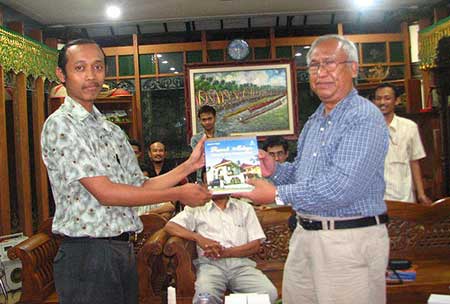
At the end of the discussion, Hadi Kurniawan – Vice Director of MelayuOnline.com – gave a book entitled Rumah Melayu: Memangku Adat, menjemput Zaman that was written by Mahyudin Al Mudra, S.H., M.M.


 Hari ini
  Kemarin
  Minggu kemarin
  Bulan kemarin