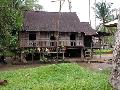
Makah – Makah is a traditional game from Nanggroe Aceh Darussalam Province. Makah – Makah is easy to play and does not require complex equipment. It is a competitive and collective traditional game. In a competition, players are divided into two teams.
1. Origin
Traditional game symbolizes the knowledge handed down through generations and possesses functions or messages (Hayuningtyas in Fitri Astuti, 2009). Makah – Makah from Nanggroe Aceh Darussalam (NAD) fulfills this definition. Despite the presence of modern games, traditional games of NAD, including Makah – Makah are still handed down through generations.
NAD traditional games convey moral messages and cultural values useful for children development. Moreover, most of the games are closesy related to Islamic teachings, which become the inseparable part of Aceh history, civilization and culture. Acehnese have embraced Islam from around 800 AD. For them, Islam is not only a belief (religion) but also a way of life because Islam teachings are the reference and measuring system in the life aspects of Acehnese (http://achehlibrary.com).
The name Makah – Makah refers to the word “Makkah” or “Mecca”, which has two interpretations. First, “Mecca” is the orientation for moslems when praying. This interpretation elaborates the essence of Makah – Makah in which the players race to get to the game goal point called Makkah (Rusdi Sufi, et.al., 2004: 27). The game thus depicts the moslems, in this case the Acehnese, who have the strong will to Mecca for haj or umrah.
The second interpretation is related to NAD being called the Antechamber of Mecca. This means that before getting to Mecca, someone must pass its antechamber; NAD. It is called so due to the appreciation of moslems, especially those who settle in Southeast Asia, to Acehnese who stand firm in developing and preserving Islam (http://achehlibrary.com).
2. Equipment
The equipment for playing Makah – Makah is easy to find in the neighborhood. The main instrument is a small stone or any other small object to hide in hand behind the back of the players.
3. Players
Some conditions for Makah – Makah players are:
- They must be boys or girls of 9 – 13 years old.
- Players are divided into two teams. Each team consists of at least 4 players. The more the players the funnier is the game (Sufi, et.al., 2004: 27-28).
4. Setting
Makah – Makah is usually played in the afternoon in leisure. Children play it in the yard or field spacious enough for the number of players.
5. Rules
According to Sufi et.al. (2004), there are some rules for playing Makah – Makah:
- Players are divided into two teams of 4 or more, depending on the total number of players.
- Each team has a team leader.
- Both teams race to be the first to reach the goal point called Makkah (more explanation on “How To Play”).
- The first team to reach Makkah is the winner (Sufi et.al., 2004:27).
6. How To Play
The following explains how to play Makah – Makah:
- Both teams stand face to face within the range of 2 meters, facing the Makkah in the middle.
- Players put their hands behind their backs.
- Both team leaders give the stone to one of their player in secret. To deceive the opponent, the leader touches all the players’ hands.
- All players than clench their fists as if holding the stone.
- Each team leader, in turn, guess where the stone is kept by pointing at the player he believes holding the stone.
- If he is mistaken, the opponent moves one step closer to the Makkah.
- The guessing is done until one team reaches the Makkah and comes out as the winner of the game (Sufi, et.al., 2004: 27-28).
7. Skill
Makah – Makah does not require special skill. The most important aspect is that the number of the players must be even. The lesser their number, the less competitive the game is.
The person who acts as the team leader must have good leadership and good in making strategy, especially when selecting the stone holder. His carefulness is fundamental to prevent the opponent from knowing who the real stone holder is.
The players themselves must also play their role well. They must be able to deceive the opponent by acting as if they are the stone holder.
8. Values
Traditional game stimulates one’s psychological development, particularly in his early age. Children develop their fantasy, imagination and creativity through traditional game. In addition, other important values in traditional game are the aspect of socialization; means of learning and emotional expression; and means of developing morality, physical ability and personality (Elizabeth B. Hurlock, 1992). Meanwhile, Yarahnitra (1992) concludes that traditional game is a highly valuable cultural product for children as a means of developing their fantasy, creation, sportive ability as well as to build their social interaction, to acquire skills, and to practice their manner (Yarahnitra in Astuti, 2009).
There are several values conveyed in Makah – Makah:
- The value of cohesiveness. Makah – Makah demands for good coordination and cohesiveness between team leader and his players, or among players themselves.
- The value of personality development and leadership, particularly for the team leader.
- The ability of good team management. A team leader learns how to manage his team to achieve the best result through this game.
- The value of trust. Trust between the leader and his team is the key to win the game. It can be inferred from this game that, in reality, we must trust those who have struggle with us.
- The value of being trusted. As described in the stone holder, we must do the best to be the person who can be trusted for a mandate.
(Iswara N. Raditya/Bdy/03-05-2010)
Translation by Apri Widiastuti (trns/65/06-20)
Photo source: http://www.hinamagazine.com
Read : 15.529 time(s).
Insert your comment here :


 Today
Today  Yesterday
  Last week
  Last month