Senin, 7 September 2026 |Tsulasa', 24 Rab. Awal 1448 H
Pengunjung Online : 6.223
Hari ini
:
244.096
Kemarin
:
25.829
Minggu kemarin
:
32.264.566
Bulan kemarin
:
43.463.948
Anda pengunjung ke 105.216.314 Sejak 01 Muharam 1428 ( 20 Januari 2007 )
AGENDA
Belum ada data - dalam proses
Berita
07 juni 2010 06:54
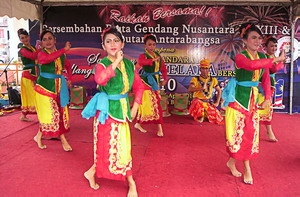
Zapin Banjar Steals The Show At Drum Fest
Melaka, Malaysia -The attendees at the recent Malay Archipelago Drum Festival at the Dataran Majlis Bandaraya Melaka Bersejarah (MBMB) were not only entertained but were mesmerised with the energetic performance of the 28 local and foreign dance troupes.
However, the team from South Kalimantan in Indonesia stood out from the rest with the writer himself being highly impressed with the dancers' bodily expression and the music that reminds one of the Zapin, a traditional dance of Johor.
The Zapin that is said to originate from Yemen was brought by the Arab traders to the Malay archipelago in the 16th century.
Though the Zapin from Johor and South Kalimantan share many similarities, there are also many variations in the steps, movement of the body and hands, and even in the music.
The Zapin within Johor too varies according to districts, with Zapin Pulau and Zapin Tenglu in Mersing district while in Muar there is the Zapin Lenga and Zapin Putar Alam.
Batu Pahat is known for its Zapin Kores, Zapin Tanjung Labuh and Zapin Sari while Pontian is known for its Zapin Seri Bunian and Zapin Mustar.
Zapin Melayu Johor and Zapin Pekajang can be found in Johor Baharu.
A notable difference is in the accompanying music. The Zapin from Johor uses the gambus (a traditional guitar like musical instrument) as the lead instrument but the tempo varies according to the districts. For example the music for Zapin Pekajang is fast paced in line with the fast dance rhythm while the Zapin Pulau is at a slower tempo in tandem with the slow dance rhythm.
The Banjar Society’s Zapin
An official of the troupe from South Kalimantan, Drs Syarifuddin R, 57, pointed out that the Zapin performed by the Indonesian group is the cultural heritage of the Banjar people around Kotabaru, South Kalimantan.
It is actually known as the Zapin Sigam and the accompanying music is known as Panting.
Syarifuddin, who is also the head of the District Cultural Council(DKD) of South Kalimantan, noted that the Zapin Sigam is the dance inherited by the Banjar community from the SigamKingdom or the PulauLautKingdom that existed circa 1850s in South Kalimantan.
Zapin Sigam which is actually pronounced as Japin Sigam is a folk dance choreographed as a show of appreciation for the rulers.
The troupe often consists of six dancers - three males and three females - and it narrates the origins of the Sigam kingdom.
The Panting, the music accompanying the dance, is played by six musicians each playing a particular musical instrument - panting (a traditional guitar like instrument), babun (traditional drum), ketipak (another type of drum), gong, violin and flute.
Syarifuddin added that the Panting is accompanied by the traditional songs of the Banjar people.
A general view will not show distinct variation between Zapin Sigam and Zapin Johor but a closer observation by the writer who has a background in the Zapin Johor dance and music revealed many of the differences. There is definitely a difference from the bodily movements and the hand sways between the Zapin Sigam and Zapin Johor dancers, but the steps remain very much the same as one of Johor's Zapin, the Zapin Pulau.
Nonetheless, the difference in the Panting and the music for Zapin Johor is significant from the tempo and rhythmic viewpoint though both share the traditional guitar as the key pace setter with the Zapin Siagam using the panting while the Zapin Johor using the gambus.
Kumpulan Yayasan Seni Pusaka
Syarifuddin also introduced the writer to the head of the Yayasan Seni Pusaka Sa-Ijaan Kotabaru (YPSKB), Abdul Samad Halid, 54, the group that presented the Zapin Sigam and the Panting music at the Malay Archipelago Drum Festival.
YPSKB was established on 19 Jan 2004 to preserve the local society's cultural heritage especially Zapin Sigam and the Panting music.
"We want to train our youths who want to learn our dance steps, if they are keen they can register with YPSKB and we open the opportunities for children from the age of 12 to learn the dance step," said Abdul Samad.
He noted that the YPSKB has more than 30 dancers who are teens between 12 and 18 years.
Apart from Zapin Sigam, the dancers have been trained in various traditional and modern dances like the Galuh Sa'Ijaan, Harkat, Kolosal, Ahui, Baksa Kembang, Tarian Landang Harapan and another version of the Zapin Banjar, Zapin Anak Delapan.
Abdul Samad said it was the third appearance of the YPSKB troupe in the Malay Archipelago Drum Festival.
Pesta Gendang Nusantara
As for the Malay Archipelago Drum Festival this time, YPSKB spent two months in selecting and training the dancers to present the Zapin Sigam and other dances, he said.
"YPSKB holds continuous training twice a week for all the dancers and musicians.
"They are not paid, only given pocket money. But they are willing to do it because of their interest in this antiquity art form," noted Abdul Samad.
As for the writer, who is of the Banjar origin, like Syarifuddin and Abdul Samad, he is proud of the rich cultural legacy of the Banjar people that is being preserved for the future generations in the Malay archipelago. (Fadzli Ramli)


 Hari ini
  Kemarin
  Minggu kemarin
  Bulan kemarin