You are visitor number 105.216.314 Since 01 Muharam 1428 ( January 20, 2007 )
AGENDA
No data available
Artikel
14 agustus 2007 06:30
Brief History of Malay Migrants to Australia in the early 1820`s:
Some of Australia‘s earliest visitors, pre-dating European settlement, were in fact Muslims from the east Indonesian archipelago. These were anglers from the island of Makassar who came to fish for the ‘trepang‘, commonly known as the ‘dugong‘ or sea cow for the lucrative Chinese market where it was considered a delicacy.
Australian records dating from the early 1820‘s indicate the number of ships, the size of the crew and the names of the captains. It is thought that the anglers of Makassar had been visiting the north coast of Western Australia, Northern Territory and Queensland from as early as the 16th century.
Evidence pertaining to these early visitors can be found in the similarity of certain words, which occur in both the languages of the Makassar and coastal Aborigines. Aboriginal cave paintings also depict the traditional Makassar vessels or ‘prau‘ and a number of Makassar artifacts have been found in Aboriginal settlements on the west and northern coast of Australia. Furthermore, some inter-marriages between Aborigines and Makassar took place and Makassar gravesites are strewn along the coastline. Mr. Campbell MacKnight, an archaeologist with the AustralianNationalUniversity has done considerable research and documentation.
The few surviving Makassar anglers, recalling their voyages as boys with their fathers when they sailed to Port Darwin and the CoburgPeninsula have retold voyages. They retold accounts of their grandfather‘s voyages to the ‘Tanah Marege‘ or ‘land of the black people‘ and the averages 60-day journey eastward to Timor and then down to Darwin. There had been inter-cultural exchanges between the Aboriginal communities and the Makassar. In 1867, the Dutch governor-general in Makassar noted that there were seventeen Aborigines in Makassar, which had returned with the Muslim fishing fleets and that Aborigines had been noticed on the island as far back as 1824
Formation of MAAN
1986 may be considered the year that rallied the Muslim Malays in New South Wales (NSW) together. Although Malays has been living in metropolitan NSW for a great number of years, social cohesion and interaction were lacking among the Malay residents.
New Malay migrants arriving into Australia usually finds it hard adjusting to their new environment. On the rare occasions when they do meet - food, religion, events at their country of origin and cultural values are common subjects of conversation. One of the most talk-about topics usually centered on the bringing up of children in a society that from time to time depicts questionable values and behavior.
The death of a Malay Muslim woman that year and her subsequent cremation at the request of her bereaved husband caused a stir within the Malay community. Subsequent events quickly brought about some rethinking among the Malays. It became evident that there was a need for an association that can provide guidance in Islam, promote cultural understanding and Islamic values; and to act asthe harnessing force within the Malay community.
A year after the idea was first mooted MAAN was formed. The name MAAN is an acronym of Malay Australian Association of New South Wales; and incidentally bears the meaning "togetherness" in Arabic.
The first president of MAAN was Pak Samat Amjah. He is an active member of the Association. Pak Samat is look upon by many in the Malay community as a pillar of strength. Today, Pak Samat holds pioneer status amongst the Malay community. In the Australian SBS Television documentary series " Tales from The Suitcase", Pak Samat revealed the difficult years he experienced as a pioneering Malay in the history of Australia. The series also centered on Pak Samat, considered a "coloured" person in his time, challenged the "White Australian Policy". MAAN is making effort to ensure that copies of the tapes are sufficiently kept for references, for visitors viewing and future generation of Malays to understand the hardship that he as a migrant Malay has undergone.
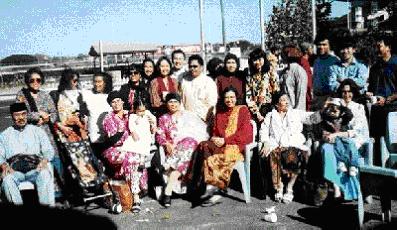
Today, MAAN not only play a pivotal role to its community in New South Wales, it also act as a "hub" for the Malays to keep in touch and foster "good silatulrahim" among the new generation Malays. Through wholehearted dedication and effort, one is no longer surprise to see members and their families of the Malay community dressed in traditional Baju Kurung‘s (traditional Malay costumes) participating in public events:
Parading in Sydney busy streets
Performing traditional Malay dances in major events
Men playing the Kumpang at social functions
Member‘s setting up hawker stalls promoting traditional Malay Kuihs (cakes), Satays etc.
MAAN as an organisation derives most of its operating expenses by actively participating in local festivities through setting up food stalls selling Malay food and delicacies. Our hosting of the annual MAAN fund raising gala and dinner night where members perform traditional dances with sketches illustrating Malay cultures and values also help to contribute to our bottom line.
The organisation aim to mobilise its members and provide to the wider community programs to help provide for its long term goal of keeping alive Malay cultural values and traditions in Australia. To date, it conducts:
Malay language classes
Malay folk arts and crafts
Malay cultural dance lessons so that it members can participate and perform in local and major festivities

 Today
Today  Yesterday
  Last week
  Last month