Wednesday, 26 August 2026 |Wednesday, 12 Rab. Awal 1448 H
Online Visitors : 3.152
Today
:
37.453
Yesterday
:
29.971
Last week
:
178.006
Last month
:
11.454.048
You are visitor number 105.216.314 Since 01 Muharam 1428 ( January 20, 2007 )
AGENDA
No data available
Artikel
09 januari 2008 08:52
A Digital Library for Malay World Studies: Redundant or Relevant?
By : Supyan Hussin, & Ding Choo Ming
Abstract
Computer technology is transforming libraries in fundamental ways. The simultaneous emergence ofthe powerful technologies for the storage, retrieval, use of images and text, combined with what can only be called an entirely newset of scholarly disciplines in a new information environment imposes an agonizingly difficult set of choices and problems onall libraries. Bu, ,this expansion of the ambit of scholarship is remarkably well-suited to the power the new technology offer. The technologies we now associate with WWW and Internet have increasingly made images, sound and full-motion video available to anyone with a desktop computer of reasonable power. The opportunities and challenges inherent in these changes are vast and largely unexplored. How will libraries react to the newly emerged digital information environment, which is necessarily incomplete with so many parameters not yet fixed? The revolution is far from over. Though no one knows exactly what to expect, more and more users have an opinion about how they prefer to retrieve information. They are expecting more than what the traditional libraries can deliver! Will print-based libraries be replaced by digital libraries?Why? Are traditional libraries redundant or irrelevant? These are some of the soul-searching issues facing print-based libraries now. Capitalizing IT, ATMA has developed portal on Malay world studies at www.malaycivilization.com. Living in complex times, filled with uncertainty and marked byglobalization, our move is only a small step in our giant stride to globalize Malay world information digitally. This integrated portal has great appeal to researchers the world over.
New Information Environment
The dream of a great virtual library has been shared by Sutherland is his article in The New Straits Times. His dream is based on two facts: Firstly. great libraries, like great forests, take centuries to grow and can be destroyed in hours.Secondly, library materials disintegrated through borrowings, photocopying and environmental factors. He added “Even rare-book curators, who wear cotton gloves to keep finger-acid off pages, know that every time one of their beloved volumes is consulted, its life is shortened. The temperature and humidity comfortable for human beings is disastrous for paper” He continued thatsuch problems make Google, a web-search company,to digitize for circulation on the web a vast collection of out-of-copyright items and to create a giant virtual library, with five of the English-speaking world‘s grandest libraries: of Harvard, Stanford, Oxford, and Michigan universities, and the New York Public Library,which have the representation of almost all the great books of the West, indeed a great news (Sutherland 2005).
The above-mentioned excitement solves conservation problems for the library, and creates a new library environment in that today‘s students are web-oriented. They see the libraries as a kind of cemetery, a place for dead thinking and very old people. They want information instantly and drink, smoke, listen to music and talk at the same time.(Sutherland 2005). But, there are problems. Rightly, Sutherland (200 asks “Why should we expect the biggest, most expensively compiled library in the world to be free? How can Google sell this huge giveaway to its shareholders? Why would Harvard, which charges outsiders US$800 (RM3,040) a year for reader‘s privileges at its Widener library, "give away" material for nothing? How will Harvard explain this generosity to its hard-headed trustees (not to say its undergraduates, paying US$30,000 a year in tuition fees)? Ostensibly, Google is undertaking the virtual library project as an adjunct to its Google‘s Print service, which makes excerpts available online of books that are in copyright. The payoff for the user is that the online version is searchable, cut-and-pastable and downloadable … Whether or not Google chooses to exercise its rights, it and its library partners will be owners of the newly processed property. So the vast reservoir of material in the out-of-copyright public domain will become "proprietary", or pay-per-view. If we get access, it will be because we are "allowed", not because we have the right. Great Books will go the way ofTest cricket. You don‘t pay, you don‘t see.” (Sutherland 2005)
Started with the above prologue, this paper shall examine the transformation of traditional print-based library to more digital library in the context of the underlying technologies which have empowered us to perform the following tasks:
To manage digitization process, storage of digital content and access to digitized images
To do bibliographical enrichment, like adding links toincorporating titles, contents, reviews, dust covers and other enhanced information into traditional descriptive records about library holdings,
To manage and integrate information from multiple suppliers with multiple hosts/ metadata formats.
To support resource discovery and searching and document delivery
The above-mentioned task can now be done very effectively with digital materials. In addition, ICT has challenged us to come up with new thinking, approaches and strategies in dealing with the range of accessibility and preservation problems that librarians and users are confronted with. Is it not librarians‘ common aspirations in heighteninguser satisfaction, in recall and precision in terms of their overriding concernfor easy, convenient and fast access to information?There is indeed no clash of values and aspirations between the traditional and digitallibraries.What the new millennium has presented us are new challenges as well as opportunities. This requires us to engage in deep soul-searching and toreflect on past events in order to map out the future course for information management, individually and collectively. With more and more digital information becoming a better alternative, thetraditional ways to access information need transformation. More and more new technologies are imposing new ways of closeness, interpretation and interaction with information, and above all, the materials coming to the users, instead of the other way. The paradox is though the proportion of electronic information media has increased rapidly,it is difficult to cut back on printed materials. Anyway,libraries now have the most heterogeneous materials for the first time in history. But, it is most unfortunate that technological challenge for libraries comes at the time libraries are experiencing inflation and budget cuts. Subscription prices of academic journals have increased by on average around 350 to 400% over the last twenty years (Saur 2003: 286). While there is no financial magic to solve this problem of constraining resources, technology itself may offer some relief in terms of forced massive budget cuts, staff cutbacks and reduction in library service and operation.In terms of collection development, Greenberg (1998:50) feels that it was easier to Harvard University, founded in 1636, to build her collection than most librariesnow, thoughno library has been financially able to provide access to the complete library information on its own.But, libraries now are in a better position to develop network to supply morematerials than in the past. The main issue is not what technology to us, but how to take advantageof it to make us empowered, viable and effective. The proliferation of new information on one hand, andthe rise of new technologies to facilitate scholarship on the other hand, does not really allow us to think very differently about the role of library and documentation center (Greenberg, 1998: 50). Users now need more and morediversematerials than they have ever needed before, both just-in-case and just-in-time. There is no way a library can collect everything that any scholar is ever likely to need.
PROBLEMS OF PRESENT ACCESS AND FUTURE PRESERVATION
The great expansion of World Wide Web in recentyearshave pushed forward a new cyberworld where more and more digital information is madeaccessible to more and more people. New technologies are not only making it much easier for users to find what they want, but also empower librarians to be more collaborative about collections, to share resources, to think in terms of access rather than ownership, to provide materials to users just-in-time, rather thanjust-in-case, and to combine preservation for the future with access for the present. But,many social concerns of human beings have blocked them from reaching the full realization of the information age (Chih Wang 2003:219). By imposing rules, including library opening and closing hours, many users have been restricted from free flow of information in the newly emerged information environment. Are the rules and restrictions the rightful steps to protect the materials? To circumvent the inconveniences, many users familiar with digital information have turned away from patronizing traditional libraries. Though it is a fact that books and journals disintegrated through constant use and photocopying, are printed materials really safe in the libraries?Many books and reports, for instance,in closed collection have been damaged by insects, humidity and other environmental problemsbeyond the control of library rules as well as the ignorance of librarians. Worse, the restrictive library rules also turn librarians into custodians, and not information providers in the real sense of the word. Saying that, the right to free flow of information now faces the strongest challenges as an increasing number of usersgiving up their rightsand turn away from the libraries. In this context, theadvances ofinformation technology in recent yearsturnedout to be meaningless to them in terms of freedom and the free flow of information. Here, we have missed the forest for the trees, by focusing on the on the wrong component in the library services. Library rulesare weak and passed for the wrong reasons, not addressing the real information needs of the users. The rules should protect the library materials and attract more users to the collections.
The relationship between users and libraries has been strained by the unfashionable library rules. Malaysian Copyright Actwas a direct reproduction of the British law. It waspassed as a sign of sovereignty. It was not surprising that the law remained irrelevant in protecting copyright and promoting creativity, fuelling recent criticism from both creators and user of intellectual property. It was of little relevance to the greater mass of our people, who relied on oral tradition and culture for information access until 1950s. Until then,information has beenshared amongthe communities with no direct economic gains, except for information in possession of groups, like traditional healers, as a source of livelihood. Such information is socially patented.We blame the colonial legacy for mostof the current problems, but notourselves, although it is evident that the colonialismhad significant impact on post-colonial Malaysia. In the light of emergingtechnological innovations and media, many librarians still firmly tied themselves to the past and acted as custodians!. Users now want more “protected works” to be transferred to databases for easy access and librarians as information providers. In addition, long term preservation interest now is no longer the preservation of media, which have weight and occupy space, but the integrity and authenticity of the information as originally recorded.Digital information is separable fromits medium which has become less intrinsic interest. Its preservation means it is ‘copied‘ or‘refreshed” from old to new technologies as they become available and as the old technologies ceased being supported by vendors and the user community! But, if the print documents are not digitized, no electronic system, however excellent, will be able to process and disseminate them. This is especially so with Malaysiana or Malay world‘s materials, called by different names in different libraries all over Southeast Asia.So far, libraries possessing themexercise supreme control over the fate of these materials, rarely circulated and are often fragile.Of small-print run and often unpublished, they are in a way rare and unique, representing “scholarly” treasure of vast importance, thus give great pride to the libraries owning them. In other words, special collections are an important part of what make each great library unique. Theyprovide the most basic access: available for reference only during library opening hours. But, in a world of increasingly uniform access to published literature as networked information, the issues are how to provide incentives to encourage these libraries to convert the materials to digital form and make them available. No matter what the reasons might be, there is an overwhelming need for a digitization project in Malaysia which will serve eventually as Memory of the Malay World, similar in objectivesandspheres of action as Memory of the World in the United States, or Google‘s Virtual Library project. While individual librarieswill have to make difficult choices about resource allocations, based on local program objectives, it is clear that the scale of the transitionto digital collection is beyond the ability of many “small and poorly endowed” libraries. Thus, there is an urgent needofcoordinated national and international program to manage the digitization of the out-of-copy-right published materials held in libraries, which forms our scholarlyand social heritage. It can be done through UNESCO and The Library Associations of Malaysia, Singapore, Indonesia!
IT EMPOWERMENT: MOVING TOWARDS VIRTUAL LIBRARY
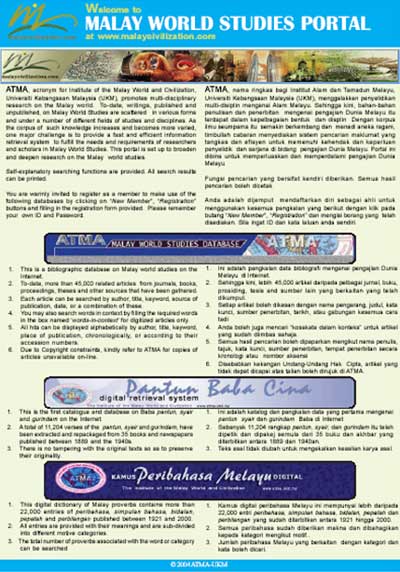
Being in the Malay world, the so-called Malay world information “catchment area”, we have no reason to be suffering from inaccessibility to such information. The problem is not the lack of indigenous information, but the viable methods of managing them and ensuring their distribution. An enormous amount of Malay world research materials still remains with us, despite that a great number of them have been moved to libraries and museums in Europe in the past. Exist in a hodgepodge of media and formats, many of them will never become popularly and publicly known and will not sustain research in the future, unless they are prudently managed and preserved. Thus, part of the responsibility of digitally documenting and preserving them falls naturally on research institutions such as ATMA. Since April 1999, under the new leadership of Prof Shamsul Amri Baharuddin, ATMA has invested heavily in developing databases, one after another, each complementing and enriching the other. Today, we have twelve different databases reachable through our portal, www.malaycivilization.com, constructed with a grant from DAGS (Demonstrator Application Grant Scheme) through MIMOS. This achievement has been necessary not only in order to ensure that the abundance of indigenous information is available all the time, but also to build local competence and capability in documenting, and lessen our dependence on American or European publishers and database manufacturers.
We capitalize on ICT as it holds great promise for knowledge management. It revolutionizes how we capture, store, disseminate and access to our local information and how we cope with the exponential growth of international knowledge. More importantly, digital technologies not only decline rapidly in cost, but also that Internet is expandingat an average rate of 69 new hosts and 23 new domains per minute, and is expected to reach a total of one million hosts in 2005 (Chih Wang 2003: 213). This miraculous development has brought forth the dawn of information age and the coming of cyberworld. Technologically, Internet is now accessible by many types of computers. Following its acceleratedgrowth,Internet has become global information highwayto which millions of people in the world connect for business, information, learning, research, entertainment and others. Though currently finding ourselves in the middle of the information age, we are suffering from information anxiety caused by “infoglut” -caused by information overloadfrom the West on one hand, but “inforfamine” in terms of Malay World on the other hand. We are also aware of the rate of technological diffusion in Malaysia has outpaced that in most other countries in the Third World, but this pace of development is notmatched with the necessary re-awakening, re-thinking and digital re-orientation. There are numerous digitization projects all over the country as reported in various seminarsand workshops in recent years. But, many of them cannot sustain, while the others are stored in personal files on individualcomputers, consequently, very little is shared and easily accessible over the Internet. Inspired by CD-Rom, WWW and the Memory of America (Ding 1999), our portal www.malaycivlization.com is designed not only as antidote to the “infoglut” and “infofamine” problems, but also to globalize Malay world information. We capitalize IT as its growth and expansion has not only gripped our imagination ofnew approach to information management, but also empower us to do it, no less thanother users and vendors,ever since the popularization of the concept at the end of 1980s. It is predicted that the growth of e-solution, including databases and portals, will be phenomenal as it will become a standard component of successful knowledge management implementation in years to come, particularly its effectiveness in delivering personalized information and other in-context information gathered through internal and external sources globally 24 hours a day. We focus on information management, rather than IT, although information management is indelibly linked to IT and technological innovations. We are more concerned with repackaging of Malay world information. Thus, our fundamental mission is to develop and improve our portal to offer the right knowledge to the right people at the right time and helping people to share and put information into action in ways that will heighten and broaden research on Malay world. This conscious effort involves a multi-disciplined approach that integrates business strategy, cultural values and work process. We use IT to carry out such functions as capturing, storing, searching, retrieving, navigating, synthesizing, maintaining and structuring information. In this context, computer is only a tool, and not necessarily a solution.Saying that, portal is only an interface, where information exchange and knowledge transfer take place, but it is one important component of successful knowledge management involving strategy, measurement, policy, contents, process, technology, culture, thuswe focus equally on cultural transformation and technology transfer.
Realizing that the tactical advantages offered by IT cannot be confused with the fundamental changes required for effective knowledge management, we identify the documents relevant at international, regional, national and local levels, and incorporate them into our portal to facilitate their preservation and better accessibility world-wide digitally. PADAT is our first project. It is being expanded and updated daily with more than 48,000 entries to-date. After five years and investing more than RM 2 million, we havenow 11 databases, one complimenting the other (Ding & Supyan 2002) (See appendix). The fruits of our labor is also measurable through the number of users increasing from time to time.The other challenging task is our activities for outreach and awareness raising and disaster prevention. Without a doubt, among the most absorbing and exciting tasks carried out is to provide access to moreMalay world information to more people, faster and easier than ever before by creatively harnessing technology in meeting the needs of emerging attitudes of users in the growing electronic library environment. This newemphasis on convenience and speed has significant implications not only because it is spilling over to user expectations for materials in print formats, but libraries are pressurized to develop rapid delivery of books and to fax journal articles to users, without them coming to the library or documentation center, if possible. See diagram below:
The changing needs and expectations of users are natural, accompanied by and connected to the sweeping changes taking place in computer technology! Is it not that university and public libraries have offered computer-assisted services in OPAC, database searching, and others since 1980s? We have devisedlibrary operations and services that need little human intervention. Now, we have to contemplate how much further we can do! It is both a challenge and an opportunity. The only way we can hope to respond to the new expectation is by means of the technology that raises the expectations! Now, libraries have to create value-added-services by personalizing, aggregating and integrating the human, structural and relational capitals. To do that, we need the required human recourses. They must be trained, experienced, knowledgeable, skilful, innovative, competent, intelligent, creative, capable of problem-solving, and able to work together as a team. Because of technology, we are increasingly offering larger amounts of information to user whenever they are located, as long as they have some manner of networked connection to the libraries. This is termed as a virtual presence of library materials Thus, we have to create a virtual presence of professionals to match the virtual presence of the information! And to provide personalized services virtually, the staff must know the systems,processes, methods, best practices,copyrights, patents, trade secrets, brands and techniques and have goodrelationship with customers, suppliers and external organizations. Personalized service gaining importance because each article is unique and specific to every user who not only has different motivation, ability, performance,education, learning, training, values and beliefs, but also able to do research at his or her own pace. To be able to do it, each article should be easily shared, used, re-used, identified andtransmitted, and no longer used by one person at a time, which is now considered a luxury. Nevertheless,the unrestrained growth of information and database access, accompanied by chaotic, haphazard and non-existent control mechanism and finding aidshas driven the imagination wild and stimulate the appetitefor everything! In the context of the ever-increasing powerful technology,we can imagine a new generation of information users for whom the traditional library methods are anachronistic and information mediation inadequate! Saur (2003: 286) Libraries an, users andpublishers share the same goals and problems Libraries mustwork on retaining their position as information and knowledge centers In this context, users and libraries are partners. This partnership must be strengthened and expanded. Libraries cannot be drifting into the future while either holding on to the old ways or leave whatever that need to be done to the commercial world! The worst nightmare will be the users will flounder in an increasing assortment of proprietary system and invisible sources of information. At ATMA, we do what we can one at a time and to ensure that we must not fail in whatever we do!
SURVIVAL OF THE FITTEST: TRADITIONAL AND DIGITAL LIBRARIES
Fifteen years ago, 98% of all information was still distributed in paper form; but now not only the proportion of digital information is continually increasing, but also that they are delivered without the help of libraries, book sellers or publishers (Saur 2003: 286). In the context of the ever-increasing powerful technology, more and more people from new generation of information seekers are finding that thetraditional library and methods are anachronistic and inadequate. This is partly because technology, joined with the transformation of scholarly work taking place in the last several decades, has created a set of appetites that traditional libraries cannot satisfy. Challenges and opportunities have always been imposed on traditional libraries regarding where to invest for the future to meet the changing scholarship and changing technology (Greenberg (1998: 44). In the meantime, many librarians are worrying about the life span of digital informationwhich is in danger of disappearing due to the accelerated change in the technology, the volatility of the carriers of digital information,the difficulties presented for the credibility of the data stored,which could be altered and even eliminated intentionally or unintentionally (Ding2000) The other problems making them worried how and wherecan they be included in the virtual world, an increasingly dehumanized environment? While technology is the key to success in creating a new information environment, quick and complete access, virtual presence of information, can we eradicate the presence of librarians? Harnessing technology, understanding users, learning new systems and developing new organization models require not only our best efforts, but also best skills. Learning new skills is not a cause for embarrassment. Now, life-long learning is the new life-style! We have to educate ourselves before educating our users!The other challenge is to develop our own capacity building to sustain it. Though location diminishes in importance, we may explore sharing reference experts among several institutions by means of networking. There are dozens of such possibilities we have yet to discover and explore. There is a certain excitement and entrepreneurial flavor associated with ventures in new technology, helping developing the infrastructure for the new information environment.
How will librarians react to the new and different knowledge environment, which is necessarily incomplete with so many parameters not yet fixed? As digital revolution is far from over, no one knows exactly what to expect. Nevertheless, users now not only has an opinion about how they prefer to retrieve information, but also will be expecting more than what the traditional libraries can deliver! The issue is not that the creation of virtual libraries spanning the globe is still a dream. That should not be an excuse for not digitizing materials to help to close the gap between promise and reality. Another realityis attitudes are changing rapidly. More and more users, scholars, publishers and the general public are no longerviewinglibraries now as before.No matter which direction we are moving to, we must be mindful of the primary and urgent need to use the mix of technologies – analog and digital – most appropriate to the task. Saying that, libraries should notcontinue operating as in the past! Librarians should begin to digitize materials in the collection to make them available in the Internet, beyond their own buildings to cater for new trends in scholarship because of the transformations of subject and objects of humanities research and teaching in the last three decades.Users are interested in findingphotos, prints, textiles, drawings, newspapers, microfilms and manuscripts in digital form because of convenience, fast, and high precision. In today‘s networked environment, materials can be found and examined from almost anywhere, without time constraints, as long as we have access to a computer with a modem and communication software. Scholarsare interestedin any form of access that will free up time and allow them to work whenever and wherever. They do not have to bedictated by the opening hours of the library or the availability of the staff. The challenges and choices are notwhetherlibraries are prepared for that, but how toprioritize these tasks because of budget and staff constrains. The issue here is do we know our immediate problem. The more we know about the problem we need to solve and why we need to solve it, the easier it is to select the right tool for the right job. Any investment we make in converting library materials with long term value to digital image is well spent on behalf librarypatrons,present and future! To us at ATMA, learning more about user‘s preferences and expectations is one new service opportunity. Because wecannot do everything, we must be sure that we are doing the right thing. In other words, our choices need be conscious ones. We must be prepared to do less than we have done in some areas in order to take on a new responsibility. It is that sort of choices we need to be making as a way of permitting us to do other things. The fundamental goal of library now is to ensure continuing access to materials for as long as those data have value. The need to digitize has complicated library work considerably and also made library operation a lot more expensive! The process of creating andmaintaining digital resources is certainly expensive, not only in terms of equipment and technology, but also in manpower. But, the cost per pagefor scanning materials into digital form continues to drop as the process becomes more automated. The transformation of microforms and photographs and music is getting cheaper and faster.
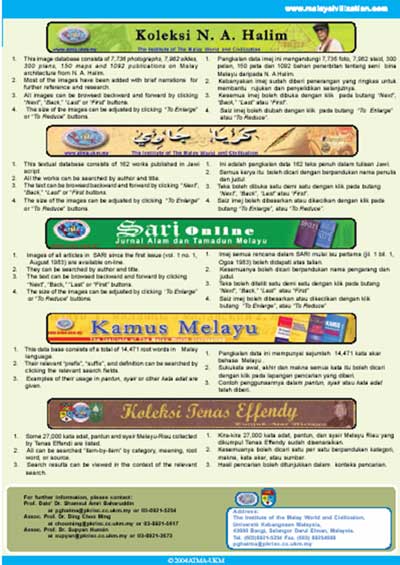
The simultaneous emergence ofpowerful technologies for storage, retrieval and use of images and text, combined with what is called a newset of scholarly disciplines, impose an agonizingly difficult set of choices and problems onall libraries (Greenberg (1998: 46). It is here that our integrated portal at ATMA has great appeal to researchers. With our portal in Internet, users can perform a range of searches in a variety of contexts in one location, without having to travel to far-flung sites or search individually using a multiplicity of finding aids. The above computerized searching not only allows them to access the images themselves, but also provides them with new ways of using visual resources. For instance, a number of images inN. A. Halim‘s Database can be displayed on the screen at once andcompared easily and rapidly.This is possible because movement between digital images is simple. Similarly, selection of possible images for use can be done very quickly. More importantly, images selected can be enlarged and studied in detail with a simple click of the mouse and also can be downloaded for further study and use.Downloading also offers the possibility of transferring images directly into slides or projecting the images from the computer through an overhead digital project onto a large screen. This allows presentation to be done easily and directly. In short, computerized access allows users enormous flexibility in how they formulate and manage searching. They can search by using words in natural language, keywords. And do a Bollean search. Computers also provide browsing options: top down and other logical ways across hierarchies and subject headings.
CONCLUSION: WAKE UP TO DIGITAL WORLD
In this time of increasing demand for library services and decreasing financial support, it is especially important that we are aware of all the options and make the right decisions to optimize our efforts. The conversion of print materials to digital representation is no longer experimental.Its value has been proved by a series of projects, such as at Cornell University, Elsevier Science Publishers, the University of Michigan,the library of Congress and now with Google.As more and more materials are digitized, users can find materials that span collections and institutions that might otherwise not be known or available.Broad access can be offered to a unique set of resources, fostering new intellectual depth and breadth in research. Scholars now have begun to have access to amount and kinds of information their predecessors could only dream of in the past. Such a success will make possible a kind of scholarship that is quite differentfrom now: combining both the power of emerging technologies andimportant trendin scholarship.Scholarship has significant broadened and deepened in both method and sources. In short, digitization is a solution to many problems facing the libraries and users. It is for future preservation, for present access, for dissemination to reach broader audiences. It also addresses storage needs, transmission speeds and cost factors. In terms of preservation, the creation of a surrogate enables libraries to preserve the originals. In terms of access reference, users have more efficient browsing of large numbers of materials. This improved access can save time that researchers can use on research and discovery. Remote access can mean reaching researchers beyond the walls of the libraries. It can also mean we can do research, find what we want, make copies and order reproductions right from our computers. Improved access also helps the library preserve the originals. Through decreased handling,less theft or wear or tear problems. Providingremote access can meanfewer bodies in the existing library space. Readers need nothandle the materials with gloves and under curatorial supervision. We can browse through hundreds or thousands of photographs without using any finding aids. With that, the searching can be completed within minutes, instead of days, or weeks or months.
As the technology changes, nothing will remain the same. One of the basic truths to remember about this emerging technology is that nothing is as sure as change itself. We must not lose sight of the fact that the transition of collections to digital formats represent a unique opportunity to rethink the way in which these collections are organized, structured, presented and managed to serve more effectively the worldwide community of scholars, for whom the libraries hold these collections in trust. Libraries must move beyond the closed door, static model to accommodate the more flexible and dynamic networked information environment, in which the management of collections may simultaneously include or at least facilitate continuous publishing. Libraries are either partners or driving forces in the production of digital content. Libraries have to break away from a traditional publishing mentality and develop models that build on the strengths of the global networked community and the nature of networked information.The challenge is how to convert such collections to digital format in a way that facilitates re-use and enhancement by the broad scholarly community over time that weaves primary content into a web of commentary, criticism, scholarship and instruction. We need a new vision of opening up historically inaccessible special collections and linking themto both the existing and developing base of scholarly publication. Library users expectmore and more material in digital form. Their reasons vary greatlymuch has been written on the general advantages of digital materials over print materials. Digital technology has opened up our collections and inspired users in ways never before. It can preserve and protect our precious resources for generations of users to come!It is a difficult challenge, but well worth the effort.New ways of looking at images may create new paradigms for using them. Through networking and digitization, scholarly communities now increasingly have a wide range ofresources readily at hand. The technology has improved access to people both near and far, with vast arrays of personalities, skills, propensities and special interest. To enable more users, multiple copies are necessary. One user/one image limitation on access to materials in the traditional library is a luxury which is difficult to maintain.New digital resources and services will transform the replace paper-based services that libraries traditionally provide. In the rhetoric about new technologies and the emergence of virtual libraries, one frequently encountersthe assertion that digital services will not produce savings. Advantages of digital materials to the library are enormous too! Computers offer access to a variety of resources. They can lead user to as rich an array of resources as possible, giving the users the capability to widen their research. They need no longer have to keep the variety of resources. By using the surrogates, the originalmaterials can be better preserved for intensive scholarship and research need. The amount of computer phobia is rapidly disappearing as younger generations seem to becomecomputer-literate.
References
Brners-Lee, Tim. Declaration Presented Tim Berners-Lee” (http://www.w3.org/People/Berners-Lee/9602affi.html)
Chih Wang. 2003. Internet Censorship in the United States: Stumbling Blocks to the Information Age.IFLA Journal 29(3 ): 213-221
Cloete, Marian & Snyman, Retha. 2003. The enterprise portal – It is knowledge management? Aslib Proceedings. 55 (4): 234-242.
Ding Choo Ming Access to Materials on Malay World studies from Leiden to Bangi: A Model for Information Repackaging on the Information Highway. ATMA-KITLV Colloquium – Dutch Scholarship and the Malay World: A Critical Assessment, 20-22 November 2000, Universiti Kebangsaan Malaysia, Bangi
----- Access to digital information. Journal of Librarianship and Information Science, 32:1 (2000): 26- 32.
----- Local Creation for Global Use in the Information Age: Accessing Malay Indigenous Information at ATMA via the portal www.malaycilvization.com. The 6th International conference of Asian Digital Libraries (ICADL): Technology and Management of Indigenous Knowledge for Global Access, 8-12 December, 2003, Kuala Lumpur.
Gorman, G. E. w2003. The digital divide- access and literacy. IFLA RACAO International Workshop on the Digital Divide, Colombo, 3 March 2003.
Greenberg, Douglas,1998. Return to the valley of the dolls: reflections on changing lanes along the information highway.Collection Management 22(3/4): 41-53.
JohanJaafar. Too many books, too little time to read. New Straits Times, 16 April 2005
Loo, Eric & Yeap Soong Beng.Cyber-colonialism in Asia: More Imagined than Real? Media Asia 25:3 (1998): 130-137, 153.
Saur, Klaus G.Libraries and Publishers – a Partnership?IFLA Journal 29 (4): 282-287
Serge, Latouche. 1993.In the wake ofthe affluentsociety: an explanation of post-development. London: Zed Books.
Supyan Hussin & Ding Choo Ming.Enhancing and Diversifying ATMA‘s Databases to Ensure Sustainability. The 3rd UKM-UC International Conference on Societies for a Sustainable Future, 14-15 April 2003, University of Canberra, Canberra, Australia.
Sutherland, John. 2005. All the world‘s best books at a click. New Sunday Times (Learning Curve). 10 April 2005.
Watson, J. 2000. Understanding portals and KM. Information ManagementJournal 34 (3): 18-22.
Wells, D; Sheina M & Hariss-Joneses, C 2000. Enterprise Portal: New Stragies for Information Delivery. www.ovum.com.
Widmayer, K. 2000. Enterprise Information Portal and Knowledge Management. International Information Management. www.metakin.com/print.php?sid=265.
------
The authors can be contacted at e-mail supyan&pkrisc.cc.ukm.my (Prof Madya Dr Supyan Hussin), andchooming@pkrisc.cc.ukm.my(Prof Madya Dr Ding Choo Ming)
________________
Supyan Hussin, & Ding Choo Ming, Institut Alam & Tamadun Melayu, Universiti Kebangsaan Malaysia, 43600 UKM. Bangi

 Today
Today  Yesterday
  Last week
  Last month