Thursday, 19 November 2026 |Thursday, 8 Jum. Akhir 1448 H
Online Visitors : 0
Today
:
14.300
Yesterday
:
114.972
Last week
:
821.392
Last month
:
11.429.130
You are visitor number 105.216.314 Since 01 Muharam 1428 ( January 20, 2007 )
AGENDA
No data available
Artikel
15 juli 2008 03:51
Bimanese Personal Names: Meaning and Use
The Sultanate of Bima
By Jeffrey D. Brewer
A personal name may be defined as a label which serves to distinguish one individual from others. Although it may be disputed how adequately personal names serve to identify individuals in some groups (e.g., Marshall I965) or even whether it is proper to call some labels personal names (Lévi-Strauss i966), it appears that the great majority of societies do assign personal names to individuals. The many descriptions of personal naming systems which have appeared in the ethnographic literature (cf. Lévi-Strauss 1966; Conklin 1972) have clearly established that in many systems personal names not only label individuals but also convey information about social relationships. For example, many North American Indian and Australian groups derive their personal names from clan animals; hence personal names serve to associate individuals with their clans (Lévi-Strauss I966). Also, as Americans, we are well aware of the relationship among American surnames, family structure, and descent lines. Many other examples could be offered.
A few studies have shown that personal naming systems are not only labels and a means of conveying information, they also have social consequences. Geertz and Geertz (I964) argue that the Balinese practice of using teknonyms, rather than other types of names, creates a “genealogical amnesia” which systematically inhibits the formation of truly lineal kinship groups and facilitates the flexible recruitment of persons to kinship groups. Antoun (I968) shows that in an Arab village calling a man by a nickname is a means of derogating him and thus influencing attitudes toward him.
The purpose of this study is to show that not only does the use of names have social consequences, but also that the naming system is an instrument for the management of interpersonal relations. The particular example provided here is the naming system in use among the Bimanese, an Indonesian group. The Bimanese have a clear idea of the concept of personal names. In Bima, as in Bali, individuals can choose from among alternative names when addressing or referring to one another; the choice is made according to the purposes of the speaker. However, unlike Arab nicknames which derive their power from the meanings of the words taken as nicknames, the power of Bimanese names is derived directly from the naming system itself.
Bima and The Villages
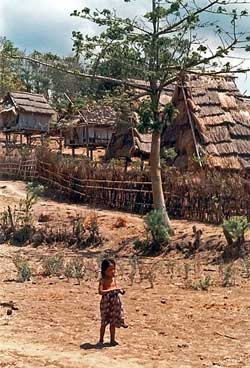
One of many villages in Bima, Sumbawa
Bima is the proper name for the eastern half of Sumbawa, one of the Lesser Sunda Islands. It is inhabited by some 450,000 people, almost all of whom are Muslim and speak Bimanese, a language closely related to those spoken on Sumba and Flores (Esser I938). The largest part of the population consists of farmers who live in compact villages lying in river valleys and lowland areas. A significant portion of the population lives in remote mountain villages. Trade and transportation are centered on eight market towns, the most important of which, Kota Bima, is also the government seat and commercial hub for all of Bima.
The data reported in this paper are primarily derived from research in two Bimanese villages, Rasa and Sila, of approximately the same population—Rasa, 882 and Sila, 925—and are similar in many other ways. Both basically are farming villages, but Rasa is located on a good road in a river valley only about ten kilometers from Kota Bima, while Sila lies on a mountain ridge some eighteen kilometers from Kota Bima, and is accessible only by steep mountain trails. The inhabitants of the two villages recognize and maintain the same naming system but the usage of names in the two villages differs. The contrast between the two villages is instructive and will be referred to later.
The Bimanese Naming System as a Cultural Code
For our purposes, personal names will be defined as those terms which are correct answers to the question, “Cou ngarana?” where the blank is filled with a description of a person. Although the word ngara might be correctly translated as “name,” the question word cou is limited to persons; in other contexts it means “who.” This construction can only elicit the names of persons. Moreover, in Bimanese theory personal names uniquely label individuals.
The system by which names are associated with individuals is complicated and contains two features not previously reported; the use of respect forms, and systematic variation in teknonym connector words. Accurate explication of this system will require the use of some technical terms, two of which, nym and paidonym, are my own coinages.
The Bimanese naming system can be divided into three components. The first and most basic is the system of nyms and nym modifications. Here, the term nym is used to refer to the arbitrary label given to each person; nym is the approximate equivalent of the American concept of “given name.” The second component of the naming system is the patronym-teknonym-paidonym system. These are names derived from the nyms of specific relatives; a patronym from one‘s father, a teknonym from one‘s child, and a paidonym from one‘s grandchild. The third component is the system of titles which are attached to nyms to indicate various statuses. Each of these components will be discussed in detail.
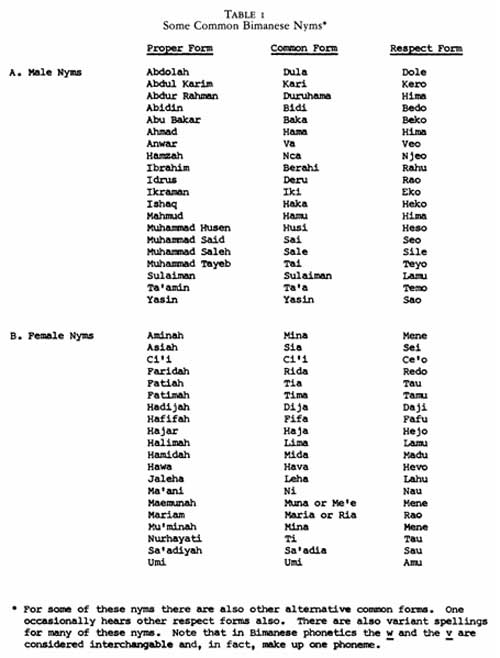
Every person is given a nym shortly after birth. Each person‘s nym is kept for the remainder of his life and is considered the most basic part of his name. Nyms are usually selected by a child‘s parents from a long list of terms which are always recognized as nyms. Most of these terms are of Arabic origin and refer to Islamic belief or history. Others are derived from Indonesian history. Parents are not restricted to this list of customary nyms, some choose new and unique nyms for their children. Rarely are children named after relatives. One important limitation does exist; most of the customary nyms are associated with only one sex, hence parents usually choose a nym appropriate to the sex of their child. Table I lists some examples of Bimanese nyms.
Most nyms exist in three forms: a proper form, a common form, and a respect form. For some nyms the proper and common forms are the same. The proper form is the one which is considered correct in a religious or historical sense; it is also the form which is bestowed upon a child. The common form is a modification of the proper form to make it easier to use in conversation. For example, Abdur Rahman is a common nym in its proper form; it is religiously correct because in
Arabic these words mean “Slave of the Beneficent” where “the Beneficent” is one of the names of God. But this form not only is long it violates two rules of Bimanese phonetics; consecutive consonants are not allowed unless the first is a nasal, and word final consonants are not allowed. To satisfy these rules, Abdur Rahman is transformed into the common form Duruhama. In a similar manner the proper form Ishaq becomes Haka and the proper form Asiah becomes Sia. (Other examples are given in Table I.). The common forms for customary nyms are well known. In some cases, two or more nyms have the same common form. For example, the common form for both Aminah and Mu‘minah is Mina; this causes no confusion except when people are asked to identify the proper form from the common form. Such requests are very rare.
The third form for each nym, the respect form, is associated with Bimanese theories of relative seniority. In Bima, as elsewhere in Indonesia, each person is considered either junior or senior to every other person. Relative seniority is based on relative age and, to some extent, on accomplishments. Seniority should be recognized by special speech forms and other observances of respect. In Bima, one should use the respect form of a nym when addressing or referring to a person senior to oneself. One should use either the common form or the proper form when naming a person junior to oneself. For example, a 30 year old man should use respect forms when naming anyone older than 30 or anyone whose age is close to 30 and whose accomplishments must be respected. All younger persons should be named with proper or common forms of their nyms.
Respect forms are constructed from common forms, most commonly in one of two regular patterns. These two patterns take two of the consonants from the common form of the nym and change the vowels to distinctive patterns. The two patterns are Ci/e/C2/o/ and Ci/a/C2/u/. Thus the respect form for Ishaq is Heko (from the common form Haka and the first pattern) while the respect form for Halimah is Lamu (derived from the common form Lima and the second pattern). In some cases, particularly where the common form has only one consonant, the second consonant in the respect form is dropped but both vowels are retained. Thus the respect form for Muhammad Said is Seo which is derived from the common form Sai and the first pattern. Some of the customary nyms have unique respect forms. The respect form for Abdur Rahman, for example, is Hima. Also, there are cases of two or more nyms which have the same respect form. For example, the nym Ahmad, like Abdur Rahman, has the respect form Hima. The respect forms for the commonly encountered customary nyms are all well known, but it is important to note that with the two patterns described above, any Bimanese can construct a recognizable respect form for any nym even if it is brand-new. Table I lists the respect forms for some customary nyms.
The second component of the Bimanese naming system, the patronym-teknonym-paidonym system, is associated with the Bimanese theory of life stages. Three such stages are recognized: childhood, when a person is incapable of adult work and responsibilities; adulthood, when a person is active and responsible; and old age, when a person is no longer physically capable of adult activities.
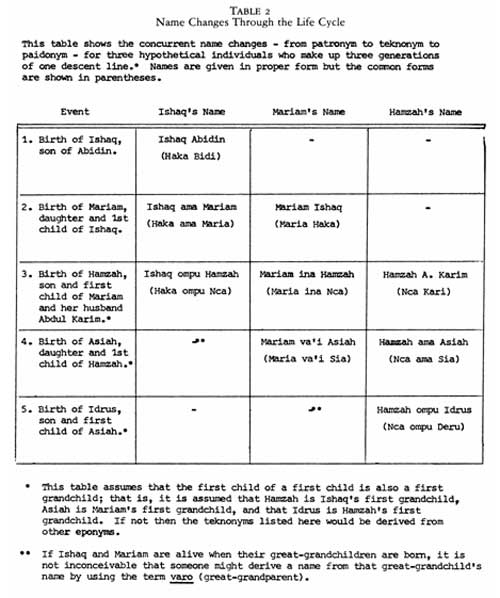
As a child, each person‘s name can include the nym of his father attached to his own nym. Thus, if Ishaq is a child and is the son of Abidin, his name is Ishaq Abidin. If Hawa is the daughter of Abidin, her name is Hawa Abidin. Once a person has his first child he is considered an adult. His patronym is dropped and replaced with a teknonym. If Ishaq‘s first child is a girl who is given the nym Mariam, his name becomes Ishaq ama Mariam where ama is a connector word meaning “father of.” Ishaq‘s wife Hadijah becomes Hadijah ina Mariam where ina means “mother of.” In common forms instead of the proper forms used here, these names are Haka ama Maria and Dija ina Maria. Correctly, a teknonym is always derived from a couple‘s first child irrespective of the sex of the child and does not change with the birth of subsequent children or with the death of the eponymous child (see Table 2).
In theory, old age is reached with the birth of a person‘s first grandchild. This transition is marked by dropping the teknonym and replacing it with a paidonym. If Ishaq‘s first grandchild is a boy whose nym is Hamzah, Ishaq‘s name becomes Ishaq ompu Hamzah where ompu means “grandfather of.” Ishaq‘s wife becomes Hadijah va‘i Hamzah where va‘i means “grandmother of.” In common forms these names are Haka ompu Nca and Dija va‘i Nca. Once assigned, a paidonym does not change with the birth of subsequent grandchildren or with the death of the eponymous child. Also, the paidonym is derived from the first grandchild, irrespective of the birth order number of the child‘s parent. That is, the eponymous child need not be the first child of a first child, merely the chronologically first grandchild.
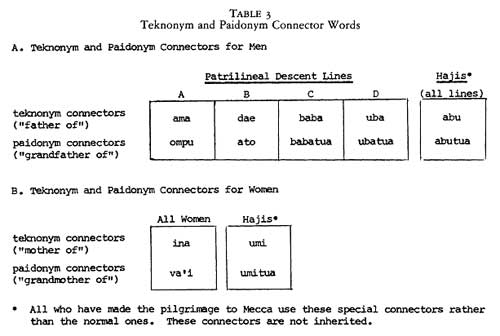
The teknonym and paidonym connector words—ama, ina, ompu, and va‘i—are all derived from the Bimanese kin terminology. All women, except for a special category discussed below, use the ina-va‘i (“mother of‘”—“grandmother of”) pair of terms. However, not all men use the ama-ompu (“father of‘”—“grandfather of”) pair of connectors. Three other pairs of male teknonym-paidonym connector words exist; they are dae-ato, baba-babatua, and uba-ubatua. In each pair the first term is the teknonym connector, the second is the paidonym connector. These pairs are linked. If a man is called Abdolah dae Idrus (“Abdolah father of Idrus”), then when his grandchild Maemunah is born he will become Abdolah ato Maemunah (“Abdolah grandfather of Maemunah”). The other two pair of terms are used in the same fashion. Each of these four sets of connector words is inherited patrilineally. That is, if a man‘s names are formed with the baba-babatua connector words, then his son‘s names will also use these connectors. The various sets of connectors are summarized in Table 3.
These four sets of teknonym-paidonym connector words distinguish four separate male descent lines. The Bimanese claim that these terms serve to indicate each man‘s ancestry. Those of the ama-ompu line are said to be a aboriginal Bimanese; those of the dae-ato line are said to be descended from Makasarese immigrants; those of the baba-babatua line are said to have Chinese ancestry; and, at least in the two villages studied, there was no agreement on the origins of the uba-ubatua line. In fact these terms do serve to connect Bimanese with other peoples. The terms dae and ato, for example, appear to be derived from Makasarese daeng (“elder brother”) and ato (“father”) while both baba and uba are similar to words for “father” in languages spoken on Flores (Lebar 1972). The suffix -tua is simply a Bimanese word meaning “old.”
Teknonym-paidonym connector words also have another use. Once a person returns from the haj, the pilgrimage to Mecca, his status as a haji is marked by the use of special connector words. For women, these words are umi and umitua used respectively in teknonyms and paidonyms. For men of all descent lines, these special terms are abu and abutua. These words are derived from the Arabic abu (“father”) and umi (“mother”). Unlike the other connector words, these terms are not inherited; only those who have been on the haj may use them.
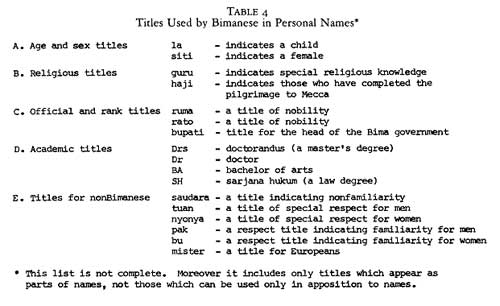
The third component of Bimanese names, titles, include terms which are added to nyms to indicate special statuses.[1] There potentially are many titles which can be added to nyms, including academic degrees, titles associated with certain offices, titles of nobility, certain polite titles extended to non-Bimanese, and some others. The more common members of these groups are listed in Table 4. Only four titles are common in village conversations and only those four will be discussed here.
The four common titles are haji, guru, la, and siti. Haji and guru are titles of religious merit. Haji, of course, is a title given to those who have returned from the pilgrimage to Mecca. Unlike the other titles, haji is considered obligatory with a nym. Guru is a title originally given to those with special religious knowledge who teach children the rudiments of religion and of Koranic chanting. Today, this title is also extended to schoolteachers. Guru is the Bimanese and Indonesian word for “teacher.” La is a title which indicates that the named person is a child, while siti indicates that the named person is female. All four of these are used as prefixes to nyms; examples are Haji Sulaima, Guru Anwar, Siti Sa‘adiah, La Dru (from Idrus).
These three components can be combined into a form which the Bimanese recognize as a complete name. A complete name includes a nym in proper form, a patronym, teknonym, or paidonym in proper form as appropriate, together with the title haji if it is applicable. Certain other titles, particularly academic degrees, are usually added to complete names at the insistence of the named person. However, in complete names certain simplifications are usually made. Many male nyms in proper form begin with Abdul or Muhammad. These two terms are usually reduced, in both writing and speech, to the letters A and M. The title haji when part of a patronym is often reduced to the letter H and the first part of Abu Bakar is usually reduced to the letter A. For example, one of my assistants, a young unmarried man with a college degree, uses the complete name Bahruddin M Saleh BA. The BA is his degree while the M is part of his father‘s nym, Muhammad Saleh. My other assistant, prior to the birth of his first child, had the complete name M Zain H A Majid. His nym is Muhammad Zain and his patronym was Haji Abdul Majid. With the birth of his first child Sri Hidayat, his complete name should be M Zain dae Sri Hidayat. The complete name is a special form relevant to certain contexts, most importantly in documents and in certain governmental uses. Note that the complete name is not a sort of basic form from which all else is derived since it involves certain simplifications and excludes certain titles.
In summary, the Bimanese naming system is a cultural code which infuses names, as they appear in conversations and elsewhere, with specific types of information. First, nyms by themselves usually indicate the sex of the named person. Second, the use of a common or proper form of a nym, except in a complete name, indicates that the named person is junior to the speaker; the use of a respect form of a nym indicates that the named person is senior to the speaker. Third, the appropriate patronym, teknonym, or paidonym indicates the life stage of the named person and relates him to another individual. Teknonyms and paidonyms also serve to indicate sex, whether the named person is a haji, or not, and, for men, which of the four descent lines the named person belongs to. Moreover, teknonyms and patronyms also symbolically tie married couples together since both spouses bear teknonyms or paidonyms derived from the same eponym. Finally, titles serve to indicate various special statuses. An important point is that, except for sex, all of this information is conveyed independently of the particular nyms used to label individuals. Moreover, when the title siti is used to mark women, even sex can be conveyed independently of particular nyms. That is, this naming system is capable of infusing any names with this information no matter what symbols are chosen for nyms.
Naming Behavior
In Bima, as elsewhere, personal names are used to identify individuals in address and reference. Personal names are not the only way individuals can be identified; descriptions, personal pronouns, and, rarely, kinship terms are also used. Clearly, descriptions such as physical description, residence location, relationship to another person, and so forth, can be used for any individual. Naming is, however, generally more efficient for known persons; thus, where possible, Bimanese use names in preference to descriptions. Pronouns, of course, require identification of their antecedents by naming, description, or, in face-to-face interactions, by appropriate body postures. All of these are used but many Bimanese avoid the use of pronouns by the use of names. Finally, kinship terms are almost never used in address in Bima as they are in the United States (e.g., mom). Instead they are only used in descriptions of relationships. Personal names are the most common way of identifying individuals.
In Bimanese theory each person has a unique name, but in fact there is a great deal of duplication of nyms. For example, in one of the studied villages, there are twelve men with the nym Ibrahim while nine women share the nym Fatimah. However, if these nyms are combined with appropriate patronyms, teknonyms, and paidonyms, names in a small village generally are unique. Even so duplications occasionally occur. In a small village like Rasa or Sila, every adult is acquainted with every other adult and with many of the children. From their knowledge of village social relations, most residents can identify individuals from relatively small portions of the labels which could be derived from the naming system. That is, if Ibrahim is a close neighbor and confidant of Abdolah, it is most likely that when Abdolah uses the name Ibrahim without further specification, listeners will understand that he is referring to his neighbor. Of course, if he means to refer to some other Ibrahim, Abdolah may have to use some descriptive phrase or some additional names to indicate which Ibrahim. In general, within the village, speakers need use only a small portion of the labels provided by the naming system to adequately identify individuals. This fact opens options to speakers, and choice of name is a means of influencing social relations.
First, in order to use a nym to label a person, the speaker must choose one of the three forms of the nym. Choice between the proper and common form is considered meaningless except in certain ritual contexts and in documents. Most people are referred to with a proper form or a common form as a matter of habit, but the two are considered interchangable. For that reason, in the following discussion, the term common form should be understood to refer to either the common or proper form except where an explicit distinction is made.
Choice between the common form and the respect form, however, is quite meaningful. If a speaker uses a common form, he is claiming that the named person is his junior, while if the speaker uses a respect form he is identifying the named person as his senior. There is no middle ground. Generally these two forms are determined by the relative ages of the speaker and the named person. However, this feature provides a powerful way of showing respect to someone whose age does not compel respect and of showing disrespect or contempt for someone whose age or accomplishments do entitle him to respect. A complicated example will illustrate both of these uses. Ahmad was the Rasa municipal secretary, the number two man in the municipal government. At age 30 he was considered a relatively young man by the influential citizens and as such was generally referred to and addressed by them with the common form of his nym, Hama. Only his family and a few close associates younger than he used the respect form, Hima. In December I975 he was temporarily elevated to the position of municipal head, a position which, unlike municipal secretary, compels respect from everyone irrespective of age. Accordingly, most of those who had previously called him Hama began calling him Hima. However, one small group of men, Ahmad‘s political enemies, continued to call him Hama both in private and in public in order to belittle him. Note too that Ahmad‘s wife Asiah, whom many people called with the common form of her name, Sia, before Ahmad‘s elevation, was also called by the respect form, Sei, afterwards.
Adequate identification of individuals can be achieved not only with nyms but also with teknonyms and paidonyms. Patronyms, of course, do not suffice, since one person‘s patronym is identical with his father‘s nym. A man whose complete name is Ishaq ama Mariam is generally equally well identified as Haka (the common form of Ishaq) or as Ama Mariam. Unlike nyms, teknonyms and paidonyms convey no information about relative seniority; hence if a speaker wishes to avoid making claims of relative seniority, he can use a teknonym or paidonym. In fact, in both villages, teknonyms are the most common names used to label adults. Even the municipal secretary mentioned earlier is more commonly referred to as Ama Surya (after his daughter Suryati) than as either Hama or Hima. Most villagers restrict use of nyms to those with whom they have established close ties such as household members and constant companions. Of course, all children and unmarried adults are necessarily referred to with their nyms since they do not yet have teknonyms. Adults call children by the common forms of their nyms while children use common forms and respect forms among themselves, as relative age and intentions dictate.
Occasionally speakers wish to use a teknonym to convey respect. This can be done by substituting the kinship term dua (parent‘s elder sibling) for a teknonym connector word. Thus, if one wanted to refer to Ama Mariam with respect and a certain closeness, one could call him Dua Mariam. The same substitution is used for women also. This form is not a proper teknonym; in fact the term dua can be substituted for any teknonym connector word. The dua form is little used.
The use of titles is the third major option available to speakers. The title la, when used with the common form of a nym (it is never used with a respect form as that would be a contradiction), implies that the named person is a child. Hence it is commonly used to make clear that a child is being discussed and not an adult for whom disrespect is being voiced. It is also occasionally used by older persons for younger adults to emphasize the age difference. The title siti implies that the named person is female. It is commonly heard in discussions of marriage or other discussions in which sex roles are important. It is, however, essential when naming persons whose nyms do not give clear indication of sex. For example, one young Rasa girl was given the nym Abdur Rahman, a nym customarily considered male. Hence she was never referred to with the normal common form, Duruhama; instead she was called Siti Rahman, a form which clearly identified her sex. Both la and siti are basically used to provide clarity of identification.
Unlike la and siti, the title haji is an achieved title and is considered an obligatory companion to the nym of a person who has completed the pilgrimage to Mecca. Omission of the title haji serves to convey a lack of respect. In fact, children and some young people who are taken on the haj by their parents are virtually never referred to with the title until they become full fledged adults. For adults the title is rarely omitted, other means of indicating lack of respect are chosen instead. Note that use of teknonyms or paidonyms to avoid the title still serves to convey the status of haji, since special teknonym and paidonym connectors are used. Since the title haji by itself confers respect it is usually considered unnecessary to use a respect form of a nym, even for one‘s seniors. On the other hand, special respect can be shown by using a respect form with haji. For example; although one 55 year old man in Rasa is normally referred to as Haji Abidin, where Abidin is the proper form of the nym, another Rasa man in his forties who is greatly respected for his religious learning and oratory is often referred to as Haji Kero, where Kero is the respect form for Karim.
The title guru is used much like haji except that it is not considered compulsory, hence its omission indicates no lack of respect. As with haji, the title alone conveys respect and can be used with the common form of nyms even of one‘s seniors. The use of respect forms indicates special respect. For example, one Rasa schoolteacher is normally called Guru Bini, where Bini is the common form for Salbini. A more highly respected teacher is often called Guru Veo, where Veo is the respect form of Anwar.
According to the rules of the naming system, the shifts from patronym to teknonym and from teknonym to paidonym occurs automatically with the giving of a nym to an appropriate newborn child. In fact, these new names are not always immediately recognized. A young couple in their early twenties generally will not be called by their teknonyms for some months or even years after the birth of their first child, largely because they are not considered adult. An older couple, one already considered adult, will immediately be called by their teknonyms after the birth of their first child. Similarly, many grandparents are still generally called by their teknonyms because they are still actively shouldering adult responsibilities. For example, one 58 year old Sila man with eight grandchildren is still called Ama Marwa (a teknonym) by everyone because he still farms and builds houses. His neighbor, a 65 year old man with nineteen grandchildren and one greatgrandchild, has only recently given up active farming and is still involved in other activities. He is now referred to by both his teknonym, Ama Sa‘amu, and by his paidonym, Ompu Tima. Only gradually is his teknonym being replaced by his paidonym. Most people remain active well after their first grandchildren are born, hence teknonyms are far more common than paidonyms.
A name reflects a person‘s adult status only if he has a child. But not all people have children. Accordingly most childless couples are referred to by their nyms. For complete names they are forced to use the nym-patronym form. Yet there are situations in which it is desirable to refer to such people with a complete name which reflects their adult status. This is done by using the false teknonyms amampoa and ina mpoa which mean literally “father of nothing” and “mother of nothing.” These phrases cannot be used as names by themselves like real teknonyms; instead they are used together with a nym when it is necessary to pick out a particular person with that nym, or in certain formal occasions when a complete name is called for.
Teknonyms and paidonyms symbolically unite married couples by means of their names constructed from the same eponym. This feature is useful because it makes it unnecessary to learn as many names since once one knows the teknonym for one person, the spouse‘s teknonym follows almost automatically. However, divorce and remarriage are common in the villages and it often happens that because of second marriages, a husband and wife will have teknonyms derived
from different eponyms. For older couples with well established teknonyms, this situation is simply allowed to stand. Often, however, adjustments are made for younger couples. For example, Lima, a young Sila woman of about eighteen, married a man from Java and bore a girl who was given the nym Atika. Shortly after the birth of this child, the Java man divorced Lima and returned to Java. Lima then married Hata, a Sila man only slightly older than herself. Their first child was given the nym Rida (from Faridah). Since that time, Hata has become a well respected man most commonly called Ama Rida. In order to indicate that Lima is Hata‘s wife, she is now referred to as Ina Rida, rather than as Ina Atika. Some outsiders still call her Ina Atika. In another case from Sila, a young man got a girl pregnant and then married her to legitimize the baby. He divorced her soon after. Both of these people married others; these marriages have been stable and have produced several children. Neither of these two people are referred to with teknonyms derived from their first child, both are referred to by teknonyms derived from their first children in their second marriages.
As might be expected, not all names are explainable by means of the naming system. For example, one Rasa man is usually called Yasin Sape whenever a complete name is needed. Yet Sape is not his patronym, instead it is the name of the town he came from. Clearly this term serves the need to distinguish among the various Yasins in the village but it conveys no other information. Also certain outstanding individuals are awarded special names, most often names derived from the naming system but which contain no nyms. For example, in Sila, one man is called simply Abutua and another is called Babatua. Both of these names are paidonym connector words without eponyms. In Rasa, too, one such man is called Abu while the outstanding orator mentioned earlier is often called Guru. The first name is a teknonym connector word standing alone while the second is a title alone. Of course, very few people in any village can be referred to so simply; in each of these villages there are only two. Moreover, outsiders are generally unaware of such names.
Note that nowhere in this discussion of name usage has there been any mention of the four different sets of teknonym-paidonym connector words or of the four descent lines which they define. In fact, the Bimanese make no use of these descent lines when managing social relations; none is considered to have any special rights or duties not applicable to the others. In general, the Bimanese recognize no corporate kin groups of any sort nor do they recognize well defined lineages. The only apparent function of these terms at the present time is to provide a greater amount of variation in teknonyms and paidonyms than would exist otherwise. For example, if two men who each give the name Mariam to their first children are of different descent lines, they would have different teknonyms rather than the same; that is, one would be Ama Mariam and the other would be, say, Baba Mariam. However, it is generally true that one or two descent lines tend to dominate in any one village. In Rasa about one third of the men belong to the dae-ato descent line and the rest to the ama-ompu line. In Sila about a third belong to the baba-babatua line, one man and his son to the uba-ubatua line, and the rest to the ama-ompu line.
Finally, as suggested earlier, patterns of name usage differ in certain recognizable ways in the two villages. In Sila, one rarely hears adults called by their nyms; teknonyms are almost always used outside households. In Rasa, on the other hand, use of nyms is common, although less frequent than use of teknonyms. Moreover, when collecting census material I discovered that more than half of all Rasa adults prefer to use the nym-patronym form of a complete name while the great majority of Sila adults prefer the nym-teknonym form. Too, Sila residents generally perform a small ceremony after the birth of a couple‘s first child which recognizes their transition to adulthood. In Rasa this ceremony is known but rarely performed.
This difference is related to the much better access to town enjoyed by Rasa residents because of their location. Rasa residents have much more frequent contacts with government officials than do Sila residents. But the Javanese dominated government much prefers to keep records with names which do not change over a lifetime. Hence government officials pressure people to use the nym-patronym form of complete name as a stable official name. If this idea is accepted, then teknonyms no longer have a sure place in the naming system. This fact accounts then for Rasa residents‘ preference for the nym-patronym form of the complete name, for the greater use of nyms, and even for dropping the adulthood transition ceremony, since without teknonyms there are no adequate symbols to identify an adult. Note that this change has proceeded so far in the town of Kota Bima, that the adulthood transition ceremony is generally unknown and at least some residents are unaware of the meaning of teknonyms. Such people assume that teknonyms are merely honorifics in which the term ama has been used as a title in front of the nym.
The Bimanese naming system both provides for the adequate identification of individuals and for conveying specific information about those persons. Use of a name in conversation allows the speaker to influence social relations by: (a) indicating respect and disrespect in a variety of ways; (b) indicating whether the named person should be considered a child, an adult, or an old person; (c) indicating certain statuses with the use of titles; and (d) manipulating names to support the identification of married couples and other important social relations. Clearly, the use of names is an important instrument for the management of interpersonal relations.
Conclusion
It is reasonable to assume that wherever a naming system is used to label individuals, it can also be shown to have important uses in the management of social relations beyond the labeling function. One obvious example is the American naming system. Like the Bimanese, the American system offers choices to speakers. For example, one can call John Smith, John, Mr. Smith, or any of several derived forms such as Johnny, Jack, and Smitty. Each of these choices is a claim to a particular relationship with John Smith. But choice is not the only way a naming system can serve to manage social relations. For example, the !Kung Bushmen recognize very few names; so few that for adequate identification they often must add descriptive adjectives to names. Because there are so few names, a great many people share each name; the !Kung choose to regard those with the same name in many respects as equivalent. By this means they can place any other !Kung, whether an old acquaintance or a new one, into a kinship slot and then use their kin ideology as a guide to behavior (Marshall I965).
This study also has more general implications. It was pointed out earlier that the Bimanese naming system can convey its information entirely independently of the particular symbols used as nyms. That is, the naming system is a cultural code which operates independently of the function of names as labels for individuals. It symbolizes three important social models: the division between the sexes; the three life stages; and the theory of relative seniority. The naming system thus serves as a social model just as much as do kinship terminologies, caste structures, and class systems. This suggests that social models of these types also could profitably be investigated as instruments for the management of social relations rather than as descriptions of social relations.
__________________
This study is based on fieldwork in Bima in 1975—76 supported by a National Institute of Mental Health Grant and conducted under the auspices of the Lembaga Ilmu Pengetahuan Indonesia. This paper has benefited greatly from comments by Michael Moerman and Philip Newman. For more information on Bima and the two villages, see Brewer (1979).
Antoun, R. T. 1968. On the Significance of Names in an Arab Village. Ethnology, 7: 158—170.
Brewer, J. D. 1979. Agricultural Knowledge and Cultural Practice in Two Indonesian Villages. Ph.D. dissertation, University of California, Los Angeles.
Conklin, H. 1972. Folk Classification. New Haven.
Esser, S.J. 1938. “Talen” in Atlas van Tropisch Nederland, Het Koninklijk Aardrijkskundig Genootschap in samenwerking met den Topografischen Dienst in Nederlandsch-Indie, M. Nijhoff, s‘-Gravenhage.
Geertz, H., and C. Geertz. 1964. Teknonymy in Bali: Parenthood, Age-Grading, and Genealogical Amnesia. Journal of the Royal Anthropological Institute 94:94—108.
Lebar, F. M. (ed.). 1972. Ethnic Groups of Insular Southeast Asia, Volume I. New Haven.
Levi-Strauss, C. 1966. The Savage Mind. Chicago.
Marshall, L. 1965. The !Kung Bushmen of the Kalahari Desert. Peoples of Africa, ed. J. L. Gibbs, pp. 241—278.
[1] Also, there are many titles which cannot be used with names except in apposition. For example, the title for the municipal head is Kepala Desa. But this title is never considered part of a name.

 Today
 Yesterday
 Last week
 Last month