Monday, 31 August 2026 |Monday, 17 Rab. Awal 1448 H
Online Visitors : 207
Today
:
9.223
Yesterday
:
33.200
Last week
:
32.235.407
Last month
:
11.454.048
You are visitor number 105.216.314 Since 01 Muharam 1428 ( January 20, 2007 )
AGENDA
No data available
Artikel
22 desember 2008 04:01
Globalization in Southeast Asia
By Peter A. Coclanis and Tilak Doshi
ABSTRACT
The authors attempt to accomplish four interrelated tasks in this article: (1) to develop a plausible and defensible approach to studying globalization; (2) to define Southeast Asia; (3) to delimit and historicize the globalization process in Southeast Asia; and (4) to describe and analyze the economic performance of Southeast Asia over the past 30 years or so, paying particular attention to the region before, during, and after the events of 1997.
Lexuses and olive trees; jihads vs. McWorlds:[i] the vague and amorphous concept known as globalization has evoked some inspired binary images from the chattering classes over the past decade or so. Alas, as globalization qua process has evolved in tandem with post-modernism qua sensibility, a good number of opaque, if not unfathomable, binary representations have appeared as well. To Roland Robertson (1992), for example, globalization suggests "the twofold process of the particularization of the universal and the universalization of the particular" (177-78). More obscure still is the approach offered by the reliably enigmatic literary theorist Fredric Jameson (1998), for whom globalization is "an untotalizable totality which intensifies binary relations between its parts-mostly nations, but also regions and groups, which, however, continue to articulate themselves on the model of `national entities` (rather than in terms of social classes, for example)." Jameson, however puzzling, is just getting warmed up: "But what we now need to add to the other qualifications implicit in the formulation-binary or point-to-point relations already being rather different from some plural constellation of localities and particulars is that such relations are first and foremost ones of tension and antagonism, when not outright exclusion: in them each term struggles to define itself against the binary other" (xii). And so on. If much of this stuff can be characterized as "globaloney," to use Claire Booth Luce`s punchy term, which has recently been recycled by economist Paul Krogman, we believe that there is nonetheless something identifiable and analytically valuable about the concept of globalization (Krugman 1998, 73). In this article on globalization in Southeast Asia, we shall try to lay out precisely what and, in so doing, will both delimit and historicize this process. We will even throw in an apposite South-east Asian binary of our own: Davos Man versus the orang ulu.2
In a very broad way, we all instinctively know or at least think we know what globalization is. The problem is pinning down the concept in analytical terms. Rather than looking to Louis Armstrong for inspiration here-when asked about the definition of jazz, the great trumpeter famously responded that "if you gotta ask, you`ll never know"-let us take a shot at specification. Despite the vaporous quotations cited previously, there has in fact been some very useful writing on globalization and its effects. According to one, the globalizers have "given a cosmopolitan character to production and consumption in every country." As a result, all old-established national industries have been destroyed or are daily being destroyed. They are dislodged by new industries, whose introduction becomes a life and death question for all civilized nations, by industries that no longer work up indigenous raw material, but raw material drawn from the remotest zones; industries whose products are consumed, not only at home, but in every quarter of the globe. In place of the old wants, satisfied by the productions of the country, we find new wants, requiring for their satisfaction the products of distant lands and climes. In place of the old local and national seclusion and self-sufficiency, we have intercourse in every direction, universal interdependence of nations. And as in material, so also in intellectual production. The intellectual creations of individual nations become common property.
Moreover, the globalizers "by the rapid improvement of all instruments of production, by the immensely facilitated means of communication, [draw] all, even the most barbarian, nations into civilization. The cheap prices of [their] commodities are the heavy artillery with which [they batter] down all . . . walls."
A good start, if a bit wordy and a touch dramatic. Oh, yes, a bit on the venerable side, too: the preceding quotations are not from William Greider or Edward Luttwak but from Marx and Engels`s Communist Manifesto, written over 150 years ago (Marx and Engels [1848] 1998, 39-40; Greider 1997; Luttwak 1999). These two scientific socialists certainly captured the spirit of globalization, even if they used different lingo: the group we refer to earlier as globalizers they prefer to call the bourgeoisie.
However powerful Marx and Engels`s descriptive language – language that they employ to "burst asunder" the "integument" of globalization, er, capitalism – other, more rigorous or at least testable and thus falsifiable definitional approaches are possible. For example, in defining globalization, one can emphasize change and process and, in so doing, stress increases in the absolute size of transnational flows of labor, capital, products, services, and the like or, more fruitfully, increases in the relative importance of these flows. Krugman, for one, often looks to the relationship between the rate of growth in world trade and the rate of growth in world production as a proxy measure of globalization; that is, if the former is consistently higher than the latter, the process called globalization is occurring (Krogman 1998, 73). Far be it from us to criticize definitional concision-in principle, we all are for parsimony but reducing globalization to a quantifiable ratio of one sort or another is a bit exiguous even for our tastes. Rather, we prefer to interpret long term growth in the relative importance of world trade, for example, as a manifestation and expression of deeper, more complex, and ultimately more meaningful qualitative changes in the structure, organization, and operation of economic life.
Along these lines, the Organization for Economic Cooperation and Development defines globalization as "the geographic dispersion of industrial and service activities (for example, research and development, sourcing of inputs, production and distribution) and the cross-border networking of companies (for example, through joint ventures and the sharing of assets)" (Bannock, Baxter, and Davis 1998, 176). Not elegant, perhaps, but rich in descriptive and even anatomical power. In this regard, social theorist Manuel Castells (1994) emphasizes interdependence, scale, scope, and simultaneity, defining the global economy as "an economy that works as a unit in real time on a planetary basis" (21). Thomas Friedman (1999), too, stresses the qualitative: globalization comes into existence when "everyone" feels the pressures, constraints, and opportunities attending the relative increase in importance of world trade, and the "democratizations" of technology, finance, and information associated with the same (59). Here, Friedman follows much the same path taken by Fernand Braudel, when the great French historian was working on the origins and spread of capitalism. In Capitalism and Material Life (1973) and elsewhere, Braudel stressed everyday people and everyday life: capitalism can be said to have come into existence in a particular place when a sufficient number of people were sufficiently affected by "capitalist" markets, behaviors, and mentalités as to render alternative "markets," behaviors, and mentalités increasingly unimportant, insignificant, or even obsolete (1973, xi-xv and passim). Can we not just substitute "globalization" for "capitalism," "global" for "capitalist" and fill in the blanks? Probably not, but by combining certain quantitative ratios-relative increases in transnational flows of one sort or another over a sustained period of time-with some of the qualitative measures discussed previously, we can rein in, if not capture completely, the wild conceptual beast known as globalization.
The mere mention of wild conceptual beast offers a nice segue into Southeast Asia per se. Even as we write, there is considerable disagreement over the proper bounds of Southeast Asia, indeed, over whether or not a coherent, readily identifiable, culturally discrete geographical entity called Southeast Asia can even be said to exist. The very term "Southeast Asia," for example, became common only during World War II, when it was used with reference to the Japanese-occupied parts of Asia south of China. Prior to that time, the area-at least in the West-was either packaged generically and climatologically as Tropical Asia or Monsoon Asia or, instead, subdivided, spliced, and diced into sub-regions known as "Further India," the Malay Archipelago, Indochina, and the East Indies, along with a residual outlier: the Hispanicized Philippines. To the Chinese, on the other hand, the area east of India and south of China was known traditionally as Nan-yang, the (lands of the) Southern Ocean (Williams 1976, 3-11; Osborne 1990, 3-5).
In the academy, it was only with the publication of D.G.E. Hall`s trailblazing History of South-East Asia in 1955 that the rubric in question began to resonate widely. It should be noted, moreover, that how-ever broad his conceptual embrace, Hall (at least in the first edition) excluded one part of the region, the Philippines, from consideration. In later editions of his History, Hall did include the Philippines, however, and most scholars have more or less followed his lead ever since (Williams 1976, 3-40).
In retrospect, it is not difficult to understand the late entrance of Southeast Asia onto the nominal or even notional scene. For several centuries, much of the area had been under the political control, whether titular or real, of one or another of the European imperial powers. Through both formal and informal means, these powers worked hard to establish and enforce close economic, political, and cultural ties between them-selves and their respective colonies or in some cases groups of colonies. At the same time, these same powers worked formally and informally to impede, if not prohibit, similar ties between neighboring parts of the area organized under different European flags. As a result, the various constituent parts of what we now call Southeast Asia often had much closer links with European metropolis than they did with one another. To employ, albeit in a slightly different way, a concept associated with the distinguished South-east Asianist Benedict Anderson: imperial logic militated against an "imagined community" in the region and, indeed, against even a commonly accepted regional name (Anderson 1983).
To be sure, we do not wish to imply that, but for what Giovanni Arrighi (1978) has called the geometry of imperialism, Southeast Asia and Southeast Asians would fit together hand in glove, or, given the area`s climate, perhaps we should say foot in thong. The historical experiences of, let us say, Brunei and the Philippines, Myanmar and Singapore, Java and Laos are none of them particularly close. This said, the area`s common geographical and climatic features, the innumerable contacts, migrations, and cultural exchanges between the area`s peoples over the millennia, and the fact that the entire area was shaped to a greater or lesser degree by the same extraneous or at least extraregional forces Indian and Sinic civilizations, Islam, and, more recently, the West gives substance to the claim that Southeast Asia can legitimately and profitably be examined, analyzed, and interpreted as a discrete geopolitical area, if not an undifferentiated whole (Williams 1976, 24-52).
Thus far in this article, we have attempted to "unpack" to use the debased currency of the academic realm the meanings of two concepts: globalization and Southeast Asia. Our task now is to bring these two concepts together, which is more problematic than may appear on the surface. For example, one of the central narrative lines in recent years in both the business weeklies and even in professional journals in business and economics has been the purported incorporation of Southeast Asia into the "global market." Count-less stories have appeared documenting either the rise of Singapore – one of the original Asian "tigers," along with Taiwan, South Korea, and Hong Kong – or, at some remove, the attendant ascent of regional "dragons" such as Thailand, Malaysia, and Indonesia. The unstated premise, the unarticulated assumption behind many of these stories is that these areas (and still others in the region, such as Vietnam and the Philippines) were experiencing something completely new. In the least adroit versions of the story, Southeast Asian economies are depicted as traditional, backward, and inefficient until a series of exogenous changes in transportation, communications, and production technology began to affect them in the 1970s and 1980s, courtesy of Western multinationals, thank you. More sophisticated narrators conceded that parts of the region were deeply involved in world markets, mainly as exporters of raw materials, as far back as the late nineteenth century, this time courtesy not of Western multinationals but rather of looser and less formal institutions and instruments associated with Western merchant capital.
Not everyone has accepted these views, of course. A cadre of specialists on the economic history of Southeast Asia has long argued that the region was a focal point for both trade and transnational flows of labor and capital for centuries prior to the age of high imperialism, which began in the second half of the 19th century. The early modern period offers a case in point. Focusing on Southeast Asia`s key role in three great trades during this period that of the Indian Ocean and the South China Sea, along with the more celebrated but quantitatively less significant "East India" trade with Europe – these scholars put the lie to glib contemporary assertions that Southeast Asia was somehow a late – comer to extra-regional, dare we say "global," economic activity. Indeed, in recent years, some of these specialists have gone further still, pushing for a fundamental reinterpretation of world economic history during the early modern period, which reinterpretation places Southeast Asia not on the periphery but at the very center of international trade and exchange (Reid 1988-93; Frank 1998). These revisionist scholars are not just reeling in the usual suspects either. For example, although they acknowledge both the symbolic and the real commercial importance of the Chinese eunich admiral Zheng He (Cheng Ho), whose seven expeditions through the South China Sea and Indian Ocean between 1405 and 1433 stand up well to comparison with anything done during the period known in the West as the Age of Discovery, they are more interested in broader trends, particularly in the scale and scope of production and exchange in the East vis-à-vis the West (Levathes, 1994). These scholars differ considerably on many empirical details. Moreover, some make extremely bold, perhaps even rash, claims and adopt strident tones. Even after allowing for the same, however, in light of their overall findings, it is difficult for anyone to deny the fact that Southeast Asia was much more prominent in world trade during the early modern era than was previously assumed. Indeed, commodities, capital, and labor may have flowed in greater quantities and across greater distances to and from Southeast Asia between 1400 and roughly 1800 than to and from any other region in the world (Reid 1988-93; Frank 1998; Wong 1997).
Similarly, these scholars and others have demonstrated that throughout the 19th century not just after 1850, when the British and French began to consolidate and formalize their imperium on the mainland Southeast Asia was a principal arena in the global economic scheme. By the 1870s, the region`s importance was obvious to all, as the "Victorian Internet" the transoceanic telegraph cable linked the region ever more closely to growing extraregional markets, particularly in Europe, and technological improvements and cost reductions in transoceanic navigation facilitated ever greater economic streams and flows (Standage 1998; Headrick 1988, 18-48, 97-144). As European, South Asian, and East Asian capital poured in, Southeast Asian commodities rice, sugar, cotton, coffee, tin, teak, and rubber poured out. Labor poured in, too, largely from South India and South China. Until the worldwide depression of the 1930s and World War II, much of Southeast Asia was as global as any part of the world. Indeed, many textbook cases of so-called open economies are drawn from the region: Burma, Malaya, and Thailand, to name but a few.
Once past the trials and tribulations of postwar decolonization and nation building, many parts of Southeast Asia attempted to reclaim their erstwhile prominence in the international economy. By the 1970s and 1980s, a number of areas had done so, leading to oh so much talk of tigers and dragons in both the East and the West. Does all of this mean that the authors of this article are craftily attempting to deprecate, depreciate, and debunk the au courant notion that "something happened" in the last decade or so? That Southeast Asia was as embedded in the global economy in 1600 or 1900 as it is in 2000? That Southeast Asia, to paraphrase country-and-western artist Barbara Mandrell, was global when global wasn`t cool? Hardly. All we have hoped to do in this section is to establish the fact that Southeast Asia has an economic history that began prior to the fall of communism and the triumph of neo-liberalism, the fact that some parts of the region were central to the world economy well before Jamestown was settled in 1607, and the fact that the region`s global importance has generally been underestimated since that time. One could, in fact, call this section "Southeast Asia Slouching Toward Globalization," in other words. This said, let us turn to the main business at hand: Southeast Asia`s economic history since World War II, particularly over the past decade when globalization became a so-called fact on the ground.
Growth, Integration, And The 1997-98 Financial Crisis
The 10 countries of modern Southeast Asia straddle a vast geographic area, bounded by Australia to the south, India to the west, China to the north, and the Pacific Ocean to the east, and are populated by some half a billion people. With the exception of Thailand, they were all European colonies at one time (and under Japanese rule in the early 1940s). Following independence in the decades after World War II, some have evolved into modern competitive democracies (Thailand, the Philippines) or have elected governments under single dominant party rule (Malaysia, Singapore) or Communist governments (Laos and Vietnam). Indonesia, Malaysia, the Philippines, Singapore, Thailand, and Vietnam constitute Southeast Asia`s larger or more developed economies. The remaining four include the tiny oil-rich sultanate of Brunei and the region`s three poorest members Laos, Cambodia, and Myanmar (Burma). Little will be said of this latter group, due to lack of data as well as their marginal importance to our theme-the globalization of Southeast Asia.
Amid national exhaustion and bankruptcy of the former colonial powers at the end of World War II, the United States emerged as the new hegemony. It had long replaced Great Britain as the world`s great maritime nation, and it alone commanded the economic resources for the postwar reconstruction of Europe and Asia. Moreover, as impresario of the new global economic system created with the establishment of the World Bank and the International Monetary Fund in Washington, D.C., the nation`s leaders felt compelled to assume primary responsibility for promoting stable and sustainable international economic growth. Clearly, U.S. policy preferences in the postwar period should be viewed at least in part in the context of the depression of the 1930s, particularly as reactions against the destructive autarkic economic policies of that period. It is equally clear, however, that U.S. commitments in Asia in the postwar period were also sustained by the strategic imperatives of the Cold War. That is to say, without U.S. perceptions of an overarching strategic interest in the prosperity and stability of Asia as a bulwark against Asian communism, it is difficult to imagine that the remarkable economic performance in Southeast Asia would have occurred as it did. Modern, internationally oriented economic growth was thus established in Southeast Asia in the context of an open, multilateral trading system based on the General Agreement on Tariffs and Trade the linchpin of the new international economic order.` Since the mid 1960s, one of the great changes of modern history began with the rapid growth of several Asian economies. Indeed, East Asia including a large part of its Southeast Asian component has grown faster on average than any other part of the world over the past three decades. Beginning with Japan, waves of rapid economic growth cascaded down first to the newly industrializing countries (NICs), or the Four Tigers South Korea, Taiwan, Hong Kong, and their Southeast Asian counterpart, Singapore. Rapid growth soon followed in the so-called next tier NICs, all in Southeast Asia: Indonesia, Malaysia, and Thailand. More recently, Vietnam and the Philippines joined the group of rapidly growing economies, after both carried out belated economic reforms in the late 1980s or early 1990s (World Bank 1993; Blomqvist 1997; Tan 1999).
In the three decades up to 1995, per capita income grew at an astonishing 7.2 percent annually in Singapore and about 5 percent in Indonesia, Malaysia, and Thailand, in contrast to South Asia`s 1.9 percent and Latin America`s 0.9 percent. Alone among the market economies of Southeast Asia, the Philippines performed poorly in per capita income growth: its average annual growth rate of 1.2 percent over the 30 year period converged with the poor performance of its developing country counterparts in South Asia and Latin America. Due to the excesses of the Marcos regime in its later years, and the decline in central authority during the following Aquino administration, moreover, the Philippines did not share in the region`s high growth performance of the 1980s and early 1990s either (World Bank 1993; Lin 1988).
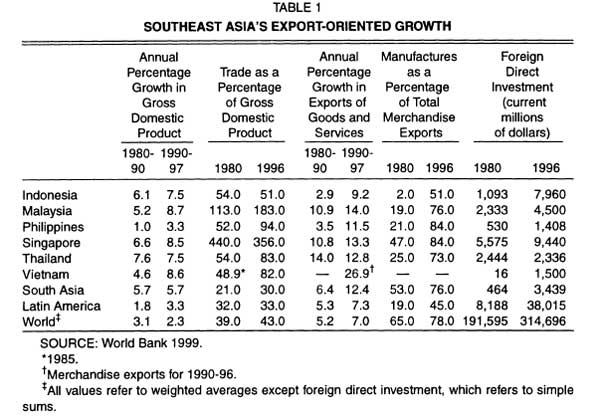
To put a sense of perspective on the globalization of Southeast Asia following decolonization, Table 1 quantifies some economic attributes that measure the region`s recent growth performance and intensifying links to the world economy.
With the exception of the Philippines the long-time "sick man of Southeast Asia" Southeast Asia`s economic growth has been exceptional, with annual rates in the 5-7 percent range for the decade 1980-90. Growth rates were even higher averaging around 7-8 percent annually during 1990-96, again with the exception of the Philippines. The Philippines has only recently begun to exhibit the rapid growth rates its counterparts in Southeast Asia have long enjoyed, averaging over 5 percent annually over the years 1994-97, as the government of President Ramos began to implement economic reforms that included deregulation, privatization, and the liberalization of the trade and foreign investment regimes.
Two factors prevented reunified war ravaged Vietnam from participating in the economic boom in Southeast Asia of recent decades: externally, the economic and political alignment with the Soviet Union, and the invasion and occupation of Cambodia in 1978; internally, the rigidity of Marxist-Leninist doctrine and state control over the economy. In late 1986, however, the sweeping events besetting the Soviet Union and Eastern Europe abroad and recurrent economic crises within the country forced drastic reversals in policy, signaled by fundamental reforms under the banner of doi moi (renovation). In the space of five years, Vietnam made a decisive break from a long history of war, central planning, and economic crises. Since then, it has registered among the region`s most impressive growth rates in output and in exports, albeit from very low bases.
Although the policies and growth patterns of the Southeast Asian countries differ significantly, one commonality among them is that their economies have been significantly more open, measured by the ratio of total exports and imports of goods and services to gross domestic product (GDP), than are the economies of their counterparts in South Asia or Latin America (World Bank 1993; Lin 1988). Not surprisingly, Singapore and Malaysia, reflecting their long histories as open, trade-oriented economies, have trade (exports plus imports) that much exceeds the size of their domestic output, but the other Southeast Asian countries also have significantly more trade-oriented regimes than their counterparts in Latin America or South Asia. The openness of the region is further underlined by the rapid growth in exports, significantly exceeding the global average, over the past two decades. (The data for Indonesia, which show a declining trade-to-GDP ratio between 1980 and 1996, and a relatively low rate of growth in exports, are misleading in that they reflect the fall in the value of oil exports.) The Southeast Asian adoption of a trade-oriented model of development, in contrast to the closed approach of Latin America, is evident in the rates of export growth achieved (World Bank 1993; Lin 1988).
The export-oriented growth experience of the Southeast Asian countries has not been a mere continuation of primary commodity export patterns that became established as a result of incorporation into the colonial order from the seventeenth century onward. Manufactured exports as a share of total exports from the region have grown rapidly over the past two decades. Southeast Asian countries have emerged as an important base for offshore production by multinational corporations. The export-oriented strategy of the key Southeast Asian countries typically began with the manufacture of low-skill, labor-intensive goods but gained momentum with the emergence of the semiconductor industry, which increasingly set up offshore assembly plants. By 1975, according to one estimate, East Asia including key export processing zones in Malaysia and Thailand employed over 90 percent of worldwide offshore electronic assembly plant workers (Radelet and Sachs 1997, 53).
Even more striking than the globalization of product markets of recent decades and the trade flows that have sustained it is the global integration of capital markets. While global trade has expanded twice as fast as world output in the second half of the 20th century, foreign direct investments have grown four times as fast. Southeast Asia has been a particularly important destination for foreign direct investment, attracting considerable sums from outside the region, which have enhanced its export performance and contributed to its long term growth potential. It is remarkable, and a testimony to the extent of the region`s openness to global flows of capital and technology, that relatively small countries such as Thailand and Malaysia and even tiny Singapore have each attracted more foreign investment than all of South Asia together. (Of course, in the converse, it is also remarkable how closed the Indian subcontinent has been to the global economy.) Over this same period, the six key countries of Southeast Asia received foreign investments that amounted to over 70 percent of the total invested by foreigners in all of Latin America and the Caribbean and to over 7 times the total invested in all of South Asia.
The globalization of Southeast Asia in its economic dimensions, then, has been robust and intensive. With the exception of Myanmar, Laos, and Cambodia, the paradigmatic strategy for the market-based Southeast Asian economies is export-oriented growth, deepening integration into the global economy by encouraging foreign direct investment. This strategy contrasts sharply with the classic (now abandoned or repudiated) Indian and Latin American developmental models espousing state ownership of industry and the "commanding heights" of the economy, together with the encouragement of import substitution behind protectionist barriers (World Bank 1993).
Yet in 1997, after three decades of sustained and rapid growth when Singapore had achieved developed country status; when Indonesia, Malaysia, and Thailand were rapidly increasing the wealth of their citizenries; and when even Vietnam and the Philippines were beginning to be labeled "high performers"-financial crisis and economic recession struck with a fury that shocked observers and participants alike. With the financial shock wave emanating from its epicenter in Thailand which floated the baht in July 1997 after a futile attempt to support the currency the contagion spread with a speed that seemed incredible. By early 1998, the Indonesian Rupiah was down more than 80 percent against the dollar, and the currencies of Thailand, Malaysia, and Philippines all fell by 30-50 percent. Within months of the baht flotation, the stock markets of all four saw losses of 60 percent or more in dollar terms. The "Asian flu," or what Paul Krugman (1999) has wryly called "bahtulism," had set in (xi).
On the eve of the crisis in 1996, when warning signs were already apparent in Thailand`s financial and real estate sectors, no one could yet imagine that Thailand or Indonesia were only months away from going, cap in hand, to the International Monetary Fund for massive financial bailouts. To be sure, some analysts, most notably Alwyn Young (1992) and Paul Krugman (1994), were already raising questions about the "economic miracle" in Southeast Asia, particularly about the degree to which this "miracle" was based on capital and labor mobilization rather than on increased factor productivity. And clearly, the region was no stranger to financial instability or recession: Indonesia and the Philippines suffered from financial shocks in 1983, Thailand in 1984, and Malaysia and Singapore saw economic downturns in 1985. However, in contrast to previous occasions, the depth of the 1997-98 downturn in currencies, equity values, and output and the simultaneity of the impact across key Southeast Asian economies set this crisis apart. Indeed, the massive losses of wealth built up in previous years and the hardships imposed on millions of people in societies that lacked institutionalized welfare safety nets constituted a water shed for Southeast Asia (Crafts 1998; Corden 1999; Mallet 1999).
Much has already been written on the Asian financial crisis. From the perspective of the globalization process in Southeast Asia, some key attributes of the crisis stand out. From the early 1990s, a rising share of global capital flows has consisted of short term portfolio funds. Today, both lending and equity markets are globally integrated, and as a result, there has been a delocalization of finance as global funds have become increasingly important as ready sources of capital and credit. The decades of rapid economic growth in Southeast Asia led to, in the words of economist Max Corden (1999), "an euphoria stage of the investment and borrowing boom" (37). Thus, while, on the supply side, large funds scoured the globe for short-run opportunities, the economic boom in Southeast Asia led, on the demand side, to a binge of corporate borrowing. Increased capital inflows fueled rapid credit expansion, lowered the quality of credit, and inflated asset prices, which encouraged further capital inflows in a frenzied boom evident in escalating property prices and increased construction in the cities and in rising equity values in the stock markets of Southeast Asia.
Contributing in a significant way to the financial crisis were the formal and informal currency pegs that discouraged both lenders and borrowers from hedging. Highly leveraged corporate sectors and large unhedged short term debt made countries such as Thailand and Indonesia highly vulnerable to changes in market sentiments. By late 1996, pressures on the baht had emerged, and they intensified through the first half of 1997. This occurred against a background of an unsustainable current account deficit (caused by a slowdown in export growth, which in turn was related to the baht`s peg to an appreciating U.S. dollar), rising short-term and unhedged foreign debt in the corporate sector, and increasingly apparent financial sector weaknesses. Weaknesses in bank and corporate governance and the lack of market discipline, with lax and poorly enforced prudential regulations, encouraged excessive risk taking. There existed close and often corrupt relationships between governments, financial institutions, and corporate borrowers, which worsened the problems. Weak accounting standards, poor disclosure practices, and lack of prudential oversight reflected such crony arrangements. The lack of appropriate commercial norms of accounting and risk assessment hid growing weaknesses until it was too late (Corden 1999; Crafts 1998).
With mounting exchange rate pressures, and ineffective interventions by Thailand`s Central Bank, the baht was floated on 2 July 1997 and promptly collapsed. With astonishing rapidity, the contagion of sharply negative market sentiments, rapid withdrawals of foreign private capital, bank runs, and drastic economic downturns spread to Indonesia (and South Korea in northeast Asia). The financial shock and its immediate aftermath led to one of the most fundamental changes to have occurred in modern Southeast Asia: the demise of President Suharto`s regime of 32 years in an Indonesia that towers over the rest of the region in geographical size and sheer weight of population (over 200 million people). Malaysia and the Philippines, less exposed to short-term foreign debt than their neighboring counterparts, were less affected but nevertheless experienced steep falls in currency and stock market values and in economic activity.
If global economic integration, domestic economic deregulation, and rapid advances in technology especially information and communication technologies are the three great pillars of modern globalization, then Southeast Asia can certainly be said to have manifested them in its postwar economic history. The postwar decades of rapid material advance led to an ever deepening integration of Southeast Asia into the global economy. Market-oriented reform, partly as a response to the requirements of the deepening integration into competitive global markets, was carried out in the Southeast Asian economies, albeit at different speeds and comprehensiveness in each of them. Economic reforms involved not only trade liberalization but other complementary steps as well: domestic economic deregulation for attracting foreign investments, and privatization of public-sector enterprises.
Globalization is leading to a push for ever greater transparency in the government and corporate sectors. Securities and corporate analysts, rating agencies, and the business media gather and provide data and analysis to track economic and business performance with ever more powerful analytic tools and ever faster channels of communication. The revolution in information and communication technologies, combined with the phenomenal growth in the global capital market since the mid-1990s, has profoundly affected-negatively in the recent financial crisis and will continue to affect the economies of Southeast Asia.
Globalization took on a virulent form in the Asian financial crisis, and it constitutes a profound challenge to the region`s governments and corporate sector. Indeed, as Lawrence Summers (1999) points out, managing international economic integration may be the preeminent challenge facing policymakers around the world. In a world of capital mobility, governmental capacity to tax capital or regulate industry has eroded. This constriction in the state`s capacity to carry out discretionary macroeconomic policy may well be perceived as a positive development in modern political economy. By requiring credible commitments to make policy and regulatory behavior of the state transparent, international capital markets-and the associated technological infrastructures in information and communications-have raised the domestic political costs of incompetence, inefficiency, corruption, and fiscal irresponsibility for governments everywhere (Friedman 1999, 83-193).
The Asian financial crisis has clearly shown that short-term capital flows were excessive and destabilizing to both borrowers and lenders alike. Thailand`s foreign corporate debts, short-term and unhedged, were a particularly risky form of global integration. Yet it would be a pity if the lessons learned from the events of 1997-98 led policymakers to impede capital flows from global markets to Southeast Asia. In this regard, Malaysia`s response to the crisis-the establishment of capital controls and the expenditure of much rhetoric regarding the "conspiracies" associated with Western capitalism-seems a dubious case in point. If anything, the recent events in Southeast Asia point to the importance of establishing robust domestic financial sectors that keep pace with rapid economic growth and integration into global capital markets.
The mainstream economics explanation of the growth experience of Southeast Asia has been based on the "Washington consensus": that is, the pursuit of economic policies based on outward orientation, macroeconomic prudence, and domestic liberalization. This means, in common parlance, first, trade a lot; second, avoid inflation and maintain sensible and stable exchange rates and interest rates; and third, promote competition and, in general, let the private sector thrive. The crisis events of Southeast Asia qualify the basic message of the Washington consensus with an important rider: that it is important to sequence liberalization of domestic capital markets to match the development of adequate regulatory and supervisory capacity of financial regulators. Are the governments in Southeast Asia equal to the challenge of establishing appropriate rules and institutions for effective systems of corporate governance, incentive compatible property rights, and transparent accounting and prudential standards in both public and private sectors? The answer to this question will largely determine the extent to which Southeast Asia emerges from its recent turmoil stronger and better able to confront the challenges of inevitable globalization in all its manifestations.
Notes
"Davos Man" refers, of course, to the global economic and business elite, who participate in the World Economic Forum, held every February at a mountain retreat in Davos, Switzerland. Orang ulu is a term used in Malaysia and Indonesia to refer to "traditional," country people.
Note that much of the data included herein is drawn from publications prepared by the World Bank, the Asian Development Bank, and similar institutions. For good recent over-views of Southeast Asia`s economic trajectory over the last 30 years, see, for example, Blomqvist 1997; Tan 1999. Older works by scholars such as Bela Balassa, Anne Krueger, and Seiji Naya are still useful as well, particularly for establishing the framework and con-text for Southeast Asia`s modern growth experience.
References
Anderson, Benedict R. O`G. 1983. Imagined Communities: Reflections on the Origins and Spread of Nationalism. London: Verso.
Arrighi, Giovanni. 1978. The Geometry of Imperialism: The Limits of Hobson`s Paradigm. Trans. Patrick Camiller. London: NLB.
Bannock, Graham, R. E. Baxter, and Evan Davis. 1998. Dictionary of Economics. New York: John Wiley.
Barber, Benjamin R. 1995. Jihad vs. Mc World. New York: Times Books. Blomqvist, Hans C. 1997. Economic Interdependence and Development in East Asia. Westport, CT: Praeger.
Braudel, Fernand. 1973. Capitalism and Material Life, 1400-1800. Trans. Mir‑ iam Kochan. New York: Harper & Row.
Castells, Manuel. 1994. European Cities, the Informational Society, and the Global Economy. New Left Review, Mar.-Apr.: 18-32.
Corden, Max. 1999. The Asian Crisis: Is There a Way Out? Singapore: Institute of Southeast Asian Studies.
Crafts, Nicholas. 1998. “East Asian Growth Before and After the Crisis.” Working paper WP/98/137, International Monetary Fund.
Frank, Andre Gunder. 1998. ReOrient: Global Economy in the Asian Age. Berkeley: University of California Press.
Friedman, Thomas L. 1999. The Lexus and the Olive Tree: Understanding Globalization. New York: Farrar, Straus & Giroux.
Greider, William. 1997. One World, Ready or Not: The Manic Logic of Global Capitalism. New York: Simon & Schuster.
Hall, D.G.E. 1955. A History of South-East Asia. New York: St. Martin`s Press.
Headrick, Daniel R. 1988. The Tentacles of Progress: Technology Transfer in the Age of Imperialism, 1850-1940. New York: Oxford University Press.
Jameson, Fredric. 1998. Preface. In The Cultures of Globalization, ed. Fredric Jameson and Masao Miyoshi. Durham, NC: Duke University Press.
Krugman, Paul. 1994. The Myth of Asia`s Miracle. Foreign Affairs 73: 62-78.
_______1998. The Accidental Theorist and Other Dispatches from the Dismal Science. New York: W. W. Norton.
_______1999. The Return of Depression Economics. New York: W. W Norton.
Levathes, Louise. 1994. When China Ruled the Seas: The Treasure Fleet of the Dragon Throne, 1405-1433. New York: Oxford University Press.
Lin, Ching-yuan. 1988. “East Asia and Latin America as Contrasting Models.” Economic Development and Cultural Change 36, suppl. (Apr.): 5153-5197.
Luttwak, Edward. 1999. Turbo-Capitalism: Winners and Losers in the Global Economy. New York: HarperCollins.
Mallet, Victor. 1999. The Trouble with Tigers: The Rise and Fall of South-East Asia. London: HarperCollins.
Marx, Karl and Frederick Engels. [1848] 1998. The Communist Manifesto: A Modern Edition. London: Verso.
Osborne, Milton. 1990. Southeast Asia: An Illustrated Introductory History. 5th ed. North Sydney, Australia: Allen & Unwin.
Radelet, Steven and Jeffrey Sachs. 1997. “Asia`s Bright Future.” Foreign Affairs 76: 44-59. Reid, Anthony. 1988-93. Southeast Asia in the Age of Commerce 1450-1680. 2 vols. New Haven, CT: Yale University Press.
Robertson, Roland. 1992. Globalization: Social Theory and Global Culture. London: Sage.
Standage, Tom. 1998. The Victorian Internet: The Remarkable Story of the Telegraph and the Nineteenth-Century`s On-Line Pioneers. New York: Walker.
Summers, Lawrence H. 1999. “Distinguished Lecture on Economics in Government: Reflections on Managing Global Integration.” Journal of Economic Perspectives 13: 13-18.
Tan, Gerald. 1999. The End of the Asian Miracle? Tracing Asia`s Economic Transformation. Singapore: Times Academic Press.
Williams, Lea E. 1976. Southeast Asia: A History. New York: Oxford University Press.
Wong, R. Bin. 1997. China Transformed: Historical Change and the Limits of European Experience. Ithaca, NY: Cornell University Press.
World Bank. 1993. The East Asian Miracle: Economic Growth and Public Policy. New York: Oxford University Press.
______1999. World Development Report 1998 /99: Knowledge for Development. New York: Oxford University Press.
Young, Alwyn. 1992. “A Tale of Two Cities: Factor Accumulation and Technical Change in Hong Kong and Singapore.” In NBER Macroeconomics Annual 1992. Cambridge: MIT Press.


 Today
Today  Yesterday
  Last week
  Last month