By : Happy Susanto, MA. dan Mahyudin Al Mudra, SH. MM.
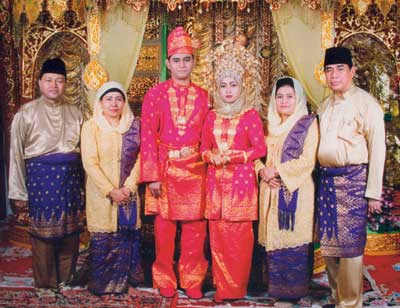
1. Malay Marriage Concept Compared to other phases of life cycles, marriage phase carries sacred meaning, holds significant values, and represents dominant influence on human‘s chapter of life. It always draws attention from different pertinent parties: colleagues of bride and groom, their families, relatives, and especially their parents. The marriage is elaborate, expensive and emotional event, which is eagerly awaited, by all the young men and women when they are treated like kings and queens of the day. It absorbs more energy and requires extra effort since the process of marriage encompasses number of various rites: plan of marriage, pre-wedding, the wedding day, and after the wedding.
Stages of marriage that should be passed before joining the couple in the sacred matrimony put the impress of complexity on the Malay marriage ceremony. Such complexity stems from the Malay philosophy commonly believed that the candidates should receive restu (approval) from their parents, neighbors, and surrounding community. Islam, in line with that, teaches the same practice. Marriage ceremonies related to social aspects, yet not included in Islamic marriage pillars, become of paramount importance. The ceremonies basically are intended to inform the community about the marriage. In Malay custom, the stages of marriage are arranged and planned thoroughly, all of which are obligatory practices to be performed by the candidates and their families. In some Malay areas, however, there are slight divergence in performing the marriage ceremonies.
According to the pure Islamic teachings, as a matter of fact, the stages of marriage are quite simple and easy. The marriage will be considered as valid and legal if all of its pillars and requirements are fulfilled. However, in several areas the Islamic teachings together with local customs are applied simultaneously. In Malay philosophy, shariah (Islamic law) is integrated with Malay customs. Such combination is reflected in a saying “Adat bersendi syarak, Syarak bersendi Kitabullah” or “ Syarak mengata, adat memakai” (Tradition founded upon Islamic law, Islamic law founded upon the Qur‘an).
The presence of families, relatives, neighbors, and community in majlis perkawinan (wedding party) is to maintain the close fraternity among them and to bless the couple so that they live happily ever after. The marriage ceremony that performed inappropriately to the local Malay custom, the simple ceremony for example, will engender gossips. The rumors of rape, cohabitation, and sexual deviation will rapidly spread amongst the community.
The marriage, according to Amran Kasimin, is more likely a capture of one‘s history. The honesty, love, and affection built in a marriage play an important rule in shaping the very meaning of Malay concept of marriage. Therefore, to receive legality and approval, the marriage ceremonies are supposed to be performed on the custom hold commonly by the community.
2. Marriage Process
A man or woman will pass along processes when (s)he would like to marry. The first process is to find an appropriate life partner for him/her. In Malay custom, the process is called merisik and meninjau (to spy and observe). The following process, after finding the partner, is merasi (to macth) by which (s)he finds out whether the partner matches with him/her or not. The processes that comes after, if (s)he feels that the partner is the one being hoped, are melamar (to propose), meminang (to ask in marriage), and bertunangan (to be betrothed). Afterwards, both candidates will conduct marriage in which the aqad (contract/covenant of marriage) between them is created.
2. 1. Merisik and Meninjau
Merisik (to spy) and Meninjau (to observe) are to find and to observe an appropriate (female) partner. It is usually done by the parents for their son especially if the son has chosen the (female) partner but with meager information on her. The main objective of merisik and meninjau is to know whether the partner is engaged with someone or not. If it is found out so, the man cannot marry her as it is forbidden, according to Islamic teaching, to propose the engaged women.
When the time for a young man to get married has come, his family will look around to identify a number of potential candidates. It is usual that parents start thinking, when their son reaches mature age, about finding and observing a (female) partner whom they recognize for him. Not only are merisik and meninjau utilized to find the partner, but also to know further about her background, characteristic and her virginity. Merisik also includes the observation on her capability on domestic chores (washing, cooking), morality, behavior, physical appearance, refinements and her understanding on Islamic knowledge.
Basically, both merisik and meninjau are a positive activity done by the parents in order to meet suitable partner for their son. In the past, they were worried if their son got married with someone whose background were unknown. Merisik and meninjau, then, were used to anticipate the wrong decision made in choosing the partner. However, nowadays the activity is forsaken and abandoned gradually. Moreover, men prefer to choose their expected partner on their own.
Merisik is conducted by men‘s family, while meninjau by both: male and female‘s family. In order, meninjau is conducted following merisik. In some cases, both are conducted simultaneously. To know the location of spouse candidate, meninjau will be conducted by the men‘s family, and usually delegated to the person who knows the spouse candidate. Meninjau will cover long time when the relatives of men don‘t know at all about the spouse candidate.
Having decided upon one particular young lady, meninjau process takes place. What should be observed? The common aspects observed during meninjau are her characteristic, behavior, and refinements, all of which, besides Islamic knowledge, were the most pivotal aspects calculated by the parents. For example, the parents will pay close attention to the way the spouse candidate presents foods for guests, languages spoken in front of people, clothes and jewelries worn and other important aspects. Besides, the background of her, such as education, economic, and lineage will be taken into consideration.
The female‘s family can also conduct merisik as a means for understanding the capability of male spouse candidate in making money, doing his job, responsibility, and commitment in building his new family.
2. 2. Merasi
Merasi is intended to match the couple candidate whether they are fitting each other. The activity of merasi is similar to that of forecasting. It is done by a shaman who can predict the future of the spouse candidate. However, nowadays, Malay people rarely conduct the merasi.
In the past, the Malay society did believe the importance of merasi as it could influence the harmony of couple‘s family. If the result of merasi shows that the couples don‘t match, their family will call out the marriage plan. It was believed that the couple who don‘t match would end in misery, poverty, divorce and misfortune.
2. 3. Melamar, Meminang, dan Bertunangan
The next step, after both feel matching, is melamar (to propose) which followed by meminang (to ask in marriage). The groom candidate‘s family is responsible for proposing the bride candidate. Melamar serves as pre-meminang process intended to ask for bride candidate‘s consent. The plan for marriage will not be decided in this step. Here, the male‘s family will only ask the answer from bride candidate whether she agrees on the proposal or not.
Melamar is carried out through sending some envoys, usually prominent figures or dignitaries of the groom candidate‘s family, to conduct a formal meeting with the bride candidate‘s family. The meeting discusses the decision that will be made by the bride candidate. Usually, the bride candidate will give the answer several days after the meeting. The interval time between groom‘s asking and bride‘s answer is to show that the bride has “value” by extending the time. In addition, such extension is also useful for bride candidate‘s family to make the decision thoroughly and observe the groom candidate background carefully.
Agreeing with the groom candidate, an envoy from the bride candidate will announce the decision to the envoy of groom candidate. In Malay custom, the groom candidate will visit the bride candidate‘s family to ask what is the decision that has been made. Afterwards, the envoys from both groom and bride candidate will conduct another meeting. The meeting will facilitate several important issues: setting the date of tunangan (asking in marriage), the amount of hantaran (gift) presented to the bride candidate, the gift items, and the number of people who accompany the groom candidate.
The terminology of meminang is derived from word pinang (betel nut), which constitutes the key equipment carried during the meminang process. The pinang is usually presented to the bride candidate together with sirih (betel leaves). The pinang, which has solid structure, symbolizes man while the sirih represents women. Both pinang and sirih are an integral plants and inseparable items. One can‘t eat the pinang without the sirih. Recently, the pinang is not the only item for the meminang process, it will be presented with other items including the sirih.
Regarding the time, there is no specific time for conducting meminang according to the Malay tradition. However, the Malays prevalently prefer Maulud month/ Rabiul Awal (third month of Islamic lunar calendar) for meminang. Evening (after maghrib) is chosen as the right time since most people are busy with their activities in the morning. The groom candidate‘s family will be welcomed by the bride candidate‘s family. The gift is put amidst the present. Before commencing the meminang procession, the representative of the candidate bride will sit in front of the head of groom‘s group. Between them, trays filled with sirih junjung is put.

Bukan uang dibilang, bukan emas-berlian dipandang, namun
ketulusan hati membalut barang antaran sebagai wujud kasih sayang.
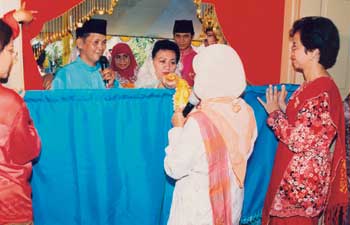
After getting acquainted, both representatives commence the procession of meminang. The bride‘s representative asks the groom‘s representative about the owner of the sirih junjung. Its counterpart will answer it by mentioning the name of the groom candidate and of bride candidate. He also states the purpose of his coming. The bride representative will take the tepak sirih (box for betel leaves) and hand it over to the groom candidate. After delivering the tepak sirih, the bride representative will state the agreement on the bride candidate‘s proposal (or not if it is rejected). The representative of groom will approach the bride candidate, then putting ring on her finger. The bride candidate usually wears glorious cloth and sits behind the curtain. This procession announces that both bride and groom officially have been engaged. Following that, the bride will shake hands of the presents, especially the ladies in bride‘s group.
3. Preparation for Nuptial Days
All family members look forward to attending the big day (wedding day) for the prospective couple. To welcome the waited day, the family members, along with their neighbors, are busy with some necessary preparations: bergotong royong (working together), reciting barzanji, and feast preparation.
To go ahead with the planned preparations, the first thing to do is building a special warehouse called bangsal penanggah. The warehouse will be a place where the ladies cook for the wedding day. The bangsal penanggah, in hinterland, is usually made of wood and its roof made of nipa palm or sago palm. Beside the bangsal penanggah, some hearths are prepared along with other cooking utensils.
3. 1. Gotong Royong (working together)
Before the wedding day come, the gotong royong or rewang is carried out by the surrounding neighbors of wedding host. In return, the host will provide some Malay foods and cakes for those who help him in preparing for the wedding day. Besides that, the host will deliver some cooks for people supporting the wedding financially. The gotong royong is usually done until the midnight.
Job description between men and women is the first thing to do in the gotong-royong. In the morning, women typically prepare kitchen utensils such as colander, ladle, skimmer, spatula, and bowl, while the men bring them outside the house, and put them in order. Fowls such as (rooster) or farm animals (goats and cow) are slaughtered typically at the midnight for their meal. Before giving it to the chef, some men will clean the meal and cut it into pieces. Along with other ingredients, the chef will cook the meal for the wedding day dish.
3. 2. Barzanji Recitatation and Feast
After Isha (night time praying) is the usual timing for the Barzanji (poems to celebrate the birthday of the prophet Mohammed) recitation. Such ritual which recently becomes less popular is attended by those who did the gotong-royong in the host‘s house. The family of prospective couple and the invited guests take part in the ritual as well. Dishes and foods put on the trays are provided during the Barzanji recitation. Each tray is usually prepared for 4 to 5 people.
Feast provided for the Barzanji depends on the family host‘s situation and financial capability. A father having one single daughter or having one daughter not yet married, is given to lavish spending, even it is out of his prosperity. Even some fathers, to pay the party, borrow sum of money from his neighbors.
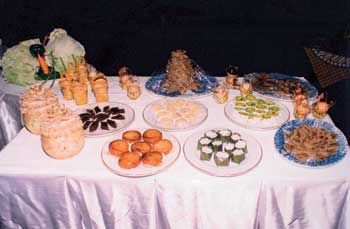
Dalam acara gotong royong selalu tersedia juadah khas Melayu,
seperti, khasyidah, pelita daun, bolu kembojo, wajit dan nasi
kunyit, serta rendang atau panggang ayam.
To set up the party for dishes, a committee, including its leader, will be appointed. The leader will intensely communicate with the host in order to organize the party. One of his tasks is to prepare the ingredients, fillings, and seasonings. He should also coordinate with the committee members to describe specific jobs for them: some will be responsible for welcoming the invited guests, some for arranging the seats, some for providing water, and some for washing the plates and glasses. In the kitchen, some other people are appointed to cook the ingredients, while other to pack foods to be brought by the guests. Those jobs are done voluntarily for the common custom amongst the Malays which is the gotong-royong (working together).
4. Wedding Ceremony
After passing the long process of rituals and customs, the prospective couple will jump to the next step that is wedding ceremony. This main ceremony is commonly known as “upacara nikah kawin”, “upacara helat jamu pernikahan” or “ upacara perhelatan nikah kawin”. For the family, relatives, neighbor, and especially the prospective couple, this nuptial ceremony is eagerly awaited. In Malay tradition, the wedding ceremony is elaborate, and all rituals within should be completely performed to a turn.
4. 1. Menggantung-Gantung Ceremony
The menggantung-gantung (to decorate something by hanging art objects) is a ritual in which the host adorns the house or the avenue of the wedding, and sets the nuptial tools and devices. Besides, the host needs to build tent, to establish the decorated gate for welcoming the turnout of the guests, set the marriage altar/stage, and to embellish the bedroom with art objects. The financial capability of the host determines the types of decoration. This ceremony usually takes long time: about 3 days prior to the wedding day. The host will decorate the venue with the auspices of the neighbors, indicating the strong tradition of Malay that is the gotong-royong.
The menggantung-gantung ceremony is performed duly as suggested by Malay tradition. Given that the objects hanged has specific significance, the process should be discussed amongst the tribe leaders/Malay leaders. It is so to avoid misplacing the decoration and objects. Malay saying states below:
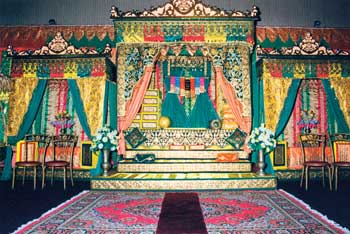
Pengantin ibarat raja dan ratu sehari, maka untuk keduanya
disiapkan pelaminan yang megah bak singgasana.
Adat orang berhelat jamuMenggantung-gantung lebih dahuluMenggantung mana yang patutMemasang mana yang layak
Sesuai menurut alur patutnya
Sesuai menurut adat lembaga
Supaya helat memakai adat
Supaya kerja tak sia-sia
Supaya tidak tersalah pasang
Supaya tidak tersalah pakai
4. 2. Berinai Tradition
The berinai is a Malay ritual influenced largely by Hindu custom. This ritual is actually performed to keep the prospective couple away from misfortune, to clean them from bad influences, and to protect them from malicious spirit. The core activity of a such tradition is to beautify the bride and bring her out gorgeous and radiant look for the wedding. The tradition symbolizes the couple‘s preparation to start living together and building a family. It is said in an expression:
Malam berinai disebut orang
Membuang sial muka belakang
Memagar diri dari jembalang
Supaya hajat tidak terhalang
Supaya niat tidak tergalang
Supaya sejuk mata memandang
Muka bagai bulan mengambang
Serinya naik tuah pun datang

Berinai bukan sekadar memerahkan kuku, namun memper-
siapkan pengantin agar dapat menjalani pernikahan
tanpa aral halangan.
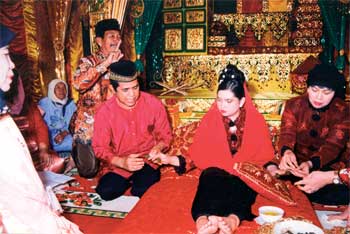
Usually, the tradition is held at night, 3 days before the main day/wedding day. One of the ritual done for the tradition is to paint bride‘s feet and hands with paste. In doing so, the bride will be assisted by Mak Andam and her close relatives.
The berinai also applies for the prospective groom, and be conducted simultaneously (bride and groom). Yet, technically, it is conducted in separate places: groom‘s and bride‘s feet are painted in their places. In some cases, Malay tradition prefers the groom before the bride.
Seri kecantikan diperoleh melalui kesabaran. Pengantin harus
berdiam diri sabar menanti, agar inai yang dipasang di jemari
tangan dan kaki menghasilkan warna cerah yang berseri.
4. 3. Berandam Ritual
Conducted at the early evening after Ashar (evening time praying), the berandam ritual is officiated by Mak Andam. While doing so, she was accompanied by the bride‘s relatives, companions and family. The ritual takes place in both bride‘s house and groom‘s respectively. Before wards, the prospective couples are suggested to take bath by using scanted water.
The significance of the ritual is the removal of physical discomfiture from the prospective couples. Besides, it is meant to offer mental and spiritual comfort as well. Symbolical meaning within the ritual is of importance for it constitutes symbol of self-chastity to cross through the new phase of life. The coming days after the wedding will be decisive for both. It has been said in Malay saying:
Adat Berandam disebut orang
Membuang segala yang kotor
Membuang segala yang buruk
Membuang segala sial
Membuang segala pemali
Membuang segala pembenci
Supaya seri naik ke muka
Supaya tuah naik ke kepala
Supaya suci lahir batinnya

Kecantikan budi mestilah yang utama, namun keelokan paras
tiada boleh terlupa. Untuk itulah, Mak Andam merias calon
pengantin agar kemolekan makin ternampak nyata.
The main activity of the berandam is to cut bride‘s hair since it is the most noticeable part of human and source of women beauty. Other rituals that are part of berandam are cutting vellus hair around the face, neck, and nape, and cleaning the forehead by sirih pinang (betel leaves) and jampi serapah.
Mandi Tolak Bala in which the prospective couple are poured with scented water of flower (usually 5, 7, or 9 types of flower) will come soon after the berandam. One thing should be noticed in this ritual is the timing of mandi tolak bala which is before the coming of Maghrib prayer. Amongst Malays, such practice is also known as mandi bunga. The significance behind the ritual is the completeness of human chastity and keeping the prospective couple from misfortune and bad spirit. Malay saying states below:

Mandi Bunga atau Mandi Tolak Bala bukan sekadar untuk meng-
harumkan raga, namun agar jiwa bersih suci, jauh dari iri dengki.
Hakekat mandi tolak bala
Menolak segala bala
Menolak segala petaka
Menolak segala celaka
Menolak segala yang berbisa
Supaya menjauh dendam kesumat
Supaya menjauh segala yang jahat
Supaya menjauh kutuk dan laknat
Supaya setan tidak mendekat
Supaya iblis tidak melekat
Supaya terkabul pinta dan niat
Supaya selamat dunia akhirat
4. 4. Khatam Qur‘an Ritual
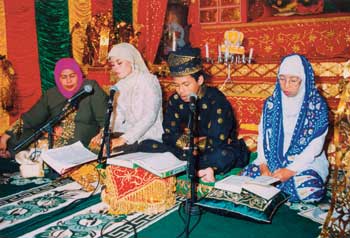
As part of the Malay wedding continuum, khatam Quran (completion of Qur‘an reciting) ritual is highly recommended. It constitutes the physical and physiological self-perfection to the prospective couple. It is meant to demonstrate bride‘s ability of reciting the Qur‘an. It also indicates the parents‘ responsibility in teaching their daughter the Islamic knowledge and skill as well. Accordingly, the prospective bride is thought to be capable of being a wife for the groom and mother of their children as well. The skill on reciting the Qur‘an also demonstrates the family conviction on Islamic values and thoughts. It has been said in Malay saying:
Pendidikan boleh tiada tamat, ijazah boleh tiada dapat, tetapi
khatam Al Qur‘an tiada boleh terlewat.
Dari kecil cincilak padi
Sudah besar cincilak Padang
Dari kecil duduk mengaji
Sudah besar tegakkan sembahyang
The ritual is commonly officiated by bride‘s religious teacher or other noble people appointed by the bride‘s parent. In the ritual which is specifically for the bride, the teacher will allot the bride time to recite some surah of Qur‘an (from Dluha to al-Fatiha and some other verses). It is ended by reading the praying of khatam al-Qur‘an. It is conducted usually on the mat before the wedding stage.
4. 5. Wedding Ceremony
The wedding ceremony has several steps, all of which is conducted in order. Not only it consists of akad nikah (covenant of marriage), but also of other activities with reference to both before the akad nikah procession and after. Typically, the ceremony is begun with the turnout of groom accompanied by the family representatives to the bride‘s house. Two bachelors called gading-gading walking beside the groom who bring antar belanja (equipment usually consists of clothing, personal adornment and articles) for the bride.
4. 5. a. Antar Belanja or Seserahan Ceremony
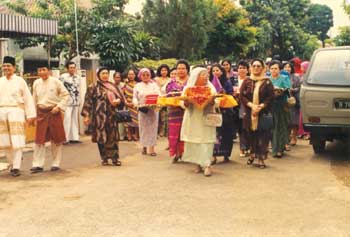
Antar belanja or what commonly known as seserahan is conducted in two ways: either it is conducted couple of days before the covenant of marriage is declared or become a part of covenant continuum. In the last way, the seserahan is given to the bride just before the covenant.
Beramai-ramai, beriring-iringan, kerabat calon pengantin
laki-laki membawa antara belanja kepada calon pengantin wanita.
The core concept of such ceremony is to implement the Malay proverbs such as “rasa senasib sepenanggungan”, “rasa seaib dan semalu”, and “yang berat sama dipikul yang ringan sama dijinjing”, all of which confirm the importance of brotherhood, unity, goodwill and family atmosphere built between bride‘s family and groom‘s. Therefore, the amount of seserahan or antar belanja is supposed to not be the center of problem between the two families. Malay saying teaches below:
Adat Melayu sejak dahulu
Antar belanja menebus malu
Tanda senasib seaib semalu
Berat dan ringan bantu-membantu.
4. 5. b. Covenant of Marriage
The covenant of marriage is of the utmost importance in the Malay wedding as being outlined by Islamic teaching in the holy Quran. Ijab (legal proposal) and Qabul (legal consent) are the necessary part of the covenant as said in Malay saying:
Seutama-utama upacara pernikahan
Ialah ijab kabulnya
Di situlah ijab disampaikan
Si situlah kabul dilahirkan
Di situlah syarak ditegakkan
Di situlah adat didirikan
Di situlah janji dibuhul
Di situlah simpai diikat
Di situlah simpul dimatikan
Tanda sah bersuami isteri
Tanda halal hidup serumah
Tanda bersatu tali darah
Tanda terwujud sunnah Nabi

Dengan terucapnya ijab dan kabul, tanggung jawab ayah atas
anak gadisnya beralih sudah kepada menantu laki-laki.
This holy ceremony is officiated by a judge or other responsible officers such as registrar. They will give official guide to the groom during the procession. After being considered syah (legal) as a husband by the witnesses, he will be blessed on walimatul urusy praying which leaded by the judge. Then, the husband says taklik (marriage vows), followed by the signing of marriage certificate. The delivery of mahar (bride price) to the bride will come after.
Covenant of marriage ceremony klick here : 4. 5. c. Menyembah Ceremony
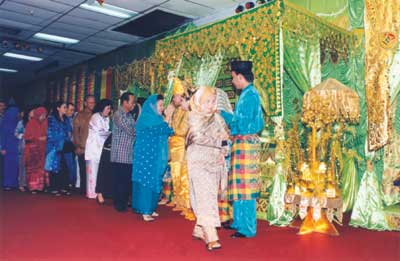
After the whole procession of akad nikah is completed, the couples are united. Then, they will conduct menyembah ceremony (paying homage) to their parents and close relatives. The core meaning of the ceremony is to receive blessing from their parents. Mak Andam usually takes the lead of this procession.
Sembah sujud kepada orang tua tiada boleh lupa, agar tuah
dan berkah turun berlipat ganda.
4. 5. d. Tepuk Tepung Tawar Ceremony
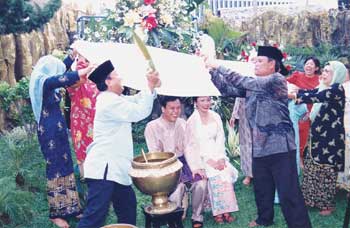
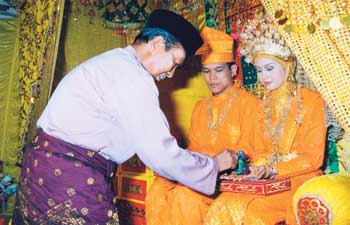
The tepuk tepung tawar ceremony will come after the menyembah ceremony. The Tepuk Tepung Tawar is meant to prevent the couple from bad fortune. In other words, the ceremony is a praying and hope of the couple to invite good things in their life. The ceremony which is ended by reciting the praying is conducted merely among relatives, adat leaders, and religious leaders.
 Tepuk Tepung Tawar hakikatnya adalah pertanda, bahwa
para tetua melimpahkan restu dan doa, bahwa marwah
pengantin kekal terjaga.
It has been said in Malay expression that tepuk tepung tawar is “menawar segala yang berbisa”, “menolak segala yang menganiaya”, “menepis segala yang berbahaya”. A advice pantun said: “Di dalam Tepuk Tepung Tawar, terkandung segala restu, terhimpun segala doa, terpateri segala harap, tertuang segala kasih sayang”. Another pantun said that “Tepung Tawar untuk Penawar, Supaya hidup tidak bertengkar, wabah penyakit tidak menular, Semua urusan berjalan lancar”.
The ceremony will be commenced by spreading tepung tawar (rice flour) under palm of the couple, smearing inai (henna or red nail polish usually used as part of adorning the bride) to their hands, sprinkling beras kunyit in flowers that will be given to the couple. The end of this ceremony marks the end of the core wedding ceremony. Other ceremonies after the marriage such as religious advices, feast party will be held soon after the tepuk tepung tawar.
Tepuk tepung tawar ceremony klick here :
4. 5. e. Marriage Advice Ceremony
Like other ceremonies, after the covenant of marriage is proclaimed, the advice ceremony is held. The core point in the ceremony is to deliver some advises, moral messages, and admonition for the couple to give them guidance on building harmonious, peace, and prosperous family. In this phase, the important leaders or dignitaries will deliver the speech. They have implemented and built harmonious family and became a paragon in the community.
Dalam menempuh hidup baru, cinta kasih mestilah ada, harta kelak boleh
dicari bersama, namun petuah dan ilmu dari tetua rengkuhlah dahulu.
The advice ceremony marks the end of the marriage process. Below the words that are usually delivered to close the marriage process :
4. 5. f. Jamuan Santap Bersama
The complete ceremony of akad nikah (covenant of marriage) will be ended by Jamuan santap bersama (feast/eating together). Many marriage tradition other than Malay have similarities in such custom in which the host provides foods and dishes to the presents, and the invited guests
4. 6. Upacara Langsung
Hari Langsung ceremony will be held after the akad nikah (covenant of marriage) ritual. Such ceremony consists of several activities, that are accompanying the groom in the procession, welcoming him, conducting bersanding ceremony, wedding party, alu-aluan and tahniah, praying ritual, santap nasi hadap-hadapan, and tahniah expression to the presents coming the wedding ceremony.
4. 6. a. Mengarak Pengantin Lelaki Ceremony
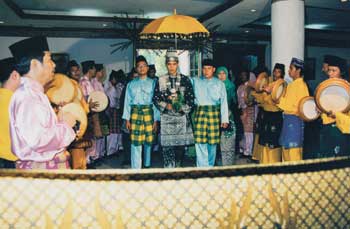
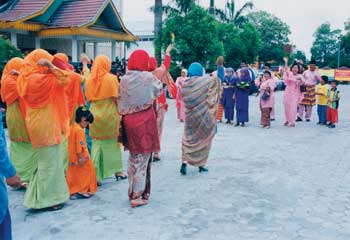
The main activity of such ceremony is to accompany the groom to walking to the house of bride. The ceremony has twofold meanings: It is intended to announce the legality of the newly-wed couple amongst the community. Besides, it constitutes the invitation to the community for praying them. The form of ceremony varies in different Malay regions.
Bernaung payung iram, diiringi rentak rebana dan gendang,
pengantin laki-laki datang kepada dewi pujaan.
During the procession, there are various goods carried by the groom. One of the famous things is jambar, most well known as semerit, poha, or dulang berkaki amongst Riau society. There are three types of goods within the jambar: first, clothing and personal adornment, foods, and utensils. The three carry the value of human‘s daily life. Regarding the amount of jambar, it varies, depending on the local custom of the regions where the ceremony is conducted. However, the value needs to be based on Islamic values, to name the few, 13 indicates the amount of praying rukun (pillars), 17 indicates the amount of rakaat (unit of Islamic prayer), and 25 signifies the amount of Rasul (the chosen messengers).
4. 6. b. Hailing the Groom
Upon the arrival to the house of bride, along with his representatives, the groom are accepted by the host. In Malay custom, such ceremony has deep meaning. Thus, the bride is welcomed heartedly
 Upacara pencak silat merupakan perlambang kepiawaian
pengantin laki-laki menghadapi tantangan.
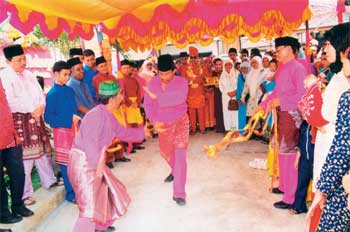
There are three kinds of welcoming ceremony: pencak silat (martial arts), bertukar tepak induk (exchanging the main box), and berbalas pantun pembuka pintu (arguing with pantun). Each has different significances. In the first kind, for example, the groom is challenged to have maturity and bravery. Besides, it also indicates the value of friendship, and affection within the heroistic character. Afterwards, the ceremony of perang beras kunyit (turmeric fight) between the groom and the bride will be held.
Perang Beras Kunyit antar kedua pihak pengantin, bukan mengo-
barkan permusuhan, melainkan menyuburkan persaudaraan.
The turmeric fight will be continued by the bertukar tepak induk. Why it should be exchanged? This is so since the tepak represents the caring, sincerity, honesty, and friendship. Thus, giving it to his partner means the expression of the mentioned values. Within the tepak, there are betel leaves, gambier, areca nut, and tobacco. Each tepak will be offered to other when the groom entering the bride‘s house. In some communities, the ceremony is held outside home which is house yard.
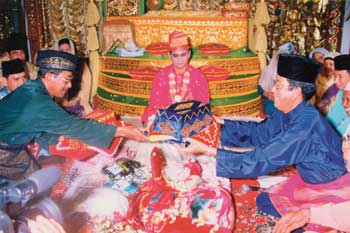 Bertukar Tepak melambangkan ketulusan hati dan bersebatinya
dua keluarga menjadi satu.
The last part is berbalas pantun pembuka pintu (arguing with pantun to open the door of the bride‘s house). As reflected in the name, the pantun is uttered next to the door of main house. Each representative from both sides utter some pantun to the other. It is usually witnessed by Mak Andam. The value within such ceremony is the asking for permission before entering the house. Mak andam will unveil the cover the curtain of the door and welcome them, thus, the procession ends.
Berbalas pantun Pembuka Pintu menunjukkan adab sopan santun
pengantin laki-laki memasuki kehidupan pengantin perempuan.
4. 6. c. Bersanding Ceremony
Bersanding (sitting on the wedding stage) ceremony is the peak of the wedding party. After the declaration of the covenant of marriage, the groom will back to his house for couple of hours to take some rest, so will the bride. Then, they will have bersanding ceremony in which the couples are met. In such ceremony, carrying arranged and adorned flowers, the bride‘s representative meet its counterpart. The flowers signify the bride‘s willingness to welcome her new husband in the wedding stage. Afterwards, some men will pick the groom up to the venue of the party.
The bersanding ceremony is to put the couple on the wedding stage where the family, relatives, guests and other people can see them together as the newly-wed couple. The core aim of such ceremony is to announce the couple‘s new status of marriage to the community. Like in the previous ritual of akad nikah, the bersanding ceremony is also interspersed with tepak tepung tawar. It is meant to inform some people who have not attended the akad nikah ritual. It has been said in Malay saying:

Tiada saat seindah ketika bersanding di pelaminan, bertabur
senyum, salam, dan sejahtera.
Apabila pengantin duduk bersanding
Sampailah niat usailah runding
Tanda pasangan sudah sebanding
Hilanglah batas habis pendinding
In a Malay saying, it is said that:
Pengantin bersanding bagaikan raja
Disaksikan oleh tua dan muda
Tanda bersatu kedua keluarga
Pahit dan manis sama dirasa
4. 6. d. Wedding Party
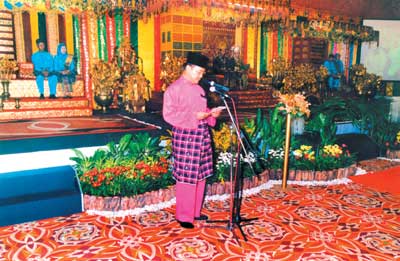
The wedding party is conducted after the bersanding ceremony held. Such party is attended by community in general. It is commenced by the coming of couple through the gate to the place where the party will be held. Sounds of kopang (Malay musical instrument) will hail the coming of the couple, accompanying them till they seat on the wedding stage/altar. Typically, such party is opened by the ritual of reciting some verses of holy Qur‘an
Below are the examples of opening remarks for the wedding party :
4. 6. e. Alu-aluan dan Tahniah Expression
This ritual is meant to express the couple‘s and family‘s gratitude to Almighty God. And also it is directed to the neighbors involving in the whole process of the marriage. In Malay saying, it has been said:
Tanda orang memegang agama
Tahu mensyukuri nikmat Allah
Tahu membalas budi manusia
Another Malay saying utters:
Tanda orang memegang adat
Tahu mengenang budi kaum kerabat
Tahu mengingat jasa sahabat
Tahu membalas kebaikan umat
Tahniah expression is the words delivered by a representative of presents to the couple and their families. It is typically accompanied by recitation of praying. Such praying is meant to generate positive thinking toward the couple‘s future, as been said in one of Malay sayings:
Adat masuk ke helat jamu
Menyampaikan doa memberi restu
Di mana kurang bantu-membantu
Memberi maaf ianya mau
Hilang sengketa habislah seteru
The wedding advises of appointed representatives is delivered during the span of time between alun-alunan and tahniah.
Alun-alunan ceremony klick here :
4. 6. f. Sending Up Prayer
Prayer recitation is a common ritual of most wedding ceremonies, especially amongst Malay society. The prayer either short or long is sent to the God for blessing the couple and the presents. It is meant to give them rahmat (affection), karunia (reward) and safety. In Malay saying, it is said that:

Walau tinggi derajat dan pangkat pengantin, walau lanjut
pendidikan, pernikahan adalah hidup baru, maka petuah
dan doa tetua amatlah perlu.
Elok kerja karena bersama
Elok helat karena sepakat
Elok manusia karena berdoa
Kalau berdoa dengan sungguh
Sengketa usai celaka menjauh
Hati panas menjadi teduh
Rahmat melimpah rezeki pun penuh
Introduction to the prayer klick here : 4. 6. g. Santap Nasi Hadap-hadapan Processsion
The procession in which both male‘s and female‘s family eat together is conducted in front of dais on which the bridal couple sits. The moral message of the procession is the harmony between families, brothers, and friends of the bridal couple.

Makan Nasi Hadap-hadapan mencerminkan kerukunan pasangan
suami istri dengan sanak keluarga, sahabat handai, serta saudara mara.
4. 6. h. Tahniah Expression
The couple will receive Tahniah from the presents. It is conducted as the closing remark of hari langsung ceremony. As mentioned above, the tahniah is conducted twice. The previous tahniah was directed to the family while the last is to the couple. Usually, the tahniah is expressed through shaking hands of the couple.
Tahniah, selamat, dan tuah dilimpahkan kepada sepasang pengantin
oleh segenap jemputan.
5. Post-Wedding Ceremony
After the core wedding ceremony, several other ceremonies will be conducted as part of the complete Malay wedding tradition. In the article, the ceremony of malam keluarga (family night), and mandi damai will be discussed below.
5. 1. Malam Keluarga (Family Night)
In the family night, the couple will visit the house of male‘s family to pay respect (menyembah/menghormati) for them. Before wards, both families introduced themselves. In this regard, not only has the male‘s family been respected, but also the important person in the family. The procession is conducted after all core wedding ceremony is completed. A Malay expression states:
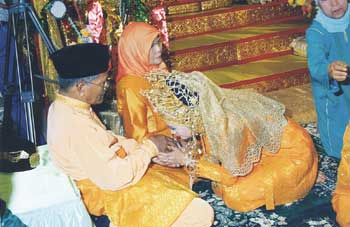 Mertua sama jua orang tua, maka sembah sujud pun diunjukkan pula.
Adat menyembah ke orang tua
Tanda hidup beradat lembaga
Tanda menjunjung tuah dan marwah
Tanda memuliakan yang tua-tua
Tanda menyatu dalam keluarga
Tanda berkekalan kasih sayangnya
5. 2. Mandi Damai Procession
The mandi damai or mandi hias (taking bath, using flower-scented water), which is the first thing to do in this procession, is intended to announce to the surrounding community that the couple has been legally bounded according to sharia. The family, in this procession, expresses their heartfelt thanks to those who have contributed in making the marriage ceremony successful. It is stated in a Malay expression:
Bila pengantin dah mandi damai
Habislah bimbang ragu pun usai
Niat terkabul pinta pun sampai
Dunia akhirat rukun dan damai
The couple will be poured by the flower-scented water and tolak bala (prayer to prevent someone from bad fortune). Through the mandi damai, the couple expresses their wants to sanctify their intention, to get better life and exhilaration, and to escape from misfortune, envious, etc. In the procession, the couple also step their feet onto rice (usually hulled rice). This occasion symbolizes their depth hope to live harmoniously, peacefully, and to get good descents. Afterwards, both should walk onto bracelet and ring as the symbol of patience when they face obstacles and dangers.
Jika dua hati telah bersebati, ijab-kabul telah pula dilalui,
maka tiada lagi penghalang memadu hati.
Suruk-surukan ceremony will come after the mandi damai. In the ceremony, the bride is pulled in (disuruk) to hide among women‘s group, whereas the groom is asked to search for his bride.
As the grateful sign to God Almighty, the mandi damai procession will be closed with preparing foods and meals provided for the presents. The procession marks the completion of Malay marriage ceremony.
6. Closing remark
Generally, the Malay marriage custom is the combination of the aforementioned stages, beginning from the marriage process stage (merisik, meninjau, merasi, melamar, meminang, and bertunangan) the preparation (gotong-royong, barzanji, and jamuan), and the wedding day (menggantung-gantung, berinai, berandam, khatam Qur‘an, perkawinan, and upacara langsung), until post-wedding stage (malam keluarga, and mandi damai). The stages should be passed in order. However, there are some slight differences of terminologies, names, and dialects for the stages found in other regions including in Malay geo-culture. Some regions own their unique ways performed during the marriage stages. The variants of stages and ceremonies or rituals will be discussed in separate articles. Wallahu A‘lam.
(HQ/ter/84/12-07)
Ungkapan Lengkap dalam Perkawinan Melayu (contoh):
Ungkapan pada Upacara Akad Nikah (contoh) : Assalamu‘alaikum Warahmatullahi Wabarakatuh,
Alhamdulillahi robbil ‘alamin,
Wal akibatu lil muttaqin
wash sholatu wassalamu ‘alaa asyrofil ambiya-i
wal mursalin, sayyidinaa Muhammadin
wa ‘alaa aalihii wa ash haa bihii rasulillahi ajma‘in;
Bapak-bapak/Ibu-ibu/Tuan-tuan dan Puan-puan
Jemputan majelis yang mulia
Yang kecil tak disebut nama
Yang besar tak dihimbau gelar
Yang bertuah dengan marwahnya
Yang berhormat dengan berkatnya
Yang alim dengan amanahnya
Yang tua dengan petuahnya
Yang muda dengan takahnya
Yang Datuk dengan kuasanya
Ninik-mamak dengan adat pusakanya
Yang bijak dengan arifnya
Yang cerdik dengan pandainya
Yang datang dari hulu dan hilir
Yang jauh tundan bertundan
Yang dekat sogo bergesa
Yang terlingkup alam nan empat
Yang tersungkup oleh adat
Yang ternaung oleh lembaga
Yang terlindung oleh ico dan pakaian
Pertama-tama perkenankanlah saya
menyampaikan ucapan tahniah
serta setinggi-tinggi terima kasih
dari keluarga besar Bapak DR. NAWAR DJAZULI
Atas perkenan Bapak-bapak/Ibu-ibu/Tuan-tuan
dan Puan-puan
Yang telah datang meringankan langkah
Memenuhi jemputan majelis ini
Kedatangan Bapak-bapak/Ibu-ibu/Tuan-tuan dan Puan-puan
Kami terima dengan muka yang jernih
Kami sambut dengan hati yang suci
Kami tunggu dengan dada yang lapang
Namun,
Bila di dalam menyambut kedatangan
Pihak calon Pengantin Pria
Dan keluarga besar Bapak DR. H. AHMAD NAJIB
Serta Bapak-bapak/Ibu-ibu/Tuan-tuan dan Puan-puan
Entah terdapat salah dan silih
Entah tersalah adat dengan adab
Entah tersalah tegak dan letak
Yang patut tidak dipatutkan
Yang tua lupa didahulukan
Yang alim lupa dimuliakan
Yang adat lupa diadatkan
Yang dahulu terkemudiankan
Lupa didahulukan selangkah
Lupa ditinggikan seranting
Maka dari itu
Dari jauh kami menjunjung duli
Kepada yang dekat diangkat sembah
Memohon maaf beserta ampun
Atas segala kesalahan dan kealpaan
Maklumlah
Seperti dibidalkan orang tua-tua
Tak ada tebu yang tak beruas
Tak ada kayu yang tak berbongkal
Tak ada sungai yang tak bersampah
Tak ada gading yang tak retak
Tak ada manusia yang tak mengandung khilaf
Bapak-bapak/Ibu-ibu/Tuan-tuan dan Puan-puan
Jemputan Majelis yang mulia
Kini berbalik kita ke pangkal kaji
Karena yang ditunggu sudah datang
Karena yang dinanti sudah tiba
Cukup lengkap dengan adatnya
Serta sepadan dengan lembaga
Sebagaimana sama-sama kita ketahui
Bahwa sebulan yang lalu
Antara kedua belah pihak
Sudah membuat kata putus
Seperti kata orang tua-tua
Kok tali sudah disimpul
Kok takuk sudah ditanggam
Kok simpai sudah dibaji
Sudah tersusun bagai daun
Sudah berdiri bagai tiang
Di sana tuah orang berunding
Di sana hikmah orang mufakat
Maka atas kesepakatan kedua belah pihak tersebut
Sekarang akan dilaksanakan Akad Nikah
antara
AWAN LAZUARDI, ST. MT. BIN DR. H. AHMAD NAJIB
dengan
INTAN BAIDURI PERMATASARI, SE. MM. BINTI DR. H. NAWAR DJAZULI
Yang akan dipimpin langsung oleh
Kepala KUA Kecamatan .........
Untuk itu marilah kita awali
Dengan pembacaan ayat-ayat Suci Al-Quran
Yang dibacakan oleh Qoriah Putri Aisyah
------Pembacaan Ayat-ayat Suci Al-Quran-----
-----Akad Nikah-----
-----Serah Terima Mahar-----
Bapak-bapak/Ibu-ibu/Tuan-tuan dan Puan-puan
Jemputan Majelis yang mulia
Orang tua-tua meninggalkan pesan
Minta petuah kepada yang alim
Minta akal kepada yang adil
Karena,
Orang berdaulat memberi tuah
Orang alim mengungkung syarak
Yang adat mengungkung hidup
Yang lembaga mengungkung raga
Orang cerdik penyambung lidah
Yang berani pelapis dada
Yang tua punca amanah
Untuk itu marilah sama-sama
Kita ikuti upacara menyembah
Back to Convenant of Marriage Ceremony
Ungkapan pada Upacara Tepuk Tepung Tawar (contoh) :
Bapak-bapak/Ibu-ibu/Tuan-tuan dan Puan-puan
Jemputan Majelis yang mulia,
Banyak batang perkara batang
Banyak putat dahannya pandak
Banyak hutang perkara hutang
Hutang adat dengan syarak
Hutang syarak sudah selesai
Sudah berlangsung akad dan nikah
Sudah berjawab ijab dan kabul
Sudah diturut sunnah nabi
Semua yang tersurat di kitabullah
Kini tinggal utang adat
Adat disarung tidak berjahit
Adat kelindan tidak bersimpul
Adat berjarum tidak berbenang
Adat yang tumbuh tidak bertanam
Yang kembang tidak berkuntum
Yang bertunas tidak berpucuk
Adat yang datang kemudian
Yang terbawa burung lalu
Tapi,
Hutang tak boleh dianjak-anjak
Hutang tak boleh dialih-alih
Bila dianjak dia layu
Bila dialih dia mati
Maka bagi kebahagiaan kedua Pengantin
Kita segera melaksanakan upacara
Tepuk Tepung Tawar
Orang berlayar ke pulau Rupat
Membawa kundur berkati-kati
Tepung tawar memberi berkat
Do‘a dan syukur kepada Illahi
Bagi memulakan upacara ini kami persilahkan untuk menepungtawari:
- Bapak DR. H. NAWAR DJAZULI , ayah dari Ananda INTAN
- Bapak DR. H. AHMAD NAJIB, ayah dari Ananda AWAN
- Ibu HJ. LAYLA MUNAWARAH, ibu dari Ananda INTAN
- Ibu HJ. ZAENAB MAHMADAH ibu dari Ananda AWAN
- Nenek dari INTAN – pihak ayah
- Nenek dari INTAN – pihak ibu
- Nenek dari INTAN – pihak ayah
- Nakek dari INTAN – pihak ayah
- Nenek dariINTAN – pihak ayah
- Kakek dari AWAN – pihak ibu
- Nenek dari AWAN – pihak ibu
- Wakil dari keluarga ....
- Wakil dari keluarga .....
- Wakil dari keluarga besar ......
- Sebagai penutup kami persilahkan Bapak H. Taufik sekaligus dilanjutkan dengan memimpin pembacaan do‘a selamat.
Tepung tawar sudah direnjis
Sudah dibilas pula dengan do‘a
Semoga berkekalan persaudaraan dua keluarga
Bapak-bapak/Ibu-ibu/Tuan-tuan dan Puan-puan
Jemputan Majelis yang mulia,
Orang tua-tua meninggalkan pesan
Minta petuah kepada yang alim
Minta akal kepada yang adil
Minta nasehat kepada yang berpengalaman
Yang banyak memakan asam dan garam
Yang sudah menempuh onak dan duri
Yang sudah diterpa gelombang laut kehidupan
Maka untuk memberikan nasehat ini
Kami persilahkan kepada Bapak K.H. Syamsuni.
Back to Tepuk Tepung Tawar Ceremony
Ungkapan pada kalimat penutup Upacara Nasehat Perkawinan (contoh):
Bapak-bapak/Ibu-ibu/Tuan-tuan dan Puan-puan
Jemputan Majelis yang mulia,
Ibarat berjalan sudah sampai ke batas
Umpama berkayuh sampai ke pulau
Bila unut sampai ke bakal
Umpama sungai sampai ke guguk
Ibarat memanjat sampai ke puncak
Ke atas tercium harum langit
Ke bawah tampak kerak bumi
Yang ruas sampai ke buku
Ibarat kaji sudah berkhatam
Dengan demikian selesai sudah upacara ini
Perkenankanlah saya menyampaikan ucapan
Terima kasih atas kesabaran hadirin
Mengikuti senarai acara majelis ini
Dan sekaligus memohon ma‘af dan ampun
Entah kami tersalah tingkah
Entah kami tersalah kata
Entah kami tersalah langkah
Selama kami memandu acara ini
Sekali lagi mohon diberi maaf
Wabillahi taufiq wal hidayah
Wassalamualaikum Warahmatullahi Wabarakatuh
Back to Marriage Advice Ceremony.
Ungkapan pada pembukaan Resepsi Perkawinan (contoh) : Assalamualaikum Warahmatullahi Wabarakatuh,
Alhamdulillahi rabbil ‘alamin,
Wal akibatu lil muttaqin
wash sholatu wassalamu ‘alaa asyrofil ambiya-i
wal mursalin, sayyidinaa Muhammadin
wa ‘alaa aalihii wa ash haa bihii rasulillahi ajma‘in;
Bapak-bapak/Ibu-ibu/Tuan-tuan dan Puan-puan Jemputan majelis yang mulia
Marilah kita mulai acara resepsi pernikahan ini dengan mendengarkan lantunan ayat-ayat suci Al-Quran yang dibacakan oleh Qoriah Rosmani
-----Pembacaan Ayat-ayat Suci Al Quran-----
Demikianlah tadi pembacaan ayat-ayat suci Al-Quran yang telah kita simak dengan penuh khidmat. Semoga Kita semua mendapat limpahan rahmat dari Allah SWT. Amin ya robbal alamin.
Selanjutnya kita beranjak ke acara berikutnya, yaitu sepatah kata pengganti sekapur sirih dari ahli bait Keluarga DR. H. NAWAR DJAZULI dan Keluarga DR. H. AHMAD NAJIB. Dalam hal ini ahli bait akan diwakili oleh Bp. H. MUHAMMAD ASAD. Kepada Bp. H. MUHAMMAD ASAD kami persilahkan.
-----Sekapur Sirih dari Ahli Bait-----
Back to Wedding Party
Ungkapan pada upacara alu-aluan (contoh) :
Assalamualaikum Warahmatullahi Wabarakatuh,
Alhamdulillahi robbil ‘alamin,
Wal akibatu lil muttaqin
wash sholatu wassalamu ‘alaa asyrofil ambiya-i
wal mursalin, sayyidinaa Muhammadin
wa ‘alaa aalihii wa ash haa bihii rasulillahi ajma‘in;
Bapak-bapak/Ibu-ibu/Tuan-tuan dan Puan-puan
Jemputan majelis yang mulia
Yang kecil tak disebut nama
Yang besar tak dihimbau gelar
Yang bertuah dengan marwahnya
Yang berhormat dengan berkatnya
Yang alim dengan amanahnya
Yang tua dengan petuahnya
Yang muda dengan takahnya
Yang Datuk dengan kuasanya
Ninik-mamak dengan adat pusakanya
Yang bijak dengan arifnya
Yang cerdik dengan pandainya
Yang datang dari hulu dan hilir
Yang jauh tundan bertundan
Yang dekat sogo bergesa
Yang terlingkup alam nan empat
Yang tersungkup oleh adat
Yang ternaung oleh lembaga
Yang terlindung oleh ico dan pakaian
Pertama-tama perkenankanlah sayaMenyampaikan ucapan tahniahserta setinggi-tinggi terima kasihdari keluarga besar Bapak DR. NAWAR DJAZULI dan keluarga besar Bapak DR. AHMAD NAJIBserta KEDUA PENGANTIN
Ananda INTAN BAIDURI PERMATASARI, SE. MM.
dan
Ananda AWAN LAZUARDI, ST. MT.
Atas perkenan Bapak-bapak/Ibu-ibu/Tuan-tuandan Puan-puanYang telah datang meringankan langkahMemenuhi jemputan majelis ini
Kedatangan Bapak-bapak/Ibu-ibu/Tuan-tuan
dan Puan-puan
Kami terima dengan muka yang jernih
Kami sambut dengan hati yang suci
Kami tunggu dengan dada yang lapang
Namun,
Bila di dalam menyambut kedatangan
Bapak-bapak/Ibu-ibu/Tuan-tuan dan Puan-puan
Entah terdapat salah dan silih
Entah tersalah adat dengan adab
Entah tersalah tegak dan letak
Yang patut tidak dipatutkan
Yang tua lupa didahulukan
Yang alim lupa dimuliakan
Yang adat lupa diadatkan
Yang dahulu terkemudiankan
Lupa didahulukan selangkah
Lupa ditinggikan seranting
Maka dari itu
Dari jauh kami menjunjung duli
Kepada yang dekat diangkat sembah
Memohon maaf beserta ampun
Atas segala kesalahan dan kealpaan
Maklumlah
Seperti dibidalkan orang tua-tua
Tak ada tebu yang tak beruas
Tak ada kayu yang tak berbongkal
Tak ada sungai yang tak bersampah
Tak ada gading yang tak retak
Tak ada manusia yang tak mengandung khilaf
Bapak-bapak/Ibu-ibu/Tuan-tuan dan Puan-puan
Jemputan Majelis yang mulia
Kini berbalik kita ke pangkal kaji
Karena yang ditunggu sudah datang
Karena yang dinanti sudah tiba
Cukup lengkap dengan adatnya
Serta sepadan dengan lembaga
Sebagaimana sama-sama kita ketahui
Seperti kata orang tua-tua
Kok tali sudah disimpul
Kok takuk sudah ditanggam
Kok simpai sudah dibaji
Sudah tersusun bagai daun
Sudah berdiri bagai tiang
Di sana tuah orang berunding
Di sana hikmah orang mufakat
Atas kesepakatan kedua belah pihak tersebut Maka, tadi pa-gi, bertempat di rumah kediaman pengantin perempuan, telah dilaksanakan Akad Nikah.
antara
Ananda AWAN LAZUARDI, ST. MT. BIN DR. H. AHMAD NAJIB
dengan
Ananda INTAN BAIDURI PERMATASARI, SE. MM. BINTI DR. H. NAWAR DJAZULI
Yang diijabkan langsung oleh Bapak DR. H. NAWAR DJAZULI
Sekarang kedua pengantin sudah sah dan resmi sebagai suami dan istri
Sudah membentuk sebuah rumah tangga yang baru
Sudah terbeban hak dan tanggung jawab
Resepsi malam ini diadakan dalam rangka mera‘ikan pernikahan tersebut sekaligus mohon do‘a restu dari anggota majelis untuk kedua mempelai. Semoga Allah SWT memberikan keberkahan, kebahagiaan berupa anak keturunan yang soleh dan taat kepada Allah SWT, yang akan berbakti kepada kedua orang tuanya, bangsa dan negaranya. Amin ya robbal alamin.
Bapak-bapak/Ibu-ibu/Tuan-tuan dan Puan-puan
Jemputan Majelis yang mulia,
Ibarat berjalan sudah sampai ke batas
Umpama berkayuh sampai ke pulau
Bila unut sampai ke bakal
Umpama sungai sampai ke guguk
Ibarat memanjat sampai ke puncak
Ke atas tercium harum langit
Ke bawah tampak kerak bumi
Yang ruas sampai ke buku
Ibarat kaji sudah berkhatam
Dengan demikian selesai sudah ungkapan kami
Pengganti tepak sekapur sirih
Perkenankanlah kami menyampaikan ucapan
Terima kasih atas kesabaran hadirin
Mengikuti senarai acara majelis ini
Dan sekaligus memohon ma‘af dan ampun
Entah kami tersalah tingkah
Entah kami tersalah kata
Entah kami tersalah langkah
Sekali lagi mohon diberi maaf
Wabillahi taufiq wal hidayah
Wassalamualaikum Warahmatullahi Wabarakatuh
Bapak-bapak/Ibu-ibu/Tuan-tuan dan Puan-puan
Jemputan Majelis yang mulia
Orang tua-tua meninggalkan pesan
Minta petuah kepada yang alim
Minta akal kepada yang adil
Minta nasehat kepada yang berpengalaman
Yang banyak memakan asam dan garam
Yang sudah menempuh onak dan duri
Yang sudah diterpa gelombang laut kehidupan
Maka untuk memberikan nasehat pernikahan ini
Kami persilahkan kepada Bapak K. H. Syamsuni
-----Nasehat Pernikahan Sekaligus Sambutan Tamu Jemputan
(Ucapan Tahniah)-----
Back to Alu-aluan Ceremony
Ungkapan pada Pembacaan Doa (contoh) :
Hendaknya nasehat pernikahan ini bukan saja tertuju dan menjadi perhatian bagi kedua pengantin yang baru ini, akan tetapi bisa juga tertuju dan akan menjadi lebih baik bila menjadi perhatian dan peringatan bagi pengantin yang sudah lama dan kita semua. Semoga Allah memberkahi kita semua. Amin.
Bapak-bapak/Ibu-ibu/Tuan-tuan dan Puan-puan
Jemputan Majelis yang mulia
Untuk menyempurnakan acara resepsi ini, marilah kita berserah diri kepada Allah SWT sambil memohonkan do‘a semoga kita semua selalu mendapatkan rahmat dan hidayah dan kesela-matan di dunia dan akhirat. Do‘a akan dipimpin oleh Bapak K.H. UMAR ABDUH.
-----Pembacaan Do‘a Penutup-----
Bapak-bapak/Ibu-ibu/Tuan-tuan dan Puan-puan
Jemputan Majelis yang mulia
Ibarat berjalan sudah sampai ke batas
Umpama berkayuh sampai ke pulau
Dengan demikian selesai sudah acara ini
Perkenankanlah kami menyampaikan ucapan
Terima kasih atas kesabaran hadirin
Mengikuti senarai acara majelis ini
Dan sekaligus memohon ma‘af dan ampun
Entah kami tersalah tingkah
Entah kami tersalah kata
Entah kami tersalah langkah
Sekali lagi mohon diberi maaf
Sebelum kami tutup, kami menjemput Bapak-bapak/Ibu/Tuan-tuan dan Puan-puan kiranya berkenan bersantap malam bersama atas hidangan yang telah kami sediakan. Namun sebelum menuju ke meja hidangan, kami persilahkan memberikan ucapan selamat bersalaman dengan kedua pengantin. Ucapan selamat didahului dengan berfoto bersama kami mohonkan dengan hormat berturut-turut:
- Yang terhormat: Bapak Gubernur beserta Ibu (misalnya)- Yang terhormat: Bapak Wakil Gubernur beserta Ibu (misalnya) - Yang terhormat: Bapak Sekda beserta Ibu (misalnya)- Yang terhormat: Ketua Adat Melayu beserta Datin (misalnya)
- Yang terhormat: Ketua DPRD beserta Ibu (misalnya)
- Yang terhormat: Bapak Rektor Universitas Hang Tuah beserta Ibu
Kemudian, diikuti oleh hadirin jemputan majelis yang mulia.
Wabillahi taufiq wal hidayah
Wassalamualaikum Warahmatullahi Wabarakatuh
Back to Sending up Prayer
(HS/bdy/13/9-07)
Happy Susanto, MA., adalah redaktur Budaya dan Litbang MelayuOnline.com.
Mahyudin Al Mudra, SH. MM., adalah pendiri dan pemangku Balai Kajian dan Pengembangan Budaya Melayu (BPKBM), serta pemimpin umum (PU) MelayuOnline.com.
References :
- Amanriza, Ediruslan Pe. t.t. Adat Perkawinan Melayu Riau. Riau: Unri Press.
- Effendi, Nasrun. 2004. Rangkaian Acara Perhelatan Pernikahan. Yogyakarta: Balai Kajian dan Pengembangan Budaya Melayu.
- Effendy, Tenas. 2004. Pemakaian Ungkapan dalam Upacara Perkawinan Orang Melayu. Yogyakarta: Balai Kajian dan Pengembangan Budaya Melayu.
- Effendy, Tenas. 2006. Tunjuk Ajar Melayu. Yogyakarta: Balai Kajian dan Pengembangan Budaya Melayu.
- Kasimin, Arman. 2002. Perkahwinan Melayu. Kuala Lumpur: Dewan Bahasa dan Pustaka.
- www.ashtech.com.my.
- www.malaysiana.pnm.my.
Ucapan terima kasih :
Terima kasih tiada terkira atas tulus hati dan mulia budi Ibu Hj. Roslaini Ismail Suko (Pekanbaru, Riau) yang telah mengumpulkan hampir seluruh foto dalam materi budaya Adat Perkawinan Melayu pada portal MelayuOnline.com ini.
Tiada kurang pula takzim disampaikan kepada seluruh keluarga yang telah mengizinkan foto-foto indah pernikahan mereka sebagai ilustrasi istimewa dalam materi budaya Adat Perkawinan Melayu pada portal MelayuOnline.com ini.
Read : 386.200 time(s).
Insert your comment here :


 Today
Today  Yesterday
  Last week
  Last month