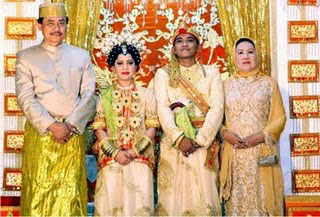
Siri’ na Pessé (Bugis) or siri’ na paccé (Makassar) are very important concepts about the identity of Bugis-Makassar as well as South Sulawesi people in general. Siri’ refers to shame and pride while pessé or paccé refers to awareness and empathy for other people.
1. Epilogue
The people of Bugis and South Sulawesi in general are known for their strong observance to customs and traditions. Even though there have been serious challenges, in the end the customs and traditions prevail and have even become stronger until these days (Hamid Abdullah, 1985:7).
The whole systems, norms, and traditional laws are called pangngadereng, which consists of five basic elements, namely ade’, bicara, rapan, wari, and sara’. The latest comes from Islamic teachings, the sharia. The five elements are connected to one another like an organic entity in the mind of Buginese. It serves as a basis for sentiment and pride contained in the concept of siri’. This is illustrated in a Buginese saying “utettong ri ade’é najagainnami siri’ku”, meaning “I adhere to my traditions to keep my self-worth” (Mattulada, 1985:61).
The above saying bears a deep meaning for Buginese. By practicing pangngadereng, a Buginese is trying to find the value of his life through the concept of siri’. According to Mattulada (1985:108), it is siri’ that motivates Buginese to act according to panggadereng because siri’ itself is mostly formed by sentimentality, emotion, and many other factors. From this come out different interpretations of siri’. People often define siri’ as shame, humiliation, disgrace, envy, and pride or honor.
Siri’, as it is understood by the Buginese, is related to the most precious things in their self, i.e. pride, reputation, and honor. All of them need to be kept and held high in life. Siri’ is not like shame in other ethnic groups. Shame, here, clings to the basic element of a Buginese man’s self which has been possessed since they understand what life really is and what pride means to human beings (Abdullah, 1985:40-41). So important it is in the life of Buginese that their life objective is to uphold and keep siri’.
Edward L. Poelinggomang, a historian from Hasanuddin University (UNHAS), explains that the culture of siri’ is a product of Buginese local wisdom to rebuild their social order which had been in an upheaval before. Historically, the condition is illustrated in the chronics which assert that life at that time was like fishes’ life in the sea, the bigger fish preyed the smaller or in Buginese language, sianré balé taué (http://www2.kompas.com).
Buginese people also have another concept, called pessé, which serves in the community as a kind of stimulator of their sense of solidarity. Pessé is like empathy, feeling of responsibility and care for a humiliated person. Therefore, pessé can be a means to restore the pride of a humiliated person.
The concept of siri’ and pessé affects the life of Buginese in every aspect. Siri’, for example, presents when a person is humiliated (ri pakasiri’) or has his social position or pride disgraced. If this happens, the humiliated man will be required by tradition to compensate for his pride for his own sake. Such can only be done by getting rid of the cause of the humiliation.
The humiliated person who is not able to recover his pride will have his name stained and people will look down on him and even isolate him. If this happens, then for the man leaving is the best way to do. This becomes one of the causes of why many Buginese migrate. According to Pelras, marriage is the most often social situation to deal with siri’. If a man’s proposal is refused, he will feel mate siri’ (losing honor) so that he has to do siliriang (runaway marriage). This does not go along with traditions. In this situation, the bridegroom’s family will have to kill him in order to keep the family’s siri’ (Christian Pelras, 2006:251).
In the past, the humiliated person who wanted to recover his pride could do jallo (run amuck), which means he could kill anyone, including people who were not involved. This happened in some more extreme cases. However, as Islamic teachings came into the land of Bugis, such siri’ compensations as inhumane revenge and torture started to change. In other words, the pride recovering methods began to be civilized since the arrival of Islam. Islam teaches its adherences to keep themselves away from evil and wrongdoings such as killing other people. Now, instead of killing others, if there is a case that wounds one’s pride, the case will be filed to the authoritative bodies like the body of adat (body of traditional matters) or the police.
2. The Concept of Siri’
Siri’ is an abstract thing in the Buginese realm of mind. Its meaning can be understood only by seeing and observing its concrete consequences in the form of actions. Therefore, the word itself contains several meanings related to many aspects of life and culture. Researchers have conducted researches on the meaning of the word siri’ regarding to both its lexical meaning and wider interpretation.
C.H. Salam Basjah and Sappena Mustaring (in Mattullada, 1985:62) have set limitations for siri’ interpretations as follows:
- Siri’ means shame,
- Siri’ is a motivation for people to kill, isolate, expel, or get rid of anything or anyone that wounds one’s feeling or pride,
- Siri’ is also a motivation for people to work their fingers to the bone on a task or effort.
Casutto explains that siri’ is “retaliation” in the form of moral duty to kill someone who breaks the law of tradition. Similar thing asserted by M. Natzir Said who determines that siri’ is the feeling of shame (krenking/beledeging) that can result in punishment for the wrongdoer from the family whose norms are violated (Mattulada, 1985:62). Aside from the experts’ opinions, there are Buginese sayings found in literature, paseng (advisory verse), and inherited ancestor’s counsel that can help understand siri’. The sayings, as quoted by Mattulada in his book Latoa (1985:63), are:
a “Siri’ emmi ri onroang di lino”, meaning that it is siri’ what we live for. Siri’ in this saying is something that gives social identity and pride for a person. One’s life will be meaningful if he can keep his pride. Similar interpretation is asserted by Hamid Abdullah in his book Manusia Bugis-Makasar (1985:37) as follows:
“In the life of Buginese-Makassarese people, siri’ is a vital element. There is no other thing more valuable than it. For Buginese-Makassarese people, siri’ is their life, pride, and honor. Therefore, if their siri’ is wounded, a Buginese-Makassarese man will sacrifice anything, including his life, to compensate for it.
b. Mate ri siri’ na, meaning dying for siri’ or dying for pride. Killed in such situation is considered a noble death. There are also Buginese sayings mate rigollai, mate risantangi, which means experiencing death that tastes like sugar and coconut milk, or in other words, experiencing a sweet death (Leonard Y. Andaya, 1983:148).
c. Mate siri’, meaning that a person who has lost his pride is no more than a living dead. To avoid it, Buginese people will have to uphold their siri’ despite risking their lives. They believe that they would better mate ri risi’na than mate siri’, better death for pride than living without pride.
Interpretations of siri’ as explained above show that the presence of siri’ in Buginese life can also become the breaker of family or relative bond. However, in reality, it does not happen because there is an opposite concept, pessé. Lexically, pessé means poignance. In broad interpretation, pessé signifies empathy for neighbors, relatives, and fellow members of a social group.
Pessé signifies solidarity not only to those disgraced, but also anyone in their social group who are in poverty, sadness, misery, or severe sickness. Therefore, pessé among members of the group is an important means of unification. There is a Buginese saying, “iya sempugi’ku, rekkua de’na siri’na, engka messa pesséna,” which means “even if a fellow Buginese no longer put siri’ over me, at least he still has pessé” (Pelras, 2006:252). Nonetheless, between siri’ and pessé there must be balance to neutralize extreme situations potential of breaking up unity and oneness of Buginese communities.
Mattulada (1985:64) explains that siri’ exists in every Buginese as a result of panggadereng itself. Thus the recovery of siri’ can be done through pangngadereng as well. On this matter, Mattulada quotes some sayings from the book Latoa as follows:
“… There are four things that can repair interpersonal relationships: (1) affection in family, (2) forgiveness to each other, (3) willingness to help and sacrifice for each other for goodness’ sake, (4) willingness to remind one another to lead a life of virtue…“
“… If so, does not it mean that ade’ is present for affection, bicara for forgiving each other, rapang for helping each other, and wari for reminding others to do good deeds?”
The purpose of life according to pangngadereng is to fulfill the essential demand of human life to maintain his pride, siri’. If pangngadereng and its aspects no longer exist, there will be no essence of human life, no siri’, and life will no longer mean anything for a Buginese (Mattulada, 1985:64). For that reason, Buginese people are very observant to pangngadereng to maintain their siri’ or pride. Those possessing high siri’ are noble and respected people. To do that, every individual’s deeds must be based on “acca na lempu, warani na getting, mappasanre ri Puang Seuwae,” wisdom to consider anything honestly, courageously, and determinedly, yet in full observance to God’s will. This shows that one can find the essence of siri’ only if he is wise, honest, courageous, determined, and faithful to God.
2. Social Implication
The concept of siri’ clearly has implications on its society, such as in the matters of people’s observance to pangngadereng, willingness to maintain their pride, social identity, the tradition of going abroad, motivation to work, and social control.
a. Observance to pangngadereng. Siri’ is a cultural demand for every individual to uphold pangngadereng in order to maintain safety, order, and prosperity of the society. Pangngadereng is a system of norms and regulations that functions as social control, either preventive or repressive. As a preventive means, through this system man is taught to recognize the good and the bad. By that everyone will understand every consequence of their deeds. If there is a violation of this system, fair punishment will be given to the doer, even when it is a man of power.
Pangngadereng upholds equality and wisdom and refuses arbitrariness, oppression, and violence. Pangngadereng as a system means a lot for its society to hold high their pride. Therefore, every individual must uphold and obey their traditions. By doing that, one is trying to reach their essence of life, siri’.
b. Willingness to maintain their pride. Siri’ can show up from many daily social situations. If a person is offended by other’s words or behavior, the rest of his family will feel the same and thus try to get even to the wrongdoer to uphold the family’s pride. One of social realities that often overlap siri’ is marriage. If someone is embarrassed because his daughter ilariang or runs away with a young man, then all male members of the girl’s family will be obliged to kill the young man to restore their family’s siri’.
c. Social identity. Siri’ is a principal element of a Buginese’ self. A person’s life is meaningful if he has pride. Nothing is as precious as siri’ to defend and hold high because it is siri’ they live for (siri’ emmi ri onroang ri lino). This becomes the social identity of some certain groups of people in South Sulawesi.
d. The tradition of merantau (going abroad) and motivation to hard work. Siri’ can be the motive behind Buginese people’s migration. Those not able to uphold their pride are considered as tau de’ gaga siri’na (coward, unrespectable, or disgraced). If this happens, there is no other way to take except leaving their homeland. These people are usually permanent emigrants, meaning that he and his family will not want to go back to their homeland.
There are also people who go abroad because they have problems with their siri’, usually young men who are disgraced because his proposal is refused as he is not able to pay the bride price. They go abroad and work hard to restore his pride in other place, whatever it takes. They will not complain, ask for help, or lament over their condition as emigrants, let alone give up easily in hard times. They will strive to succeed then go back to their homeland to show people that they can be relied on.
d. Social control. In Buginese life, siri’ is not always aggressive in nature. It does not always mean the efforts to seek for compensation for the sake of their self-worth. Siri’ can be interpreted also as a tender and pure feeling. Those who do not want to listen to elderly’s advise, those who steal or rob things, do not pray, and impolite are considered lacking siri’ in their self. So, siri’ can become social control for every individual or people in general so that their tradition, law, and morality can be well kept.
3. Epilogue
Siri’ is a concept that aims to build order, harmony, and security of social life and so hold high man’s pride and honor. Up to now, Buginese people still adhere to this principle as a guidance to live. However, the values contained in the concept of siri’ are wearing off. The values, which are supposed to be in accordance to “acca na lempu, warani na getting, mappasanre ri Puang SeuwaE”, are abandoned by people. The concept of siri’ should not be taken in narrow interpretation to keep the practice on the right track based on its true meaning. If siri’ is held high, life on earth will be well ordered, harmonious, and peaceful.
(Samsuni/bdy/09/05-10)
Translation by Reza Daffi (trans/01/07-10)
Description of primary photo: Buginese marriage is the most often social situation to deal with siri’ matters
Source of photo: http://potretwisata2000.blogspot.com
References
Christian Pelras. 2006. Manusia Bugis. (Indonesian version. Translated from English by Abdul Rahman Abu, et al.). Jakarta: Forum Jakarta-Faris École français d’Extrême-Orient.
Edward L. Pelinggomang. 2009. “Bushido’ and Siri’ mengandung sikap patriot”, [Online] (http://www2.kompas.com), downloaded on May 20th 2010.
Hamid Abdullah. 1985. Manusia Bugis Makassar. Jakarta: Inti Idayu Press.
Leonard Y. Andaya. 1983. “Pandangan Arung Palakka tentang desa dan perang Makassar 1666-1669”, Dari Raja Ali Haji hingga Hamka: Indonesia dan masa lalunya, (Ed.) Anthony Reid dan David Marr. Jakarta: Grafiti Pers.
Mattulada. 1985. Latao: Satu lukisan analitis terhadap antropologi politik orang Bugis. Yogyakarta: Gadjah Mada University Press.
Read : 26.004 time(s).
Insert your comment here :


 Today
Today  Yesterday
  Last week
  Last month