1. The History
Brunei Kingdom is one of the oldest kingdoms in the Land of Malay. The existence of the kingdom can be traced back from some historical records such as those coming from Arab, China, and some other oral traditions. The Chinese records acknowledge Brunei Kingdom as Po-li, Po-lo, or Puni, and Bunlai. While in the Arab records, the Kingdom is called Zabaj and Randj. Furthermore, in the Malay oral literary works, take for an example of Syair Awang Semaun (SAS), the word “Brunei” is derived from baru nah that means “the best place.”
While the above quotations solely explain in brief about the derivation of the word “Brunei,” there are some other historical notes that explain about the derivative spellings of the word “Brunei.” “Brunei” in an ancient book entitled Negarakertagama is assumed for being derived from ”Buruneng.” Another spelling also comes from European Sources for the History of the Sultanate of Brunei in Sixteenth Century. The book calls Brunei as “Bornei, Borneu, Burney, Borneo, Bruneo, and Burne.” And other sources even call Brunei as “Bornui” (Said Ali bin Husin) and “Burni” (in The Philippine Island) (Al-Sufri; 2001).
Brunei Kingdom is the only Malay kingdom that is able to exist up to these days. For its continuing existence, the method of investigating the Kingdom`s history requires a comprehensive elaboration covering several significant stages within. In this case, to trace back the history of Brunei Kingdom can be through two stages: Pre-Islamic Stage, during the era of Old Brunei Kingdom; and the Islamic Stage, from the reign of Sultan Muhammad Shah at the era of Brunei Kingdom.
a. Pre-Islamic Stage/ Old Brunei Kingdom
Rarely historians find the historical sources revealing the history of Old Brunei Kingdom at this stage. Some references, including those gained from Brunei History Centre, just tell in brief about the Kingdom`s existence. A small piece of manuscript found in China can hopefully reveal the history of Old Brunei Kingdom. However, the manuscript only discovers very limited data about the existence of Puni Kingdom, a Kingdom existing several years prior to the emergence of Brunei Kingdom at the era of Islamic era.
Based on the above manuscript, it is known that Old Brunei Kingdom was established in the sixth Century. It can be seen from the trade link between Old Brunei Kingdom and the Ling Dynasty ruling the China during 502 to 566 A.D. Old Brunei Kingdom was more famous as Po-li at the time. During the Tiang Tiang Dynasty (618 to 906 A.D.), Old Brunei Kingdom was still called Po-li but, starting from the Sung Dynasty (960 to 1279 A.D.), when the economic link between those two kingdoms began to establish, Old Brunei Kingdom was known as the Po-lo Kingdom. During the ruling of the Ming Dynasty (1368 to 1643 A.D.), Old Brunei Kingdom was called Po-ni (Puni) (Al-Sufri; 2001).
Geographic location of Old Brunei Kingdom, referring to the Chinese records, was south-eastern direction of Canton, which was 60 days of sailing over the ocean with normal sea winds (A-Sufri; 2000). Hsu Yun-tsiau, a Chinese historian, once undertook a research on the location where Old Brunei Kingdom was located. Based on his research, he argues that Old Brunei Kingdom was located in the eastern coast of the Malay Peninsula, in Kelantan Malaysia.
Before becoming Old Brunei Kingdom, as can be found today, Brunei History Centre much prefer “Old Brunei Kingdom” to other names such as cited in the Chinese records mentioned above. Such a preference is based on the argumentation that words like: Po-li, Po-lo, or Puni are too far from the word “Brunei” in the present.
Since Po-li, Po-lo, and Puni refer to the same location, thus it is predicted that there were some adat and custom ceremonies that may still exist due to the present. Unfortunately, the existing historical data reveal very few information about the social activities running at the time. At least, some social activities like below can be still discovered:
Socio-economic and cultural activities of the society
The Puni people, a term for the local inhabitants of Brunei in the Ming Dynasty (1368 – 1643 A.D.), were said to often conduct economic activities like trade and barter with the Chinese people. Some historical sources convey that the trade and barter would be held after three days of Chinese ships laid at anchor in Old Brunei Kingdom`s harbour. After that, the King of Puni Kingdom began to set the prices of every single good brought by the Chinese ships. After bargaining and negotiating the prices, the King then royally dished the merchants with various foods and beverages. When both sides, the King and a representative of the merchants, met unanimity, a gong was rung out to sign the opening of trade and barter activities.
It looks so weird but those all happened at the time. Moreover, it is said that not anyone was allowed to conduct trade and barter activities before the gong was rung out. For those, except for the merchants, disobeying such a convention would be sentenced for the death penalty. The Chinese merchants bartered their goods (such as camphor, deer horns, tin, perfumes, sandalwoods, bee wax, spices, tortoise-shell, and accessories made of ivory) for golden carpets, earthenware, porcelains, leads, silver crafts, gold, silks, and kiap cloth offered by the Puni people.
Puni Kingdom, likewise, expanded its economic link to other regions such as with Kochin, Java, Singapore, Pahang, Terengganu, Kelantan, and other neighbouring countries in Siam.
To some extent, some historical data also noted about some adat and custom ceremonies of the Puni people. It is said that when a Puni deceased, the dead body was put in a coffin made of bamboo. They did not bury the dead body in the ground, but in a forest and left it as such without any burial ceremony and special treatment. Two months later, the family of the deceased body used to start cultivating their farming lands (there is no sured data about the location where the family`s farming land, whether in the location where the deceased-body was put or in another).
Likewise, the Puni people used to hold Kenduri (an Islamic ritual meal) once in a year, even seven years. The celebration could be in the form of royal banquet, frolic dancing, and carolling songs followed by the playing of some musical instruments like: gongs, crier`s cymbals, and blowing flutes. They used bamboos leaves to put the foods and beverages to serve the dish and threw the leaves away after being used.
The Puni people were also known for having their own medicinal healing method called Pokok. They were able to create their indigenous medicine from roots. They fried the roots due to the roots became really scorch, and rubbed the so-called “the Bruneian salve” on the surface of a wound. Though a person was in a very critical condition, the Puni people believed the medicine could heal the person.
The Puni people were most of Buddhism followers, but they had no Buddha statue at all. They built their worshipping place in storeys with roof resembling a minaret. Around the bottom part of the so-called “minaret,” the Puni erected two buildings namely Sen Fu (Sacred Buddha) to keep a number of pearls inside. At the day of Buddha, the King used to conduct “fruit and flower worshipping ceremony” along with hundreds of the Puni people.
However, not all of the Puni people embraced Buddhism at that time; some of them had converted to Muslims. Some Islamic graveyards of the envoys of the Puni King and ordinary people are the evidences.
Most of the Kings of Puni, before 1368 A.D., were Buddhism except for a King named Ma-ha-mo-sha, who was a Muslim. The evidence for such an argument comes from a source stating that the Chinese merchants who used to give meats to the King as the offerings. However, the merchants did not offer any pork to the King, as they knew that Islam forbids pork for daily consumption. Likewise, the word “Ma” in the Chinese language usually refers to a Muslim.
Ma-ha-mo-sha was the ruler of Puni Kingdom during at the era of Hung-wu (the Ming Dynasty). He was known as Sultan Muhammad Shah who was famous as the first Sultan of Brunei Kingdom as well. Starting from the ruling period of Sultan Muhammad Shah (Ma-ha-mo-sha), the early history of Brunei (Islamic) Kingdom was started.
b. Brunei (Islamic) Kingdom
The early history of Islamic government in Brunei Kingdom started from the ruling of the King of Puni named Ma-ha-mo-sha in 1363 A.D. During the Islamic period, some significant moments happened both inside the Brunei royal family and outside the royal family that coloured the history of the Brunei Kingdom. Two of them were the penetration from other kingdoms and the colonialism coming from the western countries in almost all Southeast Asian countries including Brunei.
At least there are three highlighted stages colouring the early history of Brunei Kingdom. The first stage is Brunei Kingdom before colonialism (during the ruling period of Sultan Muhammad Shah/Sultan Brunei I to Sultan Brunei V). The second stage is the period when Brunei (Islamic) Kingdom was under the rule of Sultan Abdul Kahar/Sultan Brunei VI or Brunei Kingdom during colonialism. And the last stage is Brunei Kingdom after colonialism, starting from the ruling period of Sultan Hassanal Bolkiah up to this day.
1. Brunei (Islamic) Kingdom before Colonialism
The coming of Muslim merchants and Islamic priests from Arab countries to Brunei starting from 977 A.D. greatly influenced the dissemination and development of Islam in Brunei. Islam, however, had not been fixed as an official religion at the time. Islam grew up stronger and later on was fixed as the official religion in Brunei at the era of Sultan Muhammad Shah (1363 – 1482 A.D.). Islam kept growing more widely at the era of Sultan Syarif Ali/Sultan Brunei III.
Brunei Kingdom before colonialism had ever been conquered by Majapahit (Matassim; 2004). In an ancient book entitled Negarakertagama, written by Empu Prapanca, it is stated that Brunei was one of the Majapahit`s conquests. And according to Al Sufri (2001), Brunei Kingdom under the rule of Sultan Muhammad Shah, or commonly called Raja Awang Alak Betatar (Sultan Brunei I), could be defeated by Majapahit. For that reason, Brunei Kingdom had to pay tribute, usually in the form of 40 cases of camphor, annually to Majapahit Kingdom. Brunei Kingdom finally could release from Majapahit`s occupation following the death of Gadjah Mada.
The relinquishing of royal authority occurred when Ma-ha-mo-sha or Sultan Muhammad Shah passed away in 1402 A.D. His mausoleum was built outside the entrance gate namely An Teh Boon Goh (in Nanking, China). After burial ceremony, Hsia-wang – the son of Sultan Muhammad Shah – was empowered to rule over Brunei Kingdom by the King of China. However, remembering that Hsia-wang`s age was too young, Sultan Ahmad, the nephew of Sultan Muhammad Shah, handed over the authoritative position over the Brunei Kingdom. Starting from this, Sultan Ahmad was known as the second Sultan of Brunei Kingdom (Al-Sufri; 2000).
17 years ruling the Brunei Kingdom, Sultan Ahmad passed away. His son-in-law, Sultan Sharif Ali succeeded his father`s position as the ruler of the Kingdom. Under the reign of Sultan Sharif Ali, the territories of Brunei Kingdom encompassed Sabah, Brunei, and Sarawak. At this period, Brunei Kingdom suffered from a big revolution since the name “Old Brunei Kingdom” was altered into “Brunei (Islamic) Kingdom,” precisely coincided to the removal of Brunei Kingdom Palace to Kota Baru. The alteration from Old Brunei Kingdom to Brunei Kingdom was assumed as one of the consequence of cutting off the economic link with China (Al-Sufri; 2000). And, referring to some available historical sources, the severing of economic link with China was a consequence of the empowerment from Sultan Muhammad Shah to Sultan Ahmad, who had no blood relationship with Sultan Muhammad Shah.
Sultan Sharif Ali/ Sultan Brunei II was a grandson of Sayidina Hasan, the prophet Muhammad`s grandson. Likewise, he was an emir of Mecca. During his tenure, he endeavoured to spread and teach Islam as a follow-up to the former Muslims priests` efforts since the ninth Century. He wanted to purify Islam from the inveterate cultural influence of Buddhism amongst the Brunei people. He built a three-storey masjid in Kota Baru and inherited some other Islamic heritages that can still be found up to these days. He implied Islamic law to rule and emphasize the good governance system that highly shouldered justice and order. For those contributions, the Brunei people could live happily in prosperity. For that reason, a suffix “Darussalam” was embedded after “Brunei,” thus it means a “prosperous country.”
In 1511 A.D., when Brunei Kingdom was under the rule of Sultan Hassanal Bolkiah, the Kingdom grew up stronger and reached its glorious age following the ruin of Malacca to Portuguese. Under the authority of Sultan Hassanal Bolkiah, Brunei Darussalam became the centre of Islamic teachings and developments. Brunei Darussalam under Sultan Hassanal Bolkiah was commonly called Zaman Keemasan Empayar Brunei (the Golden Age of Brunei Empire).
Territorial areas of Brunei Kingdom encompassed the areas around Borneo Island and other neighbouring regions such as Palalawan, Sulu, Balayan, Mindoro, Bonbon, Balabak, Balambangan, Bangi, Mantani, and Saludang. Unfortunately, this glorious age could not persist in a longer time following the decease of Sultan Hassanal Bolkiah in 1524 A.D.
Sultan Abdul Kahar then appeared to succeed to the position of Sultan Hassanal Bolkiah as the next Sultan of Brunei. Starting from the tenure of Sultan Abdul Kahar, the European colonialism over the Southeast Asian countries began. Almost all Southeast Asian countries including Brunei Darussalam inevitably suffered from the European colonialism.
2. Brunei (Islamic) Kingdom during the Colonialism
Since 1521 A.D., when Brunei Kingdom was under Sultan Abdul Kahar, the Spanish colonials had targeted Brunei Darussalam as one of their occupations after knowing the country`s wealth. By taking the advantages of an internal disputation (Perang Kostila) between Sultan Saiful Rijal – the ruling Sultan of the time – and two royal princes, the Spanish colonials could just actualize the plan to occupy Brunei Darussalam in 1578 A.D.
The Spanish colonials` effort to occupy Brunei Darussalam began when a letter from the Spanish was addressed to Sultan Saiful Rijal. The letter demanded Brunei Kingdom to let Christian missionaries to disseminate Christianity in Brunei Darussalam, and asked for guarantee of safety for all missionaries during the mission. Worse, after taking a long term of scrutiny on the letter`s contents, some of Brunei royal staffers found that the letter reviled Islam and the prophet Muhammad.
Sultan Saiful Rijal got angry over the coming of the letter. As a result, a bloody war broke out between the Spanish colonials and the Brunei Kingdom`s troops with thousands of Brunei`s troops died. Likewise, a number of Brunei royal properties as well as royal high staffers were seized and kidnapped by the Spanish colonials. With the ceaseless fighting and the nationalism spirit to defend the country from colonialism, on July 1578 A.D. Brunei Kingdom could finally repulse the Spanish colonials from Brunei Darussalam.
Sultan Saiful Rijal deceased in 1581 A.D., and was replaced by his successor Sultan Shah Brunei. However, just a little data tell the story about the ruling period of Sultan Shah Brunei. He ruled Brunei Kingdom only in a year (1581 – 1582 A.D.). Came to appear as the next ruler of Brunei Kingdom after him was Sultan Muhammad Hasan (1582 – 1598 A.D.). Under his tenure, Brunei Kingdom was capable of reaching its glory again, following the success path of Sultan Hassanal Bolkiah.
At this time, Brunei Darussalam could lead ahead over the neighbouring countries in some sectors like: education, religious teachings, and economy, especially commerce. A number of Islamic schools were built upon, and many people enthusiastically attended Islamic teachings events. From this, the economic sector of Brunei Darussalam suffered from advanced development as well. Hence, Brunei Darussalam could be a prosperous country and later on, that situation was heard by the British colonials.
A British lieutenant, James Brooke, came to Serawak in 1839 A.D., and all of sudden, he then became the ruler at the same place and year. He summoned his people and troops to attack Brunei Kingdom, thus one of the Brunei Kingdom`s territories could be conquered by the British colonials settling in Serawak. Piecemeal the British colonials seized the surrounding areas from the Brunei Kingdom.
Being afraid of the worse thing would be happening, Sultan Hashim Jalilul Alam Aqamaddin then demanded patronage from the British colonials in 1888 A.D. Brunei Kingdom agreed to establish a treaty of relationship and commerce with Great Britain. However, Brunei Kingdom seemed to be the part suffering from a dead loss over the treaty signing. For such, Brunei Kingdom urged to reconsider the treaty and consequently, a new treaty called Perjanjian Naungan dan Perlindungan between Great Britain and Brunei Kingdom was established. Nothing different from the previous treaty, Great Britain seemingly took many advantages from the weakening of Brunei Kingdom. Limbang, one of the Kingdom`s territories, fell to Great Britain.
Some treaties were signed incessantly in 1905, 1906, 1959, 1971 and 1979 A.D. Those treaties were the efforts of Brunei Kingdom to save its territories and authority over Borneo Island and surrounding regions. Likewise, those were the attempts to end the “special treaty,” which was really contrast against the privileged rights of a sovereign country, between Brunei Kingdom and Great Britain (Al-Sufri; 2004).
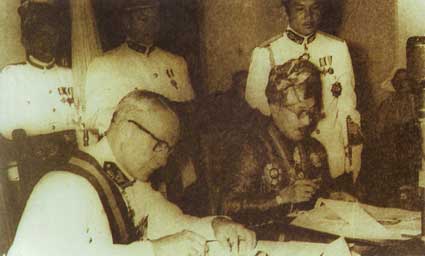
A Treaty between Brunei Kingdom and Great Britain in 1959,
when Brunei Kingdom was under the rule of Sultan Omar Ali Saifudin
Some significant moments happened in the 1960s. One of them is about the early history of the establishment of a country that is now known as Malaysia. Brunei Kingdom decided not to take part in the Unity of Malay Land as well as Sabah, Serawak, and Singapore. Brunei Darussalam decided to become a sovereign country, exclude from the Unity of Malay Land that now becomes Malaysia.
To strengthen its sovereignty over the country, Brunei Kingdom held a general election for the first time in 1962 A.D. Unfortunately, the effort found a trouble since the rebellion of Tentara Nasional Kalimantan Utara-TNKU (National Armed Forces of North Kalimantan) to overturn the ruling Brunei Kingdom. A number of civil became the victims of the rebellion.
The situation was gradually going better due to 1967 A.D. following the relinquishment of Sultan Haji Omar `Ali Saifuddin. Then, Sultan Hassanal Bolkiah Mu`izzaddin Waddaulah – the son of Sultan Haji Omar `Ali Saifudin – succeeded to the throne of the 29th Sultan of Brunei. The Sultan passed away in 1968 A.D. thus in 1970 A.D., the name “Brunei Town” (this was the name of state administrative centre of the Brunei Kingdom) was renamed to Bandar Seri Begawan to commemorate the Sultan`s merit.
3. The Brunei Islamic Kingdom After Colonialism
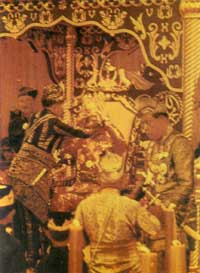
The coronation of Sultan Hassanal Bolkiah
Mu`izzaddin Waddaulah as the 29th
Sultan of Brunei Kingdom in 1968 A.D.
Sultan Hassanal Bolkiah Mu`izzaddin Waddaulah was proclaimed as Pengiran Mudah Mahkota (Crown Prince) on August 14th, 1961. He started ruling Brunei Kingdom since 1967 A.D., following the renouncement of his father, Sultan Haji Omar `Ali Saefuddin on October 4th, 1967. Brunei Darussalam was still under the occupation of Great Britain, when he was inaugurated as the 29th Sultan of Brunei on October 5th, 1967.
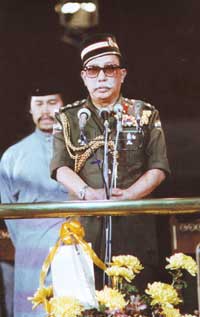 The British occupation, however, could not stop him from initiating the independence of Brunei Darussalam over the British. He urged the British colonials to revised and reconsider the treaties that have been fixed several times. He made several times of negotiations with the British colonials in 1968, 1969, 1970, 1971, 1978, and 1979. The peak for those negotiations then was accumulated on January 1st, 1984. At that time, Brunei Darussalam successfully grabbed its independence from Great Britain. No more occupation at all after this.
He made big changes in Brunei Ministerial system and tried to shape a government that was clean, honest, trustable, and based on the philosophy “Negara Melayu Islam Beraja” (Malay Islamic Monarchy). Likewise, in 1988, he built the biggest and most elegant masjid in Brunei Darussalam named “Jamae Masjid Asr-Hassanal Bolkiah.”
The masjid can accommodate 3.000 Muslim people in maximum. Inside the area of the masjid, people can find a library, a meeting hall, and a beautiful lounge. Its wonderful architecture is something to be proud of, especially amongst the Brunei people and the Brunei royal family.

The Treaty of Friendship and Cooperation between Brunei Darussalam and
Great Britain in London on September 29th, 1978.
Now, under the ruling period of Sultan Hassanal Bolkiah Mu`izzaddin Waddaulah (1967-present), Brunei Darussalam can be said to reach its glorious age. Brunei Darussalam is a country that has abundant natural resources, especially oil and gas. By implying the Islamic economic system, Brunei Darussalam becomes a prosperous country, compared to other neighbouring countries.
2. The Genealogy
The information about the genealogy of the Sultans of Brunei Kingdom can only be traced back since the emergence of the Brunei (Islamic) Kingdom. There is no historical data revealing the genealogy of the Old Brunei Kingdom. Worse, Brunei History Center likewise has no data relating to the genealogy of Kings ruling the Old Brunei Kingdom. The above list is the genealogy of the Sultans of the Brunei (Islamic) Kingdom:
-
Sultan Muhammad Shah (1363 – 1402 A.D.)
-
Sultan Ahmad (1408 – 1425 A.D.)
-
-
Sultan Sulaiman (1432 – 1485 A.D.)
-
Sultan Bolkiah (1485 – 1524 A.D.)
-
Sultan Abdul Kahar (1524 – 1530 A.D.)
-
Sultan Saiful Rijal (1533 – 1581 A.D.)
-
Sultan Shah Brunei (1581 – 1582 A.D.)
-
Sultan Muhammad Hasan (1582 – 1598 A.D.)
-
Sultan Abdul Jalilul Akbar (1598 – 1659 A.D.)
-
Sultan Abdul Jalilul Jabbar (1659 – 1660 A.D.)
-
Sultan Haji Muhammad Ali (1660 – 1661 A.D.)
-
Sultan Abdul Hakkul Mubin (1661 – 1673 A.D.)
-
Sultan Muhyiddin (1673 – 1690 A.D.)
-
Sultan Nasruddin (1690 – 1710 A.D.)
-
Sultan Husin Kamaluddin (1710 – 1730 A.D.) (1737 – 1740 A.D.)
-
Sultan Muhammad Alauddin (1730 – 1737 A.D.)
-
Sultan Omar Ali Saifuddien I (1740-1795 A.D.)
-
Sultan Muhammad Tajuddin (1795-1804 A.D.) (1804-1807 A.D.)
-
Sultan Muhammad Jamalul Alam I (1804 A.D.)
-
Sultan Muhammad Kanzul Alam (1807-1826 A.D.)
-
Sultan Muhammad Alam (1826-1828 A.D.)
-
Sultan Omar Ali Saifuddin II (1828-1852 A.D.)
-
Sultan Abdul Momin (1852-1885 A.D.)
-
Sultan Hashim Jalilul Alam Aqamaddin (1885-1906 A.D.)
-
Sultan Muhammad Jamalul Alam II (1906-1924 A.D.)
-
Sultan Ahmad Tajuddin (1924-1950 A.D.)
-
Sultan Omar `Ali Saifuddien III (1950-1967 A.D.)
-
Sultan Haji Hassanal Bolkiah Mu`izzaddin Waddaulah (1967-present)
Taking a deep look at the genealogy, we find that the Sultans of Brunei Kingdom are the descendants of King Perlak XVIII. Sultan Muhammad Shah was the great-grandchild of Puteri Ratna Kumala, the daughter of the King Perlak XVIII. Puteri Ratna Kumala itself then got married to Sultan Iskandar Shah who was originally from Tumasek.
There are two channels for investigating the genealogy of the Sultans of Brunei. The first one is through the Kings of Perlak, who was the descendants of the prophet Muhammad from the lineage Sayid Ali Al-Muktabar. And the second is through Sultan Brunei III/Sultan Sharif Ali, who was the grandson of Sayyidina Hasan, the grandson of the prophet Muhammad.
3. The Ruling Period
Referring to the Chinese notes, the length of the ruling period of the Brunei Kingdom, starting from pre-Islamic period to the present, can be said as the longest ruling period (about 14 centuries), if compared to other Malay kingdoms in the Malay Archipelago. In the Chinese notes, Brunei Kingdom has existed since the sixth Century (the Liang Dynasty) due to the present (Al-Sufri; 2000).
4. The Territory
The Po-li Kingdom, Brunei Kingdom in the former, covered 136 regions in Borneo Island and neighbouring regions. During the glorious age, the Kingdom`s territories even encompassed the entire Borneo Island (now Kalimantan Island), Zulu, and Luzon in the Philippines.
Now the Brunei Kingdom`s territory is a mere small part of Kalimantan Island – as a consequence of some treaties with Great Britain. The territory of Brunei Kingdom now borders directly to Serawak (west to east) and South China Sea (north). The area of Brunei Kingdom consists of four districts: Belait, Brunei-Muara, Temburong, and Tutong. With the entire width of 5.765 km square, Brunei Darussalam now comprises 38 settlements.
5. The Governmental Structure
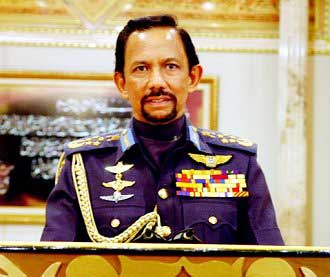
Sultan Haji Hassanal Bolkiah Mu`izzauddin Waddaulah
In the past, Brunei Kingdom was headed by a Sultan assisted by several viziers and ministers with different duties and responsibilities. Each vizier was responsible for managing several big merchants and ministers of religious affairs.
Now, it is just the same as the Brunei Kingdom`s governmental structure in the past, the highest authority is under a King with a title Sultan. The Sultan is assisted by 12 ministries assigned to hold various aspects of life. Those ministries are:
-
Prime Minister`s Office
-
Ministry of Foreign Affairs and Trade
-
Ministry of Home Affairs
-
Ministry of Finance
-
Ministry of Defence
-
Ministry of Education
-
Ministry of Industry and Primary Resources
-
Ministry of Development
-
Ministry of Culture, Youth, and Sport
-
Ministry of Health
-
Ministry of Religious Affairs, and
-
Ministry of Communications
6. Socio-cultural Life
The Brunei people were mostly either Hinduism or Buddhism followers before the arrival of Islam. After Portuguese conquered Malacca, Brunei Kingdom was the motor of Islamic teachings and development in neighbouring regions such as Luzon, Cebu, and Otan.
The Brunei people were acknowledged as the highly affable people. They highly shouldered their local wisdom and their indigenous adat and custom traditions. Referring to Pigafetta on his book First Voyage Around the World, quoted by Al-Sufri (1997), he noted that the Brunei people possessed the lofty culture and civilization. Such an argumentation can be proven from Pigafetta`s narration stating that the Spanish envoys were amazed to know that they were royally dished up with a number of delicious foods and beverages were served on golden spoons and bowls.
The Brunei people, likewise, are known for possessing the distinguishing nationalism spirit that is commonly called Semangat Kebruneian (the Bruneian Spirit) (Al-Sufri; 1999). That is why; Brunei Kingdom could finally routed the Spanish colonials when they were going to vanquish the prosperous country of Brunei Darussalam.
In the present, Brunei Kingdom employs the Islamic law for all spheres of lives. The state regulation applied in Brunei Darussalam is called Hukum Syarak (the Constitutional Status of Islam{ic Law}) that covers some aspects of life such as Undang-undang Jenayah Islam (the Islamic Jurisprudence), Muammalah (social intercourse), law on family, and the royal supreme court. The application of Islamic law in Brunei Darussalam is a consequence of Sultan Sharif Ali`s eagerness to create the Brunei people become the “real Muslims” (Al-Sufri, et al.; 1999). Therefore, the Brunei people prefer to base their daily activities on Islamic shariat. One of the most highlighted phenomena is the daily women dresses of the Brunei called Baju Kurung, a modification of hijab in Arab countries.
Islam in Brunei Darussalam tends to follow Shafie Madhab on fiqh, and Ahlus-Sunnah wal-Jama`ah principles on aqeeda. Since the proclamation of its Independence on January 1st, 1984, Brunei Darussalam imply the governmental concept called “Islamic Malay Monarchy” that later on is accepted as the state ideology of Brunei Darussalam.
Nanum Sofia (sej/02/07-08)
Translated by Irfan Nugroho (ter/76/11-08)
References:
-
Al-Sufri, Haji Awang Mohd. Jamil. 2001. Tarsilah Brunei: Sejarah Awal dan Perkembangan Islam. Bandar Seri Begawan, Brunei: Pusat Sejarah Brunei, Kementrian Kebudayaan, Belia dan Sukan.
-
___________, 2000. Latar Belakang Sejarah Brunei. Bandar Seri Begawan, Brunei: Pusat Sejarah Brunei, Kementrian Kebudayaan, Belia dan Sukan.
-
Read : 53.827 time(s).
Insert your comment here :


 Today
Today  Yesterday
  Last week
  Last month