1. History
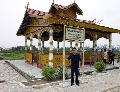
Sultan Abu Bakar Mosque in Johor, Malaysia, is one of historical heritages in Malaysia depicting the glory of Johor Kingdom in the past. The history of the mosque can be traced back from the life of Sultan Abu Bakar bin Temenggong Daeng Ibrahim (1862 – 1895 A.D.). Under his rule, Johor Kingdom reached its golden age where many people lived in prosperity as the result of raising industrial economic at the time. Now, the mosque stands firmly and functions as Sultan Abu Bakar Museum.
The establishment of Sultan Abu Bakar Mosque started after the capital of Johor – at Belanga Bay, Singapore – was moved to Tanjung Puteri (now Johor Bahru, Malaysia) in 1866 A.D. The mosque was built in 1893 A.D. (1311 H) and completed in 1900 A.D. spending about 400.000 RM.
Considering the enormous historical value of Sultan Abu Bakar Mosque; now, the preservation and the maintenance of the mosque are handed over by Malaysia Kingdom. The mosque is also one of worth visiting tourism destinations in Malaysia that is opened for public from 9 a.m. until 4 p.m. for free. However, on Friday the mosque is closed for tourists visit but not for daily praying.
2. Location
Sultan Abu Bakar Mosque has strategic location on a hill nearby Lido Beach facing directly to Tebrau Strait, amid Singapore and Malaysia. The mosque is on Masjid Sultan Abu Bakar Street, 80990, Johor Baru, Johor Darul Takzim, Malaysia, next to the Islamic town in Johor. From the backyard of the mosque, visitors could see Singapore very clearly.
3. Width
The capacity of Sultan Abu Bakar Mosque is 2000 people in maximum, but there is no detailed data telling the exact width of the mosque.
4. Architecture
Sultan Abu Bakar Mosque‘s architecture combines between Indian, Persian, European, and local architecture together. It is square with protruding qibla wall. The roof above the prayer hall is a single layer pyramidal roof. That is the distinction of the mosque from other historical mosques in Malay Archipelago.
The mosque has four minarets that are placed on every corner of Sultan Abu Bakar Mosque united by the entrance doors. Other minarets, besides to mihrab dome, face directly to Lido Beach. On every minaret, there is a Roman hollow decorating the minarets.
Each minaret is four-storey building on which the floor is different from each other in style. The first and the second floor are square while the third and the fourth floor are Persian octagonal. Each floor in the minarets is beautified with dentil balustrade and some pilaster decorated with flute and windows on every two pilaster on the minarets. This style is European type of architecture during the renaissance era. Amortizement on the end of the pilasters is also one of the European architectural styles in Sultan Abu Bakar Mosque.

5. Draftsman
There is no record about who the architect and the draftsman of the mosque were. The only data about the establishment history of the mosque states that the one who was responsible during the building process of the mosque was Datuk Yahya Awaluddin and Batwip Mohamad Arif who served as supervisor.
6. Renovation
(In the process of data collecting)
Sources :
- Yulianto Sumalyo, 2006. Arsitektur Mesjid dan Monumen Sejarah Muslim. Yogyakarta: Gadjah Mada University Press.
- http://www.johordt.gov.my
(NI/ter/03/05-08)
Photo credit: www.wisatamelayu.com
Read : 31.578 time(s).
Insert your comment here :

 Today
Today  Yesterday
  Last week
  Last month