1. Origin
Main Canang game can be found in West Bunguran, Tujuh Island, Riau Islands, Indonesia. Riau society usually calls the game as Patok Lele or Tuk Lele. This past popular game among children in seashore area became the royalties‘ hobby of Riau Sultanate in the 17th century. However, ordinary people in turn can also participate in Main Canang game
2. Player
Main Canang game typically requires 2-5 young people whose age in between 7-20 years old. This game can be played equally either men or women.
3. Place and Tools
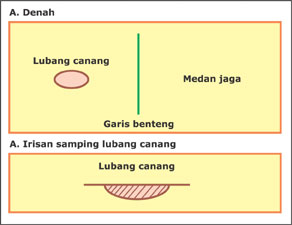
Main Canang requires no spacious land as can be played in street, pavement, seashore, or foothill. The needed tools are simple; 2 sticks of canang with different size. First stick which measures 30 cm in length and 2,5 cm in width is called induk canang (main stick) while the second, 18 cm in length and 0,75 in width, is called anak canang (minor stick). In addition, this game also needs a hole, line. The hole, 30 cm in length and 5 cm in width, 3-5 cm in depth is used for central mark of the game. The line has two usages; it is used to mark the border or usually called garis benteng (castle line), and used to decide whether the stick fall within his opponents area.
4. Rule and Process
Main Canang game is divided into two types; beraje (individual) and berundung (collective). Beraje is played usually by men and women 2-5 people while berundung by men and women 3-5 people. Considering that canang involves two different sexes. It should be separated strictly between men and women team particularly if young adult is among the players.
5. Cultural Values
Cultural Values such as accuracy, religiosity (Islam) and fairness are all embedded in this game. Each player tries to throw his canang on the line where the other players agree to give point, the demarcation between men and women, the willingness to accept the winner from the opponent show the value of accuracy, religiosity and fairness.
Source :
Balai Kajian Sejarah dan Nilai Tradisional Riau, 1984, Permainan Rakyat Daerah Riau, Departemen Pendidikan Dan Kebudayaan.
Read : 27.384 time(s).
Insert your comment here :


 Today
Today  Yesterday
  Last week
  Last month