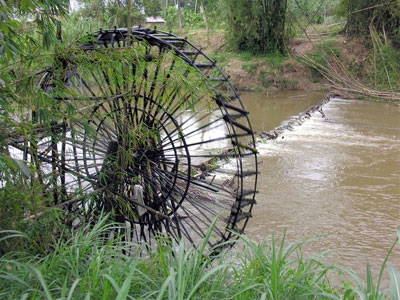
Waterwheel is an irigation appliance to flow water to rice fields. The wheel will rotate on on its axis when pushed by river or dam water. In Jambi, such waterwheel is used to supply water for irrigation fields, which are rice fields whose watering does not depend on rains (as opposed to rain-fed fields) or that does not have any water source channeled through ditches. Traditional waterwheels are made of wood thus cost less, more simple in the making, and more environment-friendly than the modern ones.
1. Origin
Generally, Jambi farmers will make ditches to channel water to their fields. The water will flow from a spring or a river. However, in the absence of such water sources, they have no choice other than flowing water by containing river water to a dam, then channel it to the fields using waterwheels. This is common in Jambi, a province situated in the East Coast of Sumatra, facing the South China Sea and Karimata Strait.
Jambi Province geographically contains soil, either forestal soil or agricultural soil. As a result, the majority of Jambi residents work in the field as farmers. They also have understandably created cultural products in the form of traditional farming appliances that are unique. The waterwheel is one of them. Unfortunately this tool has been even rare in Jambi countrysides, while it is actually very effective in order for the field to survive in dry season, in which water shortage is always likely to occur, keeping the farmers away from working.
In Jambi, there are various steps a farmer must do to cultivate an irrigated field, namely cutting through the grasses and straws, hoeing and ploughing the soil, reversing the soil upside down (mencindang), cutting through the dikes, and planing the surface. In irrigated fields’ case, to do the abovementioned activities, a farmer need a good irrigating system. The waterwheel, therefore, is very vital because a solid soil will be hard to cultivate without enough watering so that it can be hoed easily (Ibrahim Budhang et al., 1990).
The waterwheel is an appliance made of wood and in such a shape of fan, circular with an axis in its center so that it will rotate like a wheel when pushed by water stream. Thus it is called the waterwheel. As opposed to windmill which is driven by wind, waterwheel is steered by water and functions to channel the water from a river to the fields. Waterwheel is used in irrigated rice fields, which are fields that do not rely on rain water.
As it developed, there have been two models namely traditional waterwheel and modern waterwheel. Both of them are used to flow water, the difference lies on the materials they are made of. Traditional waterwheels are generally made of wood and bamboo, while modern waterwheels are made of iron and plastic (hard pipe). As to effectiveness in the water debit result and durability, it is all relative. It depends on how they are used and kept.
2. Materials
The waterwheel has a simple shape and is constructed with materials available in Jambi woods. A traditional waterwheel is structured of some components, that are:
- Wheel
- Peraku (water tower)
- Besut (water tube)
- Empangan (water container)
- Peluang kincir (water way)
As for the materials required to make a traditional waterwheel are:
- Bamboo
- Coconut palm timber
- Rattan
- River stone
- Sand
3. Construction Process
Waterwheels usually used by Jambi farmers are traditional tool. Therefore its method of construction is quite simple, yet demands precision. One slip in tying the fan and the bamboo will result in water flow interruption due to unbalance rotation of the fan.
After all materials are prepared, the first thing to do is cutting the log of coconut palm off into about 48 to 56 sticks (depending on the need). Then, make 24 to 28 holes each 6 x 4 cm (the size depending on the need) in the propeller. It is then installed like a fan and tied fast with rattan.
The next step is making the peraku. The first thing to do is preparing a log of timber than make rakuk (carving) on it as long as 30 cm. Peraku is usually made wider upside and narrower downside. The purpose is for the water to be spilled easily so that it will flow down right away.
Then, cut the bamboo to make the peluang kincir (water way). To anticipate corrosion, the bamboo should be the thick ones. As for the length, it depends on the need.
It is then followed by making the besut (water tube) by cutting the bamboo to a fitting size. Besut is an appliance that will keep the water flowing swiftly.
Empang is prepared after that. Empang is a place to contain the water that flows from the river or uphill spring, thus, made in the lower level ground so that the water will flow. The empang is made by setting up river stones surrounding the area so that it will make a strong and resistant container. However, if the water still leaks out, the farmers usually make use sacks containing sand or straw to mend the leaking part of the stone-wall. When the water is held, it is then channeled through peluang kincir to the fields.
When everything is prepared, the next step is to set it up to becoe a waterwheel. The setting-up process is done on the river in order to adjust the amount or volume of the water. Therefore, the waterwheel can go on spinning even when there is less debit of water. For that reason, empang should be made in such a way that it will supply water proportionally.
4. Advantages and Disadvantages
As an appliance made by hand, traditional waterwheels have some advantages and disadvantages compared to modern waterwheels.
The advantages are:
- The tools and materials needed to make it are easier to get, especially in Jambi, a region whose many areas are still woods
- It cost lesser or could even be non-costing because the tools and materials can be obtained from surrounding environment (nature)
- The operation method is simpler and easier
- It is more environmentally friendly
- It is more durable because it will not get stained.
The disadvantages of traditional waterwheels are:
- It needs a more intensive upkeep to anticipate if there are straws or other materials trapped in the propeller, which would disturb the work of the waterwheel
- Traditional waterwheels produce weaker power
The advantages of modern waterwheels:
- It is relatively cleaner since it is made of iron
- It is easier to keep
- The power it produce will be relatively bigger
The disadvantages of modern waterwheels are:
- It is relatively more expensive
- It could get stained as it has contacts with the water continuously
- It is not environmentally friendly since it harness the power of fuel or electricity
5. Values
Behind traditional waterwheels, there are cultural values quite important in the efforts of empowering and educating country residents. Among the values are:
- Economic value. This is clearly apparent in the little cost needed to make a traditional waterwheel. Even for the Jambinese whose habitations are mostly surrounded by woods, the materials could be easily obtained for free. This value is also reflected in the operational cost and maintenance. Unlike iron that requires more attention and care, timber and bamboo only need to be kept of anything that can block the propeller from rotating.
- Value of togetherness. The making of a waterwheel is usually done collectively. This is because one waterwheel will provide for many farmers. This is of course will strengthen the sense of solidarity and togetherness of the farmers. Likewise, when a waterwheel gets broken, they will also repair it together.
- Nature preserving value. Traditional waterwheels are environmentally friendlier than the modern ones. Aside from its natural origin, timber, that will be in contact with water all the time, will not give negative effect both on the plants and the fishes as wells as their habitat in the river. This will of course be different with modern iron waterwheels because they are made through manufacturing process which is very chemical. When the iron is touched by water, it will likely give bad effects on the farmers’ plant as well as the fishes and their habitat in the river. This will be worse when the maintenance involves lubricant oil. The waste of the oil could disrupt the process of biological oxidation of the environment, especially after it flows to the river, ditches, fields, and so on.
- Culture and tradition preserving value. Traditional waterwheels are an irrigation appliance that has been inherited for generations. Therefore, the use of traditional waterwheel could be seen as an effort to preserve the old culture and tradition. This is important and should be promoted, knowing that traditional waterwheels have more advantages compared to modern waterwheels or other modern irrigation appliance such as those that are diesel-driven.
- Value of simplicity and function-based attitude. The construction of wooden traditional waterwheels also gives the farmers a lesson to think more of simplicity and function instead of style. It is true that modern waterwheels can produce relatively stronger power that results in more water for irrigation. However, considering the modern waterwheels’ expensive value and complex maintenance, traditional waterwheels are clearly more advantageous. Moreover, as to its function, between the two kinds of waterwheels, there is no big difference.
- Artistic value. The construction of traditional waterwheels contains also an artistic value, the art of handicraft. They are made of wood and thus, making holes and planing the wood to refine it certainly require a good handicraft skill. The propeller that resembles the shape of a flower has of course a high artistic value.
6. Epilogue
The issue of greenhouse effect that has inflicted long dry seasons has made farmers hard to get water to irrigate their fields. The use of irrigating diesel-machines that cost a lot (for machine and fuel purchase) and their bad effects on human being and environment (with the diseases and dirty air resulted from emission gases), has increased the spirit to introduce the Jambinese-farmer waterwheel to all Indonesian farmers.
This spirit could even be stronger after knowing the advantages of traditional waterwheels and the values they hold as opposed to those of modern waterwheels. Somehow, irrigation appliances, despite their ability to increase crop quantity and quality, should not set aside natural awareness. However, aside from each appliance’s advantages and disadvantages, the government still has a non-finished task, namely improving the economic wellbeing and education of farmers. Farmers should live an economically appropriate life and be smart in using technology.
Yusuf Efendi (bdy/15/02-10)
Translation by Reza Daffi (trans/09/03-10)
References
Books
- Ibrahim Budjang et al., 1990. Peralatan produksi tradisional dan perkembanganya di daerah Jambi. Jambi: Departemen Pendidikan dan Kebudayaan.
- Tim Dinas Pertanian Tanaman Pangan Propinsi Jambi, 1982. Bercocok tanam padi sawah. Jambi: Dinas Pertanian Tanaman Pangan.
Internet
- Badan Penelitian dan Pengambangan Departemen Pekerjaan Umum, n.d. Kincir air tipe PUSAIR (pdf). Jambi. Badan Penelitian dan Pengambangan Departemen Pekerjaan Umum. http://balitbang.pu.go.id. (Accessed on Februari 6, 2010).
- Pelanta. Kincir air (traditional irrigation) (internet): Pelanta Rantaunet. http://rantaunet.multiply.com. (Accessed on Februari 6, 2010).
Read : 76.926 time(s).
Insert your comment here :


 Today
Today  Yesterday
  Last week
  Last month