Saturday, 5 September 2026 |Saturday, 22 Rab. Awal 1448 H
Online Visitors : 0
Today
:
3.527
Yesterday
:
26.946
Last week
:
32.264.566
Last month
:
43.463.948
You are visitor number 105.216.314 Since 01 Muharam 1428 ( January 20, 2007 )
AGENDA
No data available
News
19 januari 2010 02:36
BPKBM and MelayuOnline.com Defining Malay, Diaspora and Plurality
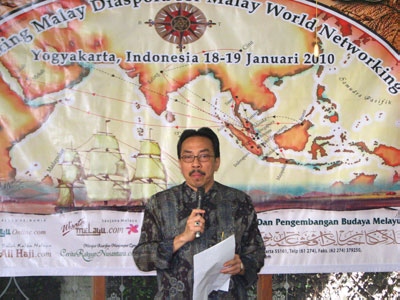
Welcoming Speech from Mahyudin Al Mudra SH, MM
Yogyakarta, MelayuOnline.com – Malay is not a cultural family with a single entity, it is plural and widely diverse. Throughout the history of its evolution, Malay has mingled with various other cultural elements and adjusted itself to them. The adaptation process brought in a new culture containing values of Malay’s. However, being plural, there are different interpretations of Malayness due to socio-political interests, resulting in misunderstanding and discrimination. To increase the intensity of discourse about Malay Diaspora, therefore, is considered important in order to unify Malay ethnic groups existing all over the world.
This standpoint became a basis for BKPBM to hold an international workshop entitled “Revisiting Malay Diaspora for Malay World Networking” on 18-19 January 2009. The workshop, carried on at the Balai Melayu, Jalan Gambiran 85 A, Yogyakarta, is held also in order to celebrate the third anniversary of the portal www.MelayuOnline.com.
Speaking in the first day, Monday (18/01) were Prof. Muhammad Haji Salleh (Center for Basic Research and International Studies of the Malaysian Science University), Dr. Halimah Hasan (Faculty of Modern Language and Communication of the Malaysian Putra University), Ir. Gusti Kamboja, MH (Sultan/Tradition Holder of Matan Sultanate and Head of Ketapang Regional House of Representatives), Prof. Dr. Heddy Shri Ahimsa-Putra (Professor of Anthropology of the Faculty of Cultural Science, Gadjah Mada University and consultant of www.MelayuOnline.com) and Prof. H. Suwardi MS (Professor of History of the Faculty of Education Teachership, Riau University). The first session was conducted by Dr. Aris Arif Mundayat (Director of Center for South East Asian Social Studies, GadjahMadaUniversity and consultant of BKPBM) as the moderator, while the second by Dr. H. Mohd. Sharifudin Yusop.
In his welcoming speech, Mahyudin Al Mudra SH, MM. as the holder of BKPBM, explained about the purposes of the workshop, i.e. to preserve Malay culture, to start a real cooperation in sharing information and to build networks among Malay universities and organizations. “I hope this workshop could be an initiating step (for us) to build networks and produce knowledge, by Malay for the World,” wished he.
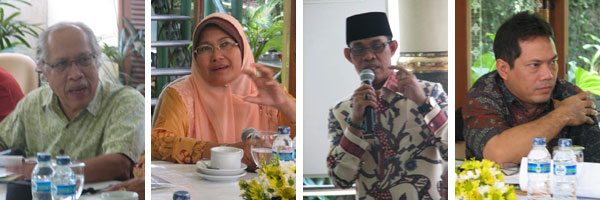
Prof. Muhammad Haji Salleh, Dr. Halimah Hasan, Ir. Gusti Kamboja, MH, Dr. Aris Arif Mundayat
Prof. Muhammad Haji Saleh got the first turn to present his working papers about historical timeline of Malay diaspora. He explicated about the path of Malay diaspora, the causes of migrations, the transformations in the new places and so forth to the migration phases of Minangkabau people to Semenanjung. In the presentation, the story of Malay diaspora beginning from pre-colonial, colonial, to colonial era was explained.
Next to Prof. Muhammad’s presentation, Dr. Halimah Hasan floored his working paper entitled “Folklor Melayu Africa Selatan (South Africa’s Malay Folklores)”. The very long time since the first arrival of Malay people, brought by the colonial government to South Africa over 400 years ago, and the effect of apartheid have worn off the form of arts and cultures of CapeMalay. Yet, the culture could still be regarded as Malay because there are still some similarities to the mother of Malay culture in the Nusantara. “The similarities are seen in arts and culture sphere as well as religious tradition,” said Dr. Halimah. She further gave an example of the resemblance in birth ceremony, i.e. the tradition to name the baby or “doopmal”, that in culture of Malay Peninsula is known as “Naik Buai”, “Istirahat Pijak Tanah”, or “Tedak Siten”.
The last speaker in the first session of day one was Ir., Gusti Kamboja, MH. who tried to trace back the culture of Kalimantan people using genetic, biological-anthropologic, linguistic, and traditional and cultural approaches. He too offered a vision of the future of Malay that is prone to extinction if nobody cares. This can already be seen in the phenomena of the abiding extinction of local languages.
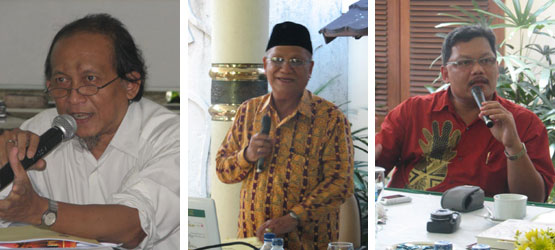
Prof. Dr. Heddy Shri Ahimsa-Putra, Prof. H. Suwardi MS, dan Dr. HJ. Mohd Sharifudin Yusop
Discussion in the first session was quite lively. The participants were so enthusiastic to ask questions over the presentation. After lunch break, the workshop was continued with the second session. Likewise, the second session ran very well. The first speaker, Prof. Dr. Heddy Shri Ahimsa-Putra, raised some issues about Plurality in Indonesian-Malay Malayness. According to the professor, Indonesia and Malaysia sees Malay in different concepts, social constructions, and symbols of understanding. This is the reason of why there is often dispute between the two sister nations. Furthermore, he offered phenology paradigm to really see reality in society.
The last speaker, Prof. H. Suwardi MS delivered his working paper entitled “Potensi Melayu Menjadi Perkasa (Malay’s Potential to Become Strong). In his opinion, Malay has a great potential to become one of the strong cultures. It, nevertheless, relies on the people practicing Malayness. “That is the importance of education for young generation, so that they could absorb the right Malay values and to protect themselves with faith and self-resignation to God to face the future’s global effects that are getting more and more complicated,” said he. Workshop day one finished at 4 p.m. west Indonesian time, and would be followed by the second day on Tuesday (19/01/2010).
Elisabeth Murni (brt/04/01-10) Translated by Reza Daffi (terj/06/01-10)


 Today
Today  Yesterday
  Last week
  Last month