You are visitor number 105.216.314 Since 01 Muharam 1428 ( January 20, 2007 )
AGENDA
No data available
News
07 juni 2010 06:47
Malaysia`s Peranakan Struggle
Malacca, Malaysia - There are few things in this world as demanding as a Peranakan mother teaching her daughter to cook.
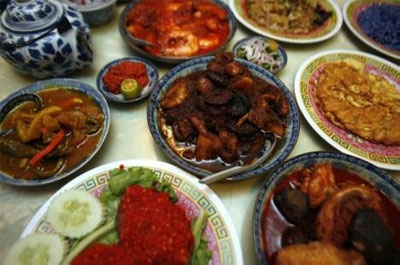
Peranakan is a hybrid Malay-Chinese culture that dates back to 1400 and is found in Malaysia, Singapore and Indonesia. One of the most visible signs of Peranakan culture can be found in the kitchen, where distinct spicy food requiring hours of laborious preparation is made.
A standard Peranakan dish, Lemak Nanas Udang (Pineapple Curry Prawn) contains coconut milk, chillies, lemongrass, turmeric, shrimp paste and tamarind, all blended into a tangy dish.
The experts say the secret is in using a mortar and pestle to grind the spices. But now the sound of pestle hitting mortar is a thing of the past in most Peranakan kitchens, replaced by the sound of an electric blender.
“In my mother’s time, women had to toil in the kitchen all day and night,” said Maureen Guan. “If my mother did not cook my grandmother would scold her, saying, ‘a nyonya [woman] must learn to cook otherwise your mother-in-law will look down upon you.’”
The pressures of modern life are seeing fewer young girls are learning the culinary skills from their mothers and grandmothers.
Apart from the recipes, other Peranakan traits such as its language, a Malay dialect with many Hokkien words, are slowly fading as Peranakan marry outside their community.
“As each generation goes by, more will be lost. That’s the challenge that we are facing today as a lot of the younger babas [men] and nyonyas don’t quite know what it’s all about,” said Lee Su Kim, president of Malaysia’s Baba Nyonya Association in the state of Selangor.
To some Peranakans, the future looks bleak. About 26 years ago Guan and her husband, Chock Choon Sin, opened a Peranakan restaurant, Makko Nyonya Restaurant, in Malacca — the birthplace of the cuisine.
Malacca was the most prosperous harbour in the region during the 15th century due to its strategic location.
But the Chinese traders drawn to Malacca were not allowed to bring women, resulting in many of them marrying a local, resulting in the unique cultural mix.
Chock said none of his children appeared interested in taking over the family restaurant. “As long as cooking is concerned, I’ll try my best to maintain the original way of Nyonya cooking, especially the taste,” he said.(Angie Teo)


 Today
Today  Yesterday
  Last week
  Last month