Sunday, 6 September 2026 |Sunday, 23 Rab. Awal 1448 H
Online Visitors : 1.109
Today
:
17.061
Yesterday
:
26.946
Last week
:
32.264.566
Last month
:
43.463.948
You are visitor number 105.216.314 Since 01 Muharam 1428 ( January 20, 2007 )
AGENDA
No data available
News
25 november 2010 03:16
Weaving a Distinct Bruneian Identity
Bandar Seri Begawan, Brunei Darussalam - The Bruneian identity can be expressed through the country's art of weaving, says the founder of a company producing high-quality handicrafts and souvenirs.
Capitalising on this unique aspect of Brunei's heritage, Asmad Hj Umar, marketing and development manager of Syarikat Asnika, a producer of souvenirs and handicraft items, says he hopes to create a Bruneian identity with the company's line of shirts made from traditional sinjang fabric.
"If you go anywhere around the world, Thailand has its own identity, Malaysia has its own identity. If you go to the big meetings, you want to use the batik shirt, (but) that's not ours," he says.
Presenting samples of the shirts to His Majesty The Sultan and Yang Di-Pertuan of Brunei Darussalam at the recent 'Ease of Doing Business' event at the International Convention Centre, Asmad says he wants to create a means for culturally identifying Bruneians who are overseas attending governmental events such as Apec and Asean.
"Brunei doesn't have an identity," he claims, adding that Bruneians who attend formal functions in countries such as Malaysia, would normally wear batik attire instead.
As far as he is aware, Asmad says Asnika is the first to produce these type of shirts with this particular intention in mind, but added that he welcomes others to follow suit. "If anybody else creates this, I don't mind. This is the first that I created, (and) it's quite unique, nobody's doing this," he adds.
The shirts use 20 per cent of the traditional sinjang material only, as a whole shirt made from the fabric would not be comfortable and extremely expensive to sell, he explains. Twelve pieces from their initial production batch out earlier this year, have been snapped up by Brunei Petroleum, Asmad reveals.
A passion for quality marks Syarikat Asnika in a class above the rest, having firmly established itself as the premier supplier and producer of high-quality handicrafts and souvenirs catering to both local and foreign consumers.
Established 19 years ago by. Asmad and his wife-Dk Noor Hani Pg Haji Shahbudin, who is also the company's general manager, Asnika has made a name in producing quality traditional fabric which is highly sought after for its quality.
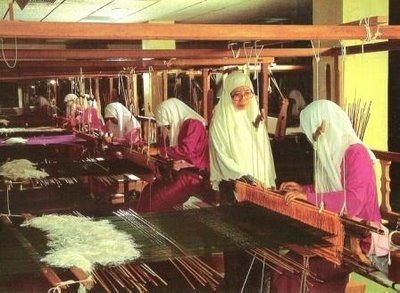
The challenge, Asmad says, is not so much competition but in fulfilling customers' high demand for the sinjang. This traditional woven fabric is an essential item at Bruneian Malay weddings, forming a part of the collection of gifts from the groom to the bride.
Although not many understand the art of weaving the fabric, many, especially locals, "admire our craft", he said, adding that some clients, "buy more than three, four pieces a year".
"That's quite a lot of money," he added.
"If you've got the passion, then the heritage and handicrafts industry is a lucrative avenue to explore," says Asmad.
The average price of a piece of sinjang fabric really varies greatly, he says, as there are different designs and different flower patterns which determine the complexity of the finished piece and the amount of skill needed to create the designs, especially those that are provided by customers.
Pieces are sold from as "little" as $450 for the most basic and traditional designs, but the price can go much higher depending on the quality and complexity of the design. Asmad says an intricately weaved sinjang with high-quality gold and cotton thread imported from Japan can cost around $1,500 a piece.
"The raw material makes it so expensive so you have to think of where did you get the thread? Did you get it from Japan? Or did you get it from Holland? Or from China?" he adds, saying Asnika only uses thread imported from Japan.
"Now, let me tell you why it's so expensive. We've been in this business for almost 19 years. None of our clients have come back to say 'Oh your colour has faded, it's become blue'. No."
If you don't use high-quality thread, he says, after three or five years the colour will fade or spot over time, but he has never had a customer complain about that problem. Although catering mainly to the local market, they do count foreign customers from countries like Malaysia, as well as Europe.
Dk Noor Hani is the design force behind the company's success. Apart from creating her own designs, she also creates patterns based on consultations with clients. Asnika's attempt at modernising some traditional prints and styles have met With success, Asmad says.
"We can do modern styles but it's more time-consuming because when it comes to the younger generation, the patterns and the flowers, they have a kind of different interest on that. So, for modern design we mostly do it for females, for kain, or baju," he explains. Modern designs also require much more handiwork and manpower to complete; so they are focusing on the traditional patterns for now.
To demonstrate the complexity of their craft, Asnika has placed a loom at their Sumbangsih branch "so people can understand" how hard it is "to do the weaving", adds Asmad.
Not all of their products are expensive, says Asmad, adding that it's all about perception. "In fact, it's not expensive, we create the prices from $8 to $3,000." According to Asmad, small gifts such as mugs and paperweights bearing the sinjang fabric can go for as little as $10.
"In Sumbangsih, there's about four or five companies up there, they have about 30 pieces of this cloth hanging (there). In our shop, zero. They say why don't you have kain hanging up? Because it's sold out. In other countries they have 50 pieces all hanging there but we don't do that, we go for high-quality," he says.
Starting out from their flagship store in Kiulap, Asnika can now include Brunei Shell Petroleum and Brunei LNG Sdn Bhd (BLNG) as some of their major clients.
Asked why he decided to go into the handicrafts souvenir industry, Asmad, who was involved in the insurance sector, counts his wife as the inspiration for the business. "I just do the marketing. My wife (graduated) from the Handicraft Centre with the certificate, completing her training at the centre for three years (and during that time) she was really focused on these handicrafts," he explains.
Dk Noor Hani learnt to create a variety of handicraft items during her stint at the centre, making her mark on the craft and souvenir industry via items such as tea cosies, table runners and handbags featuring traditional fabrics which are not widely produced as souvenir items.
Asmad and his wife have also begun to create their own line of Brunei souvenirs, detailed with native birds such as kingfishers which are indigenous to the Borneo region. But Asmad is not in it for the money, he admits, saying passion for local heritage and crafts is the reason he chooses to handle the side business.
With an investment of nearly $25, 000 in total to start up Syarikat Asnika, Asmad admits he hopes his children will carry on the 'business and that the cultural handicrafts industry will continue to grow in Brunei. If the younger generation does not maintain an interest in this, he says, then not only will the handicrafts industry disappear but so will this important part of our local heritage and culture.
He encourages others to venture into this industry, but says you must be focused and gain expertise and knowledge. "They must be focused, they must be knowledgable, not because you have money. They must have love for this," he adds.


 Today
Today  Yesterday
  Last week
  Last month