Monday, 2 November 2026 |Monday, 21 Jum. Awal 1448 H
Online Visitors : 1.066
Today
:
19.011
Yesterday
:
40.758
Last week
:
51.501
Last month
:
11.429.130
You are visitor number 105.216.314 Since 01 Muharam 1428 ( January 20, 2007 )
AGENDA
No data available
News
31 maret 2008 03:20
Cultural Dialogue on Malay Leadership
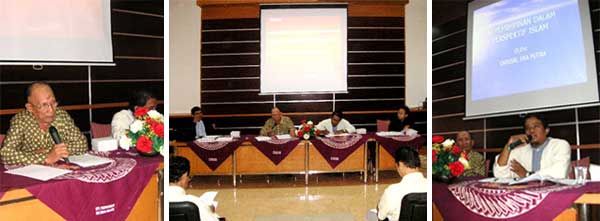
Yogyakarta, MelayuOnline.com- Who is a leader? A leader, based on Malay culture, is a person having high moral value, Ir. Said Fadhillah Alatas, M.Si. replied. Such argument appeared in a Cultural Dialogue “Leadership on Malay Mass Organization Based on Islamic Point of View” held by Karimun Island Student Association on Friday (28/03/2008). The dialogue was held in Theatrical Room of Islamic State Univerity of Sunan Kalijaga, Yogyakarta.
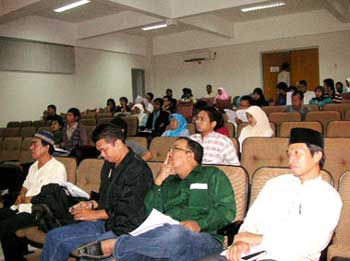
The dialogue was attended by approximately 80 people. Came as the speakers were Ir. Said Fadhilah Alathas, M.Si. – The Head of KMPKR/ a lecturer in UPN Yogyakarta, H. Okrisal Eka Putra, Lc., M.Ag. – A lecturer in Islamic State University Yogyakarta, and Ahmad Salehudin (Editor-in-chief of RajaAliHaji.com).
On his paper, Fadhilah Alatas conveyed his idea about an ideal leader referring to Gurindam Dua Belas – written by Raja Ali Haji, and Tunjuk Ajar Melayu by Tenas Effendy. In Gurindam Dua Belas, point 11 and 12, a leader is a person who fulfils promise and struggles for justice.
Point 11
Hendaklah berjasa kepada yang sebangsa//hendaklah jadi kepala buang perangai yang tercela//hendaklah memegang amanat buanglah khianat
(The point above suggests to avoid doing bad deed and firmly holding citizen`s mandate)
Point 12
Raja Mufakat dengan menteri seperti kebun berpagarkan duri//hukum adil atas rakyat tanda raja beroleh inayat...
(The point above means when justice stands in earth, people`s prosperity will be easily reached)
According to Fadhilah Alatas, citizens have rights to choose a proper leader but they must consider some factors such as character, habit, language, justice, solidarity, responsibility, and religion. People`s prosperity can be reached when cooperative communication between a leader and common people are available.
Ahmad Salehudin as MelayuOnline.com`s representative, delivered his paper about the existence of mass organizations. According to Salehudin, mass organizations, in the era of New Order, were born from the need to struggle and guard public interest. In that era, mass organizations were able to establish autonomous civil society under the hegemony of state government.
After the ruin of New Order, mass organizations seemed to lose their former orientations. Such condition got worse when so many political elites strived to reach either personal or groups` interests. Moreover, they compete with other mass organizations unfairly by debilitating and bringing down their competitors.
This condition then led mass organizations away from their former orientations to struggle and guard public interests. Every mass organization pitted their self against the others to persuade public into certain groups` interests. Primordial issues such as “putra daerah” (indigene), religious purification, political and economic interests, and socio-political framework of Indonesia, which begins to be liberal, have brought mass organizations into diverse clashes for their own interests.
Remembering the situation above, Salehudin offered three solutions based on Islamic point of view and Malay philosophy. First, mass organizations ought to concern about the effort to enhance people`s prosperity and education. The second solution is giving advocation to common people, and the third solution is controlling government by criticizing public policy and the deviation of commands.
One of the participants argued that now, Malay people begin to leave their identity as Malay. Most of Malay people do not respect their parents anymore. Responding that opinion, Salehudin offered an idea to set Malay identity as mindset, outside the framework as culture.
So far, Balai Kajian dan Pengembangan Budaya Melayu-BKPBM (the Center for Research and Development of Malay Culture) has carried out some efforts to develop and preserve Malay culture to reach the glory of Malay civilization in the future. Just like what a pantun below ending the dialogue.
Rindu bayang siang dan malam Kasih dan sayang dilande tsunami Adat resam selalu tertanam Agar tak hilang Melayu di bumi.

 Today
 Yesterday
 Last week
 Last month