You are visitor number 105.216.314 Since 01 Muharam 1428 ( January 20, 2007 )
AGENDA
No data available
News
28 juli 2009 08:21
On Marapu, the Local Belief of the Sumbanese
Monthly Discussion of the Center for Research and Development of Malay Culture
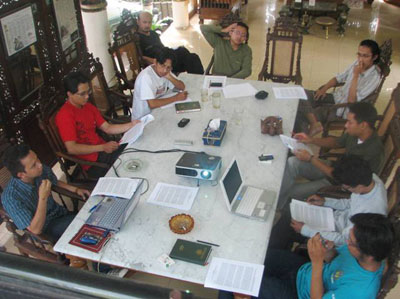
Yogyakarta, MelayuOnline.com - Fierce debate on the government‘s definition of “religion” versus “local belief” of the Sumbanese, including the devotees of Marapu “religion” in Sumba, appeared on a monthly discussion themed “The Marapu Religion: Divine Concept and the Sumbanese‘s View on Ancestors.” Coming as the keynote speaker was Lukman Solihin, a research fellow at the Center for Research and Development of Malay Culture (BKPBM) and the editor-in-chief of MalayTourism.com. Accordingly, such a discussion will be customarily held on the third week of a month, locating at Balai Pinang Lima building, the office of BKPBM.
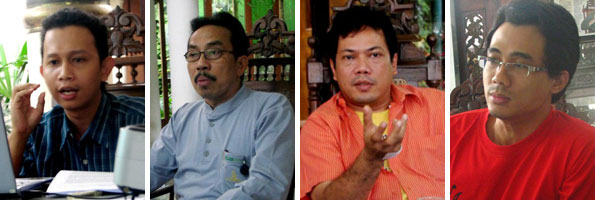
The discussion was held on Saturday (25/7/2009) since 1 PM, due at 2:30 PM. Coming to appear at the discussion were Mahyudin Al Mudra – the head of BKPBM and the director of MelayuOnline.com, Dr. Aris Arif Mundayat – the director of Center for Southeast Asian Social Studies of Gadjah Mada University (PSSAT-UGM) as well as a consultant of MelayuOnline.com, and redactors of MelayuOnline.com, MalayTourism.com, RajaAliHaji.com, and CeritaRakyatNusantara.com.
The Concept and Manifestation of Marapu
The discussion went on smoothly. Lukman explained in detail the divine concept of Marapu belief embraced by the Sumbanese. Lukman also clearly explicated the manifestation of the Marapu belief in the daily life of the Sumbanese. The manifestation of the Marapu belief, according to him, can be found at the Sumbanese‘s settlement patterns, worshiping monuments, sacrifice ceremony, and burial ceremony. “The Sumbanese‘s divine concept materialized in Marapu belief is the representation of how the Sumbanese are eager to establish harmonious relations with their ‘God,‘” he said. “The Sumbanese then run their life based on such a belief system,” he added.
“Marapu belief is categorized into an archaic belief. It is natured to glorify ancestral spirit, to believe in the existence of the dead spirit, and to embrace fetishism – a belief in the magical power of inanimate objects,” he said. Lukman further classified Marapu belief as a nature belief, based on the nature belief‘s characteristics as stated by Yewangoe in his book Korban dalam Agama Marapu (1980). Lukman states that the power and authority of nature is highly respected in the Marapu belief. “From such highly respect to the nature, there is the highest deity concept in the Marapu belief, even though Marapu belief is categorized archaic belief. The over-glorifying to the ancestral spirit and inanimate objects are media to worship the highest deity,” Lukman‘s remarks.
Marapu belief appears to greatly influence some spheres in the Sumba society. Marapu belief has been materialized into a “model for reality” in the Sumba society. The manifestations of Marapu belief are on the Sumbanese‘s settlement patterns, the Sumba traditional house architecture, worshiping places, and sacrifice or burial ceremonies.
“Local Belief” versus Government‘s Definition on “Religion”
A fierce debate occurred at the question-answer session. One interesting issue that emerged in this session was the use of “religion” word in the Marapu belief. Mahyudin Al Mudra questioned the discourse because so far, the government does only recognize six official religions in Indonesia while other “religions” are considered “local belief.”
Responding to Mahyudin, Lukman employed Clifford Geertz‘s theoretical frameworks on religion as a symbol system. Indeed, Greetz views everything, including religion, as symbol system thus it significantly influences people to run this life based on certain religions. The use of “religion” word, according to Lukman, is best viewed in the perspective of the Sumbanese‘s cultural context, not in the perspective of government that of course will always be influenced by certain political interests.
On the other hand, Aris Arif Mundayat appeared to back Lukman‘s opinion on the use of “religion” in the Marapu belief. Aris suggested that the insight on the Marapu belief should be positioned on the Sumbanese‘s cultural context. “If the Sumbanese considered Marapu a religion, why not?” he said jokingly. Further he added, “If we use “religion” in the Marapu belief, this will be our effort to enlighten the Indonesians, that of viewing social facts should not only be limited on the government‘s political hegemony, but also on the understanding of the subject we are scrutinizing, in this case how the Sumbanese view Marapu belief,” said Aris.
Afthonul Afif, MelayuOnline.com‘s editor-in-chief, suggested another opinion, excluding from the discourse of government‘s definition of religion and local belief concept. Afthonul viewed there are similarities between religions and local believes in Austronesian areas. “Religions at those areas are usually natured megalithic, in which the devotees worship to ancestral spirit through big stones as a medium. There is a belief that ancestor came down from the sky through a stone ladder connecting earth and sky,” he said.
Aris suggested a brilliant insight on how to view the Marapu belief. In his opinion, there is a need to raise awareness amongst the Indonesians that Indonesia is a plural country. “Consequently, it is necessary for the government to build cooperative relations with the people aimed at accommodating the local believes,” Aris‘s remarks.
Iswara NR (brt/04/07-09) Irfan Nugroho (ter/133/07-09)


 Today
Today  Yesterday
  Last week
  Last month