You are visitor number 105.216.314 Since 01 Muharam 1428 ( January 20, 2007 )
AGENDA
No data available
News
24 maret 2009 03:40
From Cape Town to the Land of Minangkabau
Panel Discussion and Awarding Ceremony of 2008 LKTI
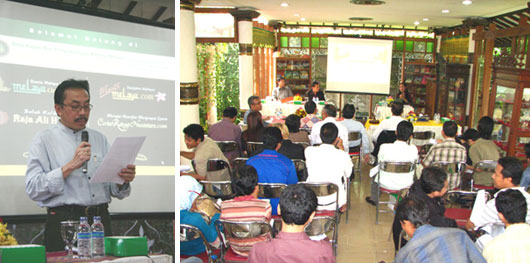
Yogyakarta, MelayuOnline.com- Panel discussion and the awarding ceremony of the 2008 International Lomba Karya Tulis Ilmiah – LKTI (Academic Writing Competition) had run successfully. The events held by the Center for Research and Development of Malay Culture (BKPBM) in cooperation with the Center for Southeast Asian Social Studies of Gadjah Mada University (PSSAT-UGM) took place at Balai Pinang Lima building on Friday (20/3/2009). Amongst the presents were academics from Indonesia and Malaysia, researchers, students, cultural workers, and some Malay prominent figures.
As said by Mahyudin Al Mudra, the head of BKPBM and the director of MelayuOnline.com, the panel discussion was the participants` academic responsibility. “Through such a panel discussion, the winners` papers are tested,” he said.
Of the three winners of the 2008 LKTI, only two winners attended the discussion while the remaining one will be “tested” next month. The two winners attending the discussion were Ahmad Sahidah and Israr Iskandar.
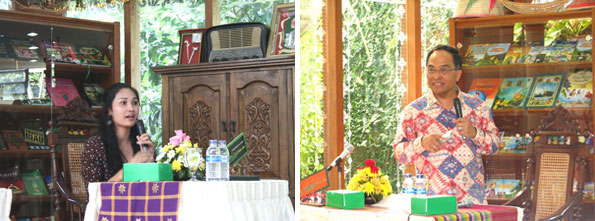
The panel discussion was hosted by Gilang Desti Parahita, a research fellow of PSSAT-UGM. Coming also as a keynote speaker was Mr Andrajati, a consulate general of the Republic of Indonesia to Cape Town, South Africa. He presented a paper entitled “Diaspora Budaya Melayu di Capetown, Afrika Selatan” (Malay Cultural Diaspora in Cape Town, South Africa).
Andrajati emphasized on the relations between Indonesia and Cape Town, referring to the same cultural roots between the two countries. Cape Town, or formerly called Cape of Good Hope, was used by the Dutch colonials to alienate the rebel Indonesians.
This is proven from the historical traces of Sheikh Yusuf, a Gowa (Makassar of South Sulawesi) descendant who was alienated to Cape Town by the Dutch in 1694 A.D. Another Indonesian finding himself alienated by the Dutch colonials is Imam Abdullah bin Qadi Abdus Salaam. He was a royal official of Tidore Sultanate who was alienated by the Dutch in 1780 A.D.
Those two Islamic scholars did not solely bring Islamic teachings to their alienation, but also Malay adat and custom as well as Malay language. “Based on a research, at least there are 350 Malay words that can be found in the Malay society in Cape Town,” he remarked.
Indeed, some words spoken by the Cape Town people are also found in the present Malay language. Just to mention some of them are “minta maaf” (apology), “terama kasie” (thank you), “sembahyang” (prayer), “wagtoe” (time), “labarang” (Eid-ul-Fitr/Eid-ul-Adha), “badjoe” (clothes), and “tusok konde” (chignon).
In some adat rites, the Malay people of Cape Town acknowledge these terms, such as “memotong rambut bayi” (cutting baby`s hair), “memberi nama bayi” (naming a baby), “mengubukan jenazah” (burial), and “mendoakan jenazah” (praying on behalf of a deceased person).
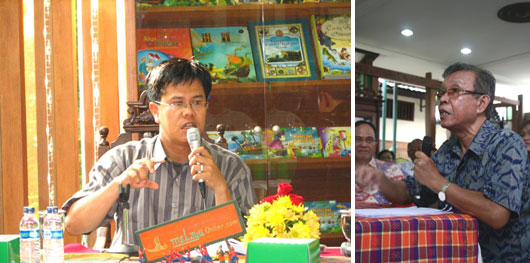
While the Malayness of the Cape Town society is really close to the Islamic matters, Ahmad Sahidah as the first speaker argues “becoming a Malay means becoming a Muslim, and he/she must be open to all new understandings.” Ahmad undertook a research on an ancient manuscript namely Bahr al-Lahut (the Sea of Divinity). According to Ahmad, the manuscript`s author clearly tells people that there are ways to become Malay. One of them is becoming a Muslim and deepening the Islamic teachings.
Mahyudin Al Mudra stands against Ahmad`s opinion. Mahyudin stands on that becoming Malay should not to be a Muslim. To him, Malay is not only about Islam because the history has unveiled there are stages in the development of Malay in the Archipelago.
Malay had once been “invaded” by Hinduism, Buddhism, Christianity, and Islam alone. “I`m not against Islam as one of the Malay identities. We ought not to cut the history of Malay at one certain historical stage. We must see the Malayness before and after the coming of Islam,” Mahyudin`s remarks.
Ahmad Sahidah, the second speaker of the discussion delivered a bit different theme. He highlighted mostly on the woman activism and democracy in the Land of Minangkabau. There is a view that women are highly respected in the Minangkabau adat and custom. However, such a high respect to women is not found in the politics.
Bundo Karang Foundation – a woman organization in West Sumatra – concerned greatly with cultural works. On the other hands, the organization`s existence was considered legitimating the New Order regime.
“Bundo Karang was regarded as the representation of the New Order regime. Hence, people view Bundo Karang properly represents all the Minangkabau women. Of course this is not true because only certain women who could chair positions in that organization, that of those who have family relations with the government” Sahidah`s remarks.
The New Order regime collapsed, the Reform Order appeared to the surface. Changes in the central government apparently did not touch the Minangkabau women. The Minangkabau women are still faced with marginalization, worse in the politics. Of fifty members of Provincial House of Representative, only four Minangkabau women chair positions in the House of Representative.
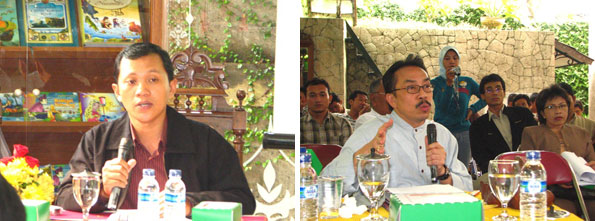
Prof Dr Sjafri Sairin, MelayuOnline.com`s consultant and a full professor at Gadjah Mada University, delivered criticism over Sahidah`s work. According to him, democracy is a modern political framework, consisting of state and citizen. On the other hand, Bundo Karang Foundation is natured matrilineal, a traditional concept that roots from clan.
“Consequently, it`s non-sense to compare the modern concept of democracy against the traditional concept of the Minangkabau women`s matrilineal,” Sairin said. He suggested a new approach on scrutinizing the democracy in the Land of Minangkabau by engaging the position and function of that traditionally matrilineal concept into the study of contemporary politics.
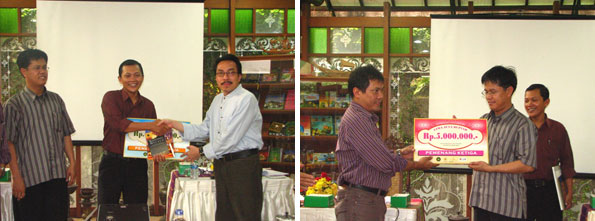
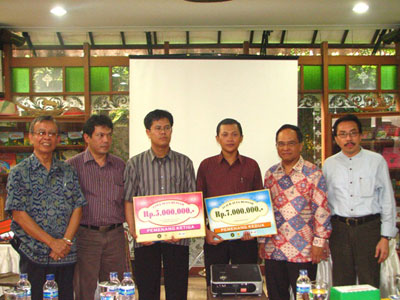
At the end of the discussion, the two winners were bestowed with some amounts of money and certificates. The first runner up, Ahmad Sahidah, was entitled to IDR 7,000,000 by the University of SainsMalaysia.
At the end of the discussion, the two winners were bestowed with some amounts of money and certificates. The first runner up, Ahmad Sahidah, was entitled to IDR 7,000,000 by the University of SainsMalaysia.
The second runner up, Israr Iskandar, was entitled to IDR 5,000,000 by PSSAT-UGM. Iskandar is currently serving as a lecturer at the University of Andalas, Padang, West Sumatra. The third runner up, Siti Nurhidayah, was rights for IDR 3,000,000 from Mr Andarjati.
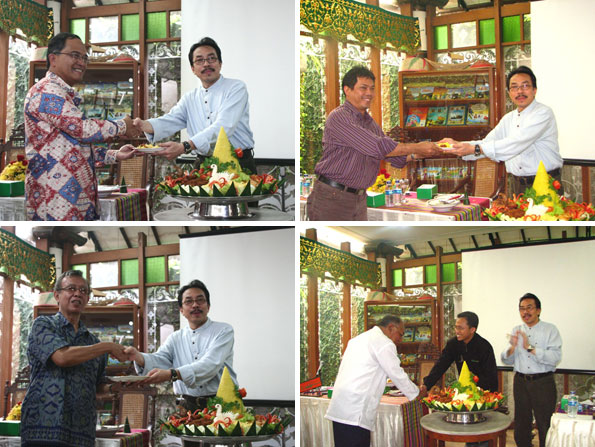
The end of the day`s event was a tumpeng (yellow rice served in a cone shape) cutting ceremony. Indeed, January 20th, 2009 precisely coincided with the first anniversary of RajaAliHaji.com. Before closing the anniversary celebration, Mahyudin wished that RajaAliHaji.com could stay enlightening the people, as the website`s slogan the Living Malay Wisdom.


 Today
Today  Yesterday
  Last week
  Last month