Friday, 4 September 2026 |Friday, 21 Rab. Awal 1448 H
Online Visitors : 1.558
Today
:
27.233
Yesterday
:
25.579
Last week
:
32.264.566
Last month
:
43.463.948
You are visitor number 105.216.314 Since 01 Muharam 1428 ( January 20, 2007 )
AGENDA
No data available
News
29 agustus 2009 02:00
Putting Pendet Controversy Aside, Indonesian Dancers Dazzle In Prague
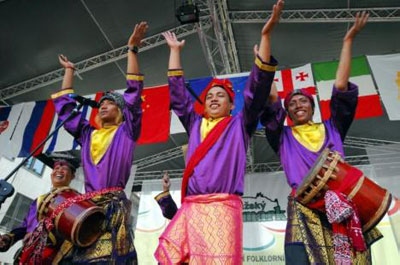
Indonesian dancers perform a Czech folk dance at the Prague festival. (Photo courtesy of www.praha.eu.)
Prague, Czechoslowakia - While their compatriots back home fumed over the use of the Balinese pendetdance in a Discovery Channel ad about Malaysia, an Indonesian folk dance troupe dazzled crowds with a Betawi dance at a festival in Prague.
The JakartaStateUniversity student dance group performed the Lenggang Nyai dance at the opening of the the 6th Jarmark International Folklore Festival. The Indonesians had the honor of performing first, according to an Indonesian Embassy official.
The Prague city portal www.praha.eu wrote that the group also performed the traditional Czech Holka Modrooká dance.
“The highlight was when the dancers spoke a few Czech words to invite all the spectators to sing with them,” it reported, adding that the performance drew “a big round of applause.”
The eighteen dancers and musicians are also performing the Giring-Giring dance from Kalimantan, West Java`s Reog Dok-Dok and Ketuk Tilu, Papua`s Yosim Pancar, and the Piring Cupak dance of West Sumatra on their tour, which includes stops in Pisek, Czech Republic and Bratislava, Slovakia.
Among the festival`s 1200 performers are groups from China, Georgia, Serbia, Turkey, Slovenia, Dominican Republic, Israel, Cyprus, Russia and CzechRepublic.
The pendet feud erupted late last week after reports that Malaysia had used an image of Bali`s traditional dance in an official tourism ad. While the Discovery Channel later claimed responsibility, saying it had made the error independently in an advertisement for a series about Malaysia, the incident inflamed Indonesia`s longstanding resentments over Malaysia`s use of cultural traditions in its marketing.


 Today
Today  Yesterday
  Last week
  Last month