You are visitor number 105.216.314 Since 01 Muharam 1428 ( January 20, 2007 )
AGENDA
No data available
News
14 sepember 2009 02:00
The Rags To Riches Story Of Indonesia`s Wayang Batik
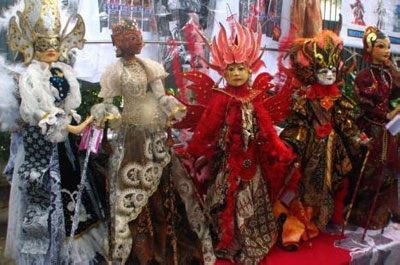
Solo, Central Java - Amijoyo W Edi, a Solo antiques dealer, manages to combine the best qualities of two Javanese traditions: batik fabric and wayang puppetry. He dresses his wooden puppets — which he originally made for the Solo Batik Carnival in June — in flamboyant costumes fashioned out of batik rags.
“The puppets were supposed to be miniatures of typical carnival participants,” Amijoyo said. “But they looked amazingly alive to me — to us all! I decided to make another one. And then, yet another.”
Asmijoyo experimented with different colors, motifs and costume designs, and also with raw materials like resin and wood with which to make the bodies of the puppets. He has made about 40 wayang batik in all.
A number of prominent people have praised Amijoyo`s puppets, including fashion designers and national dignitaries, and the puppet maker said he had received a steady stream of orders.
“People want wayang batik for their own collections, not just to admire from afar,” Amijoyo said. “So, I was motivated to create more.”
Amijoyo does not make his puppets alone. “My staff — there are four of them — make the bodies and sew the costumes from rags,” he said. “Then they will be shown to me. I make embellishments as I see necessary. I really enjoy the mix-and-match process.”
To make one wayang takes Amijoyo and his team about two weeks. “But there are times when we have to hurry to finish them,” he said.
Amijoyo aspires to make his puppets meaningful for both himself and others. He said three basic principles governed his puppet workshop.
The first principle is cultivating the imagination. Second is that the existence of the puppet workshop should help perpetuate and protect traditional Javanese culture — “Well, at least kids will know about this cultural heritage and appreciate it,” Amijoyo said.
The third principle is that Asmijoyo doesn`t want his puppets to be mass produced, but for each and every one of them to be truly individual in nature. Amijoyo said he wanted his puppets to be seen as collector`s items rather than playthings or souvenirs, which is why he is content making just one or two a month.
Joko Widodo, the mayor of Solo is reportedly so impressed with Asmijoyo`s funky-looking puppets that when official guests from other countries visit the city, he will often show them examples of Asmijoyo`s work.
Except for Amijoyo`s home on Jalan Lesanpuro, which doubles as a gallery and workshop, no other store in Solo sells wayang batik.
Moreover, Amijoyo frequently travels out of Solo, so his home is seldom open to visitors.
The only venue where people can be assured of seeing his creations is the Ngarsopuro night market, held near the Pura Mangkunegaran complex in downtown Solo every Saturday.
“Even Ibu Marie [Elka Pangestu, the trade minister], fell in love with my chicly dressed puppets when she visited Ngarsopuro. She bought one immediately,” Amijoyo said.
In the near future, the father of three plans to marginally increase his production output and diversify in terms of characters and fabrics.
He said he particularly wanted to create more action-figure characters — local equivalents of Wolverine or Samurai X — make even more outlandish costumes and start using other traditional Indonesian textiles besides batik.
However, Amijoyo, an environmentalist at heart, has committed to using only discarded or recycled goods for his puppets.
“It takes time, and it takes a huge effort,” he said of the puppet-crafting process.
“My mind is brimming with creativity, but that alone is not enough. I have to put my ideas on paper, and then have them built into things we can all see, hold, and appreciate.”
Amijoyo recalls being “totally shocked” when he received an order one day to ship off tens of thousands of his puppets abroad.
The impossible request came from a European visitor to a Web site of one of Amijoyo`s colleagues who had posted a picture of his puppets.
“The European must have thought he was ordering mass-produced dolls. No, no. This is a piece of artistry, contrived carefully and aesthetically, not simply an industrial product,” Amijoyo said. Tash Roslin


 Today
Today  Yesterday
  Last week
  Last month