You are visitor number 105.216.314 Since 01 Muharam 1428 ( January 20, 2007 )
IMAGE GALLERY
AGENDA
No data available
Opini
03 juni 2010 02:36
Sailing Mempawah River, Pilgrimage to Sebukit Rama
Journal on the Trip to Mempawah Kingdom, West Kalimantan (2)
By Iswara N. Raditya
Our car was moving so fast along the main road of Pontianak Regency capital on Tuesday (02/19) that morning. Aam Ito Tistomo a.k.a. Mas Aam, our photographer, Karaeng Oe Syaipul Ansari, and myself were on our way to Amantubillah Palace, the pride of Mempawah Kingdom. We departed fromSyaipul’s house. Syaipul was MempawahKingdom’s minister for foreign affairs. He let Mas Aam and I stay in his place while we were covering in Mempawah, the capital of Pontianak Regency, West Kalimantan. That day, only the two of us were present in MempawahKingdom because Bang MAM, the familiar name of Mahyudin Al Mudra, S.H., M.M., head of the Center for Research and Development of Malay Culture and also Chief Editor of www.MelayuOnline.com, had to head back for Pontianak to handle important business.
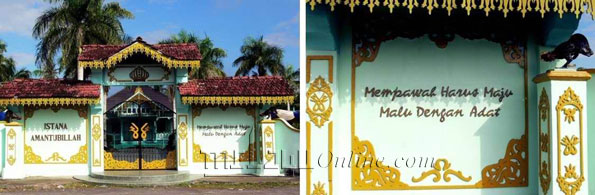
After a short trip of more or less 15 minutes, we arrived at the palace. Even from distant we could already see a big gate, which was no other but the front gate of the royal area. Soon as we passed the gate and MempawahRiverBridge, there appeared the white wall surrounding the palace. A writing on a side of the entrance gate of AmantubillahPalace complex read “Mempawah Harus Maju, Malu dengan Adat” (Mempawah must advance, We should not embarrass the tradition). These words have been the people’s jargon of MempawahKingdom.
Mempawah Kingdom
Meanwhile, on both sides of the Palace front gate, there proudly stood two statues of roosters. It looked as if the statues were the ushers of Amantubillah Palace. Rooster has been one of pride symbols of MempawahKingdom as Opu Daeng Menambon, the founder of Islamic Mempawah Kingdom, was very keen on roosters which is believed to signify courage and manliness.
Amantubillah Palace lies in an area called Pulau Pedalaman, which has become a subdistrict/village under the administration of East Mempawah District, Pontianak Regency. As its name suggests, Pulau Pedalaman is an island surrounded by a river known as Mempawah River. It was the center of MempawahKingdom administration during the reign of Gusti Jati, entitled Sultan Muhammad Zainal Abidin who ruled c. 1820-1931. Sultan Muhammad Zainal Abidin was grandson of Opu Daeng Menambon (1740-1761) and son of Gusti Jamiril, entitled Panembawah Adiwijaya Kesuma (1761-1787).
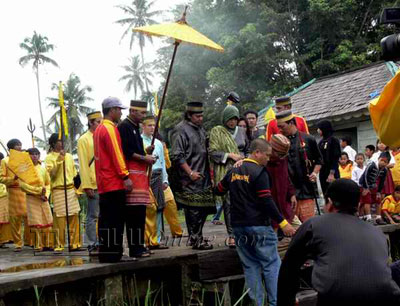
It was still quiet when the three of us entered the complex of the palace. But it was not long as soon after we got in, the troops and officials of MempawahKingdom arrived one by one and got ready to perform the rite of Robo-Robo, i.e. pilgrimage to the grave of Opu Daeng Menambon. Opu Daeng Menambon is the first king of Islamic Mempawah Kingdom who passed away on 1761. Opu Daeng Menambon was buried in a sacred place at the top of a hill called Sebukit Rama. It took approximately an hour by boat to get to Sebukit Rama from Pulau Pedalaman.
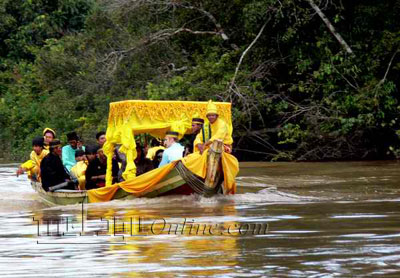
Thanks to Oe Syaipul Ansari, Mas Aam and I were allowed to sail along on pilgrimage to Sebukit Rama, riding in one of the three boats. It was really an honor for us because not everybody could ride in the boats which usually are used by the royal family or the kingdom’s dignitaries. The frontmost boat was the most beautiful and grand, ornamented with yellow cloths, the color of pride of Mempawah Kingdom. This particular boat was only for the king, queen, king’s children, and king’s relatives.
King of Mempawah Getting on The Boat
There was one thing that drew my attention. Among those in the first boat, there was a young blond man, a bule (Indonesian term of reference for Caucasians). Who was that man? As I got to know him, later on I was informed that he was Martin, a Dutchman, the pair of the King’s oldest daughter or that is to say, the king’s future son-in-law. I was also told by a king’s relative that Martin had converted into Islam. Mempawah Kingdom was indeed open to cross cultural matters.
The openness of the Mempawah King’s family is then understandable as they really are not exclusive noblemen. They respect others and are willing to get along with outside world. Mempawah King, Pangeran Ratu Mulawangsa Mardan Adijaya, M.Sc. is an alumnus of a university in Kanada while his consort, Ratu Kencanawangsa Dr. Ir. Arini Mariam, M.Sc., finished her highest academic degree in Australia.
The second boat was for Mempawah Kingdom’s dignitaries such as the army commander, kingdom’s relatives, and a number of other high officials.Mas Aam and I rode along in this second boat. Meanwhile, the third boat contained the kingdom’s troops and the musicians. The trip to the grave of Opu Daeng Menambon in Sebukit Rama was taken through the streams and traditional Mempawah music was accompanying us along the way.
We departed from the tributary of Mempawah River behind Amantubillah Palace. It was not far from the palace and still within the palace area. The river in which we started was not so wide, but it looked like it used to be the royal family’s place for refreshing in the past as at the river bank, there is a place that seemed to be a resthouse. The tributary of Mempawah Rivar is also where one of the tests is given in the midnight for the candidates of The Royal Troops of Mempawah Kingdom(Laskar Kerajaan Mempawah). They say, there are still wild crocodiles in the river.
The boat of the royal family was up front, followed by the second boat wherein there were the troops and musicians playing fast exciting rhymes, while our boat was sailing behind them. The order was automatically changed as we were on the wider stream of Mempawah River. The three boats often sailed in row and different positions, but then some time a boat got ahead of the others.
It was a fantastic and unforgettable experience for me to sail along Mempawah River that I thought was very vast, or maybe also for Mas Aam. We live in Yogyakarta and I think no Kalimantanese would think any river in there is big. In fact, our brothers in Borneo call the rivers in Java “parit” or ditches.
Sailing the River to Sebukit Rama
Throughout the trip, I did not stop wondering the vastness of Mempawah River and observing the river banks which looked more like a swamp with all the twisted roots here and there. “It is indeed a good place for crocodile,” I said to myself. Nevertheless, I did not worry much as I believed that these people were already experienced and familiar with the route. Moreover, there were the locals fishing at the river banks and waving hands as we were passing them. Besides, I was also entertained with the show of the wild monkeys hanging and jumping from tree to tree at the river sides.
Not long after, we halted a while on a curve. The music stopped, the situation turned into silence as adzan was being recited from the royal family’s boat. Then the offerings were spread around our boat. After the traditional rite, we continued out trip to Sebukit Rama, where many people gathered, waiting for us (to be continued).
__________
Iswara N. Raditya, redactor of www.MelayuOnline.com Translation by Reza Daffi (trans/06/05-10) Source of Photo: document of www.MelayuOnline.com (Photographer: Aam Ito Tistomo)


 Today
Today  Yesterday
  Last week
  Last month