Tuesday, 18 August 2026 |Tuesday, 4 Rab. Awal 1448 H
Online Visitors : 690
Today
:
11.125
Yesterday
:
22.556
Last week
:
179.363
Last month
:
11.454.048
You are visitor number 105.216.314 Since 01 Muharam 1428 ( January 20, 2007 )
IMAGE GALLERY
AGENDA
No data available
Opini
09 juni 2010 06:38
Assembling around the Grave of Opu Daeng Menambun
Journal on the Trip to Mempawah Kingdom, West Kalimantan (3)
By Iswara N. Raditya
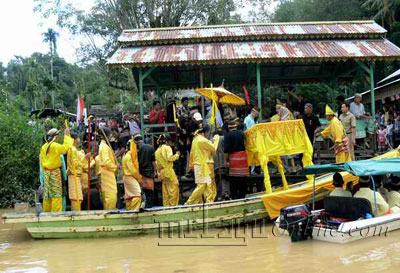
After sailing Mempawah River for about an hour, we finally got to Sebukit Rama where Opu Daeng Menambun was laid to rest. The three of our boats were pulling over slowly and from distance there were seen a crowd of people waiting for us at the bank of the river. Apparently, the pilgrimage to the grave of Opu Daeng Menambun, which was part of Robo-Robo ceremony, appealed to people of Mempawah in particular and West Kalimantan in general. The traditional rite has been established as an annual agenda by the local government in the purpose of encouraging tourism enthusiasm, especially cultural tourism in the province of West Kalimantan.
The King’s Boat Docking at the Bank of Mempawah River
Our presence (Mas Aam, photographer, and myself) as representatives of www.MelayuOnline.com in Mempawah Kingdom, Pontianak Regency, West Kalimantan, was to follow and cover events during the Robo-Robo traditional ceremony. The rite itself was a commemoration of the arrival of Opu Daeng Menambun in Mempawah. The term Robo-Robo derived from the word “Rabu”, or Wednesday, which was believed to be the day when Opu Daeng Menambun set foot in Mempawah for the first time—on a Wednesday in the fourth week of Safar month to be precise.
From Sidiniang to Sebukit Rama
Opu Daeng Menambun was the first ruler of Islamic Mempawah Kingdom. Prior to his reign, Mempawah was governed by Dayak people, for instance, under the leadership of Patih Gumantar since around 1380 A.D. Because its capital sat in Sidiniang Mountains, Sangking area, Mempawah Hulu, the kingdom was better known as Sidiniang Kingdom. Later on, the capital was moved several times.
After its downfall as a result of Suku Bianju Kingdom’s attack in 1400 A.D. which saw Patih Gumantar killed, the kingdom’s civilization was waning. However, 200 years on, in around 1610 AD, there raised a new government on the ruins of Sidiniang Kingdom. The leader of the new kingdom was King Kodong or King Kudung. The King moved the seat of his government from Sidiniang to Pekana not long after.
In around 1680 AD, King Kudung passed away and was entombed in Pekana. The throne was then assumed by Panembahan Senggaok, also known as Senggauk or Sengkuwuk. The name “Senggaok” was used as the seat of government moved from Pekana to Senggaok, which was an area in the upper course of Mempawah River. Panembahan Senggaok had a daughter named Utin Indrawati who was married with Sultan Muhammad Zainuddin from Matan Tanjungpura Kingdom. From this marriage, Putri Kesumba was born. The princess later married Opu Daeng Menambun, the man who brought Islam to Mempawah.
Opu Daeng Menambun himself was a nobleman from Luwu-Bugis Kingdom, South Sulawesi. Opu Daeng Menambun together with his father, Opu Tendriburang, and four brothers, Opu Daeng Perani, Opu Daeng Celak, Opu Daeng Marewah, and Opu Daeng Kemasi, visited Malay Kingdoms to proselytize Islam and in some cases help the kingdom they got to stop by. Their arrival in Malay lands became one of Bugis migration chapters in the 17th century. Opu Tendriburang Dilaga and his five sons played a great role in Malay Peninsula and Borneo, particularly in spreading Islamic teachings.
Opu Daeng Menambun (1965-1763 A.D.)
In 1740, Opu Daeng Menambun started to rule Mempawah Kingdom. The day on which Opu Daeng Menambun set foot in Mempawah for the first time, on Wednesday of the fourth week in Safar month, was commemorated with a traditional ceremony called Robo-Robo. Since Opu Daeng Menambun sat on the throne, Mempawah Kingdom transformed into an Islamic kingdom. Islam, thus, became the official religion.
Becoming the king of Mempawah, Opu Daeng Menambun was entitled Pangeran Mas Surya Negara, while his wife, Ratu Kesumba, was entitled Ratu Agung Sinuhun. Not long after assuming the throne, Opu Daeng Menambun moved the seat of his government from Senggaok to Sebukit Rama, which was also where Opu Daeng Menambun passed away and was entombed in 1763.
The Sacredness of the Hilltop Grave
Our boats finally docked at the bank of Mempawah River. Many people greeted us, especially to honor the royal family of Mempawah Kingdom. Then, the royal entourage headed for the grave of Opu Daeng Menambun. Mas Aam and I speeded our steps to catch up with the entourage at the graveyard entrance. A long set of staircase spanned upwards behind the gate.
The staircase reminded me of the Mataram Royal Graveyard in Imogiri, Bantul, Yogyakarta, wherein kings of Surakarta Sunanate and Yogyakarta Sultanate were laid to rest upon a hill. Perhaps, Mempawah people’s belief bears a likeness to Javanese cosmology. According to Javanese traditions, kings or leaders must be buried in a high place because they believe that the higher the place, the closer it is to God. The concept that king is God’s representative/descendant explains the basis of this belief.
In front of the gate, there were many people jostled to get in. It seemed that the enthusiasm to participate in the annual ceremony was high. I was among those people struggling to ascend the staircase. Consequently, I was parted from Mas Aam even though I got to see at a glance that our photographer tried to run up as fast as he could in order to catch up with the royal entourage. I knew, Mas Aam did not want to miss important moments to take pictures of.
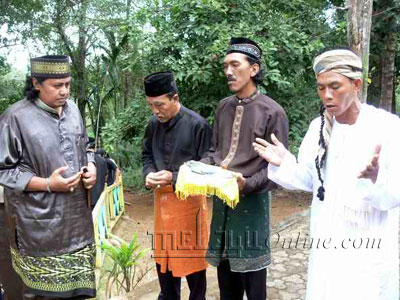
Praying in front of The Grave
I stepped up the stairs, one by one. Unlike the Mataram Royal Graveyard whose stairs were wide and straight, the stairs here were narrow and windy so that it demanded extra energy to get to the grave. At length, I got to the top of Sebukit Rama. The grave of Opu Daeng Menambun lies in a modest building. Although not really huge and grand like typical king’s graves, it is quite neat and clean. In front of the building which looked more like a small mosque, high officials of West Kalimantan provincial government as well as Pontianak regent government had been waiting for the King of Mempawah. Before entering the building to perform the pilgrimage, we all prayed together.
The royal entourage entered the building. But unfortunately not long after, heavy rain poured over the place. It was odd though, because until several minutes before, from Mempawah River to Sebukit Rama, it was sunny and even sultry.
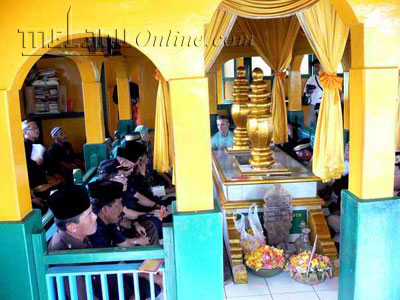
Despite the heavy rain, the pilgrimage moved on. King of Mempawah and the royal family, along with the high officials of West Kalimantan provincial government and Pontianak regent government, sat in line neatly around the Opu Daeng Menambun’s grave, which was decorated with yellow ornaments, the Malay color of pride. The pilgrimage took quite a long time and we were wrapped up by sacredness of the traditional rite. The scent and smoke produced by incenses added to the stuffiness of the room, which was already crowded by people who wanted to take part in the event. But somehow, the pilgrimage went on calm and solemn.
The Grave of Opu Daeng Menambun
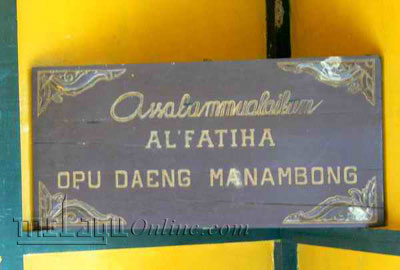
The grave was surrounded by a fence ornamented with yellow cloths. On the corner, there was a wooden board with an inscription that reads “Assalamualaikum, Al’ Fatiha, Opu Daeng Manambong”. The name of the king was often written differently. There were many versions in the books that I used as reference to write about the history of Mempawah Kingdom. Thus, the name written on the board was different from that on the gravestone, on which there was an inscription that reads “Opu Daeng Menambon Ibnu Bin Tandre Borong Daeng Rilaga, Lahir 1106 H (1695 M), Wafat 1774 H (1763 M)”.
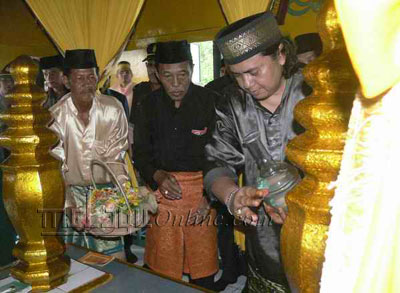
The pilgrimage ended with spreading flowers over the grave and cleaning up the grave with pure water. King of Mempawah along with the royal family and some of the high officials performed the closing ritual in turn.
Cleaning Up the Grave of Opu Daeng Menambun
After the whole rite was done, everyone prepared to leave Sebukit Rama. But again, oddly the rain subsided. As the royal kingdom and high officials of the regional government left the grave complex, one by one, the people descend the staircases to go home. I myself reunited with Mas Aam and soon left the sacred place. Down there, a car provided by the committee of the ceremony had been waiting for us.
__________
Iswara N. Raditya, history redactor/reporter of www.MelayuOnline.com Source of Photo: Collection of BKPBM/MelayuOnline (Photographer: Aam Ito Tistomo)


 Today
Today  Yesterday
  Last week
  Last month