Sunday, 6 September 2026 |Sunday, 23 Rab. Awal 1448 H
Online Visitors : 1.638
Today
:
22.582
Yesterday
:
26.946
Last week
:
32.264.566
Last month
:
43.463.948
You are visitor number 105.216.314 Since 01 Muharam 1428 ( January 20, 2007 )
IMAGE GALLERY
AGENDA
No data available
Opini
15 mei 2008 04:27
Exploring Malay Grandeur Through Alwatzikhoebillah Palace, Sambas
MelayuOnline.com Culture Journey in West Kalimantan (3)
The MelayuOnline.com one-day cultural journey in West Kalimantan ended in Alwatzikhoebillah Palace, Sambas. Previously, MelayuOnline.com had visited two other Malay palaces; those were Kadriah Palace in Pontianak and Amantubillah Palace in Mempawah. Based on study conducted by History Study Center of West Kalimantan in 2000, there were 40 sultanates, but there were only 21 sultanate palaces, which were recorded. Limited time made MelayuOnline.com not to continue to find Malay history in 18 other palaces (or former palaces) because on that day, Friday, February 2nd, 2008, the crew had to leave for Kuching, Malaysia.
The name of “Alwatzikhoebillah” was taken from Arabic language, which means “who trusts God”. The meaning of this word is close to “Amantubillah”, the name of Mempawah Sultanate Palace, which means “I have faith in God”. Those two words, “alwatzikhoebillah” and “amantubillah”, have the meaning of the obedience to God, and also symbolize the soul and body surrender of the whole sultanate elements and its people to the Creator. From those two words, we can see how strong the influence of Islam doctrine is in every aspect of Malay people‘s life, so the view and the beliefs, which revolves in the palace and are shown by symbols also represent the belief of the people around.
There is also something that is interesting to be noticed, that Mempawah and Sambas Sultanates made the attitude of surrender to God as their main symbol, as reflected in the name of every palace. Meanwhile, the name of Kadriah Palace was taken from someone‘s name: Habib Hussein Al-Kadrie, Sultan Syarif Abdurrahman‘s father (the founder of Kadriah Sultanate who was also as its first sultan). It seems that the naming of Kadriah Sultanate was influenced by Arabic tradition, which always made the ancestor‘s name become the name of dynasty. For example, in Arab there are Umayyah Dynasty, Abbasiyah Dynasty, and Fatimiyah Dynasty. All of them refer to the ancestors of every founder.
In Arabic tradition, recording the descendant line is very important especially if the line ends to someone who has social status or high virtue level. However, there is no tradition like this in Malay society, so Malay people not really know about their family tree (genealogy) in detail. That dissimilar tradition created the variation in selecting the symbols, as seen on the palaces in West Kalimantan, although the founders lived in the same area and culture: Malay.
***
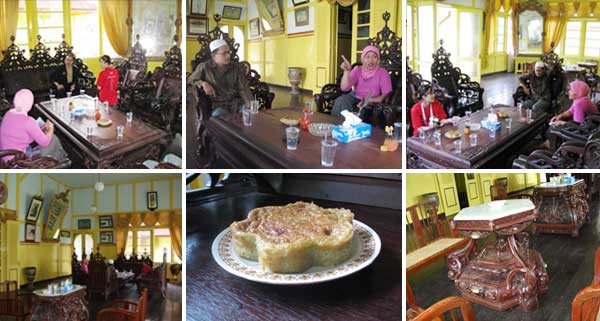
The visit of MelayuOnline.com to Alwatzikhoebillah Palace was welcomed by Queen Endang Sri Muningsih, who coincidentally was relaxing in the front room of the palace. After asking MelayuOnline.com to sit in big and antique ancient chairs, Queen Endang served us a delicious Kemojo sponge cake and fresh drinks and take part in conversation. Coincidentally, there were still few visitors coming in the morning, so we could talk freely about everything, especially about the perpetuation efforts of Alwatzikhoebillah Palace and other inheritance things of Sambas Sultanate. However, sometimes our conversation swerved from the first conversation context, even we also discussed how to prevent land sick by Malay method.
Sometimes the crew focused on things located around the front room of the palace which seemed ancient but well-kept. Suddenly something spread in the mind of MelayuOnline.com General Manager to file and study those things, then publicize them to the society as preservation effort of Malay heritage. Such good aim was eventually said, and Queen Endang accepted it well and also said if that perpetuation effort was done, the palace family would help us to provide the whole information and data needed. Hopefully, this became the first step of well cooperation between the Sambas Palace and MelayuOnline.com. Just a moment after the conversation, MelayuOnline.com went around the palace area.
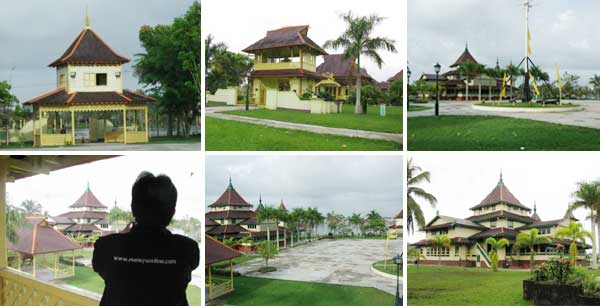
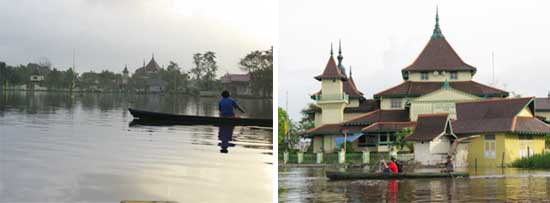
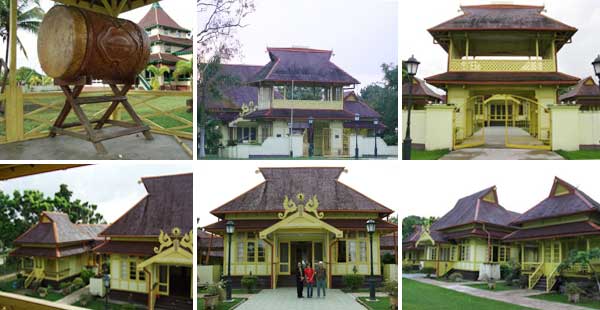
Inside the Sambas Palace complex, there are some buildings; palace, mosque, residence house of sultanate family, meeting hall, and two main gates. Open field or square, which has about one hectare breadth, connects the first main gate with the whole existed building, so those buildings become a unity. The unity concept among the palace, mosque, and open field is just the same with the palace building concept in other areas in Indonesian archipelago.
The first main gate is a gate to enter the square and also a border between public way and palace area. While the second main gate bounds the square and palace yard. If we look at the whole building from the first main gate, we will find the buildings layout inside this location so well-arranged. On the right side of the square, there is Jami‘ Syafiuddin Mosque (Jami‘ Sambas Mosque), which was built in 1877 AC by Sultan Muhammad Tajuddin. This mosque architecture, which consists of two floors, is very beautiful, the roof consists of three stages with pyramid form for the top stage. The first floor is used for men and the second floor is used for women. Every part of the building has separated roof with other building‘s roof, so those roofs seem layered. The first roof is the lowest roof, then it is followed by the second and the third roof, which become the second floor roof. Every roof is separated by eight windows, which function as air circulation regulator. The main materials of this mosque are the selected woods, which are said coming from the palace owned by one of Sultan Tajuddin‘s wife located in other side of the river which is spread out in front of the palace.
On the right side of the mosque, there are two meeting halls located precisely on the right and left side of the second main gate. Those two meeting halls seem moderate but clean. The wall has about a half meter height, and the roof is made from wood chops supported by 10 prop pillars, which has about 2 meters height. In the past time, these halls are used to receive honor guests before meeting with sultan. Nowadays, those meeting halls are functioned as bedug (large drum used to inform the Moslems about praying time) place. It is pretty astonishing to see bedug in the yard of Sambas Palace, because bedug becomes special character of mosques in Java to show the praying time. How can bedug move to West Kalimantan? In the past time Sambas Sultanate was open for foreign culture to enter and develop in its area.
The great numbers of people outside Kalimantan that come to Sambas, for both politic and economic necessity, encourage the existence of cultural contact and acculturation process between local culture and foreign culture. Among such a lot of cultures, Java culture is the one that influences Sambas Sultanate. It was brought by Majapahit soldiers about the 14th century when Sambas Kingdom still followed Hindu religion. The bedug is one form of those influences in the case of the Sultan‘s sons‘ title. For example, the son of Sultan Umar Akamuddin (the fifth Sultan of Sambas) is Raden Pasu whose title is Prince Anom. The word “raden” and “prince” are titles which are commonly used by aristocrats in Java.
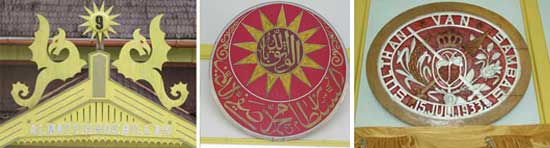
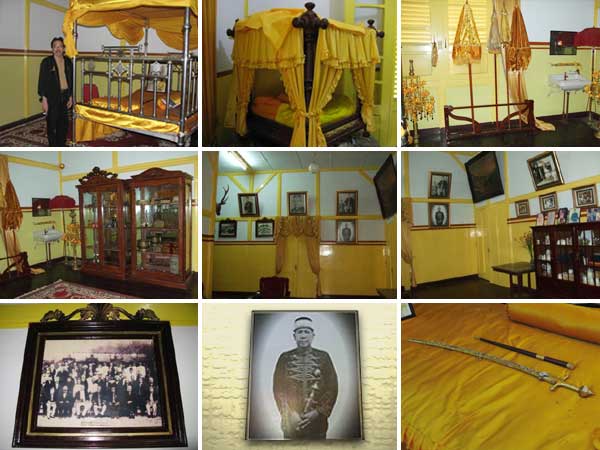
If we stand at the back side of the second gate, we can see clearly three palace buildings, which connect each other with the domination of yellow, Malay special color, which symbolizes prestige and behavior level. The main building is located in the middle and has the biggest size. Meanwhile, the buildings on the right and left side are the supporting buildings, which have different functions. Above the door of the main building, there are two sea horse symbols, which have wings facing the sun symbol located in the middle. The inside part of the palace is divided into three rooms; those are front, middle, and back room. The front room has pretty large size which is functioned as the throne room of sultan and queen in the past time. In this room, the photographs of sultans wearing sultanate luxurious clothes are unfolded in every corner. The middle room consists of four rooms, which become the room of sultans and their families in the past time. In this room, there are also many photographs of sultans with their families, honor guests, and sultanates programs. Meanwhile, the back room has narrow size and seems empty.
The additional building on the right side in the past time was used as a place to receive honor guests who visited the palace. Meanwhile, the building on the left side was used to prepare all of sultans and their family needs. Nowadays, the front part of the right building is used to keep the heritages from the Sultans of Sambas. Creese, spear, and other kinds of weapons, included gong are well-kept in this room. Although those weapons have already been rusty, it does not decrease their art and historical values.
On that day, MelayuOnline.com became the first visitor who entered the inheritance room. Slowly, the door was opened by one of the sultanate family while MelayuOnline.com crew waited curiously. It was understandable because the crew was the fan and the collector of ancient goods. After the door was opened widely, we could feel the mystical nuance together with fragrant smell from the flowers, which were strewn in some room corners. Maybe for some visitors who had sharpened their inner feelings ability well would feel more about such mystical power from the weapons which had been hundreds years old. The people‘s belief about the mystical power of these weapons was seen in the pile of money, from thousands until fifty thousands which were put by the visitors who hope to get goodness.
Enjoying the historical things around the palace enthusiastically, MelayuOnline.com did not notice that the time had been 08.47 WIB. In fact, the crew had to go to the border of Indonesia-Malaysia quickly. It took us about 9 hours from Sambas. Almost 3 hours MelayuOnline.com enjoyed the Malay history in Sambas Palace. A moment after talking again to Queen Endang, MelayuOnline.com left the palace in order to visit the grave of Sultan Abubakar Tajuddin II (the eleventh Sultan of Sambas) and Sultan Muhammad Syafiuddin II (the thirteenth Sultan of Sambas) which were located not far from the palace area.
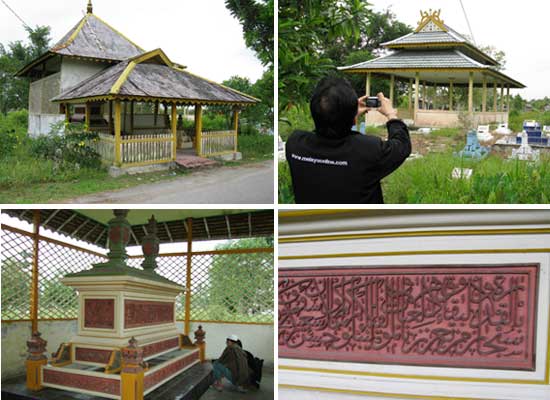
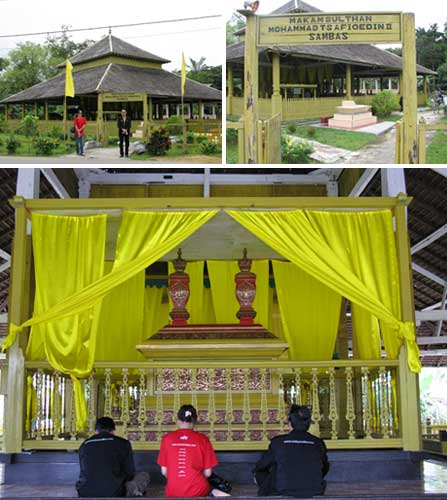
After following the narrow and wavy streets for a few minutes, the crew arrived in the graves area of Sultan Abubakar Tajuddin II. The condition of that grave was quite pitiful. The floor, wall, and roof of the grave seemed already brittle. When entering the grave area, the crew tiptoed and raised their pants a little bit to avoid the water which was flooded around the grave.
However, the sympathy of MelayuOnline.com was cured a little bit by seeing the condition of Sultan Muhammad Syafiuddin‘s grave, which was in better condition. The ground around the grave was dry, and the grave location was high enough, so it could not be reached by the water. The tombstones of those two sultans‘ graves were filled with carvings of Qur‘an sections which mentioned about the request of magfirah (forgiveness) to the Almighty, warning section that human was made from soil and would be back to soil, and also sections which teach about God‘s oneness. In the lower part of those tombstones, there were carving of the two sultans‘ family tree which ended to Sultan Muhammad Syafiuddin (1631-1668), the first Sultan of Sambas.
By seeing three Malay palaces in West Kalimantan directly, MelayuOnline.com found some things that should be noted. The efforts of West Kalimantan regional government to build a mission as Malay cultural centre in Southeast Asia still needed more preparation. On one side, West Kalimantan Malay House had actually been built gloriously in Pontianak City, which was projected as Malay activities centre in West Kalimantan. Everybody would shake their head as amazement sign when seeing that glorious Malay House. On the other hand, the local government had not optimized the perpetuation efforts and the promotion of Malay history inheritances in that area yet. When entering the palace location, for example, there were still no sufficient information facilities about the involved tour object, such as simple booklet or even leaflet. There were also no other supporting facilities which were sufficient to support a location to be more proper to be visited.
It is different from Brunei Darussalam and Malaysia. Brunei has a commitment to becoming the Borneo Malay culture centre, and seriously has run kinds of activities, not only connected with knowledge but also cultural and historical reservation to support the success of the mission. Such in the case of Malaysia which had done the tidying up in every sector long time ago to support their mission as the Truly Asia and Malay culture centre in 2020. To sum up, those two countries has started and run to finish point of Malay culture centre in Southeast Asia. What about Indonesian Malay?


 Today
Today  Yesterday
  Last week
  Last month