1. The Origin
The number of natural disasters such as drought, flood, and landslide happening in Indonesia are evidences that our natures begin worsening. The wealth of Indonesia’s natural resources is exploited mercilessly by irresponsible people and groups. In fact, state regulation forbidding such crimes has been established and severe punishments for those breaking the law have been fixed as well, but there are no significant changes at all. They seemingly view state regulation as a mere “holy book” that has no capability of reducing the number of crimes as mentioned above. Is there any solution for this?
It is our local wisdom with its product called “adat law” that may become the solution for the dilemmas. It is collectively established by all society members based on the existing socio-cultural conditions around, so it is more effective to manage and organize our natural resources. Furthermore, it is more capable of “forcing” every single society member even though there is no written data at all.
For its status as an unwritten law, its existence amongst the modern society is still debatable. Modern society’s orientations and interests turn to be more complex following the political, social, and cultural changes. Consequently, adat law is gradually marginalized (eradicated) from its existence because of assumption of hampering state’s development. Worse, state policy on giving Hak Pengelolaan Hutan-HPH (Forest Concession Permit) to irresponsible holders and the lack of control over the forest concession have become the causes for such a ruthless exploitation that damages our nature and environment.
The evaluation towards forest management is necessary to do now. Wider opportunities for local inhabitants to manage and take advantages from natural resources can be the ways; but, certainly, it must be based on state regulation which is combined with adat law together. As a result, revitalization on adat law is a must so that it can walk in-line with the state regulation and the interests of modern society. While revitalizing the adat law, we must also bear in mind that its values and substances should not be uprooted from its origin.
Kapotia Nulibu Ada is a locally adat meeting existing amongst the people settling the area around Lake Lindu, Central Sulawesi Province. It is an effort to revive the adat law that begins to forget by common people and to worsen amidst the inevitable wave of globalization. Likewise, it is aimed at formulating the new adat law as the attempts to revitalize the society’s local wisdom and to respond the most recent social dilemmas such as nature preservation, exploitation, and land rights. Its focuses are mostly on waya (violation against the available adat law) and sompo (punishment for those breaking the adat law).
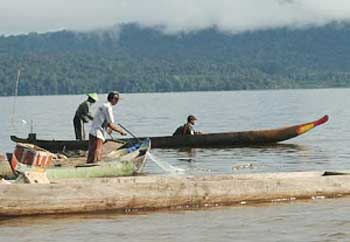
One of the adat law’s sections debars the local inhabitants living
around Lake Lindu from angling fish using tools and materials that may
damage the environment
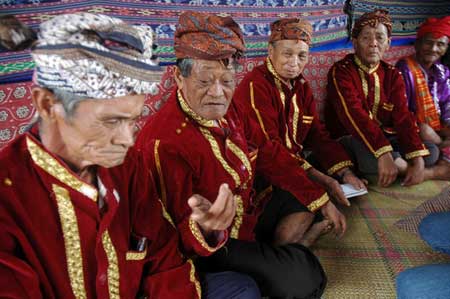
Kapotia Nulibu Ada is usually headed by several adat leaders and participated by some society members chosen by the adat leaders. All attending this adat meeting can speak up about their aspirations and expressions freely. But, final decision is on the hands of the adat leaders’.
Every single person of the society are obliged to obey all terms resulted from the adat meeting. For those who are known to disobey the adat law, he will be sentenced for proportionate punishment. It can take the form of paying fine – usually a buffalo – to the adat leaders and those who cannot pay the fine will be evicted from the society, and worse, will be killed.
On the surface, the adat law seems to own powers to force either local inhabitants or foreigners to comply with the law existing in the society, but the fact talks differently. It was effective enough to maintain the society’s members to live in harmony with nature in the past. But in the present, its existence often stands on the contrary to the state regulation – with its authority to let foreigners fully exploit the available natural resources in Lake Lindu. To some extent, if such exploitations persist for a long time, it is possible to bring the moral and social degradations amongst the youths. Consequently, worthwhile values of local wisdom will no longer survive.
One question then comes to appear: how long does it remain to exist? If hundreds years ago the adat law could guarantee the existences of the society and its environment, so why it can’t right now? It is the time we urge that all people to collectively keep and revitalize the adat law and adjust it to the modern civilization.
2. The Tools and Materials
Kapotia Nulibu Ada will be a mere common adat meeting without reciting sacred oath ceremony joined by all attending the meeting. They swear that they will, time after time, obey every single term resulted from the meeting. More importantly, there is what so-called a “sacred ceremony” to take the oath from all society’s members including those attending the adat meeting and adat leaders. For further, there will be explanation about the detail of the ceremony such as bellows:
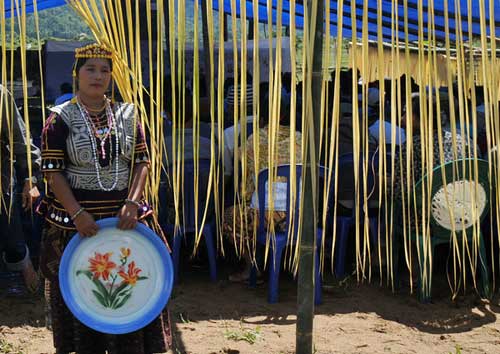
A girl in traditional costume who takes part in Kapotia Nulibu Ada is dishing the attendances with foods
a. Materials
In the past, all the materials needed for the adat meeting were gathered from the society members; but now, either governmental or non-governmental institutions usually take part in supplying the materials. The materials can be in the form of:
- A buffalo
- Siga or sarong
- Pongo (betel vine and areca nut)
- Cooking ingredients
b. Tools
- Traditional costumes of Central Sulawesi Province that will be worn by all attending the adat meeting, and by women who are appointed to prepare some foods and offerings.
- Guma (parang) and knives that are used by some society member, either those joining the meeting or not, to slaughter the buffalo and divide the meat to all families.
- Dulang, traditional plates to put the siga and sarong.
- Cooking utensils
3. The Date and Place
Kapotia Nulibu Ada is customarily held twice in a year. For the date and time of when the adat meeting will be hosted is referred to the previous meeting. The meeting is commonly convened from the dawn to evening locating in the village hall or the people’s house that may accommodate about a hundred people.
4. The Practice
a. Preparation Stage
Preparation stage of the adat meeting commonly takes place several days before the day. Detail preparation stages before the meeting can be explained as follow:
- Creating a group of people (committee) who are responsible for guarantying the meeting will run smoothly. The committee are in charge with stocking all materials needed before and after the meeting.
- After the committee has been created, its members later on have to supply the materials such as traditional costumes, a buffalo, dulang, siga or sarong, cooking ingredients, cooking utensils, and pongo.
- Then, several adat leaders appoint some society members consisting of society’s prominent figures and governmental staffers, who may participate in the meeting.
- After that, the adat leaders call the committee to spread invitations to those who get permission to join the meeting
- A day before, when the invitations have been distributed, the committee and the adat leaders move to the venue where the meeting will be held. Activities during in this stage can be decorating the venue with ornaments made of young coconut leaves, and erecting a tent in front of the venue – in case of the venue cannot accommodate all the participants
- At the end of the stage, the committee prepares for some traditional costumes that will be worn by the adat leaders, participants, and women supplying foods during the meeting.
b. The Main Stage
As mention above, Kapotia Nulibu Ada is a locally adat meeting for discussing the adat law regulating mostly on the society’s local wisdom in keeping and preserving its nature and environment. The meeting is headed by several adat leaders and society members getting permission from the adat leaders. The stages during the meeting can be described as follow:
- At dawn, several adat leaders and participants must arrive at the venue. One by one they come and take a sit inside the baruga (the venue). The adat leaders sit in the most front part facing the participants.
- Soon after the participants and adat leaders have arrived at the venue, an adat leader then bestows a buffalo, a traditional costume, a parang, a siga, and a sarong to a representative of governmental staffers. It is a symbol of the society’s reliance on cultural and adat assembly.
- Next, another adat leader bestows a pongo to another governmental staffer. Such a bestowal is the society’s admiration to the government.
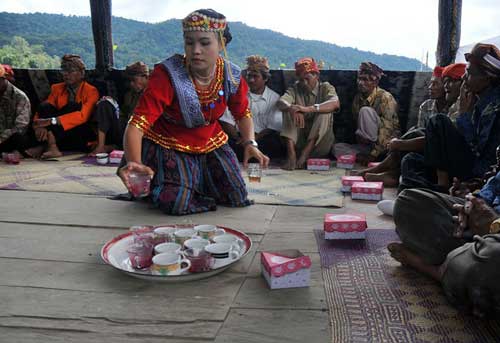
While the male participants are discussing every single section of the adat law,
the female are cooking for foods and beverages for all the participants and
committee during the adat meeting
- The main session is begun and headed by the chair of adat leaders. He is responsible for organizing the order the meeting, and likewise, for luring all participants to actively engage in the meeting by throwing some suggestions and opinions. Therefore, we often see there will torture debate about certain terms of the adat law since everyone attending the meeting has the same rights to speak on. The final decision maker, however, is on the hand of the chair of adat leaders.
Most common topics discussed in the meeting are about the social and environmental lives. It is aimed at safeguarding the indigenous systems of Lake Lindu people in preserving and keeping the nature balance. Hence, often, there will be section of the adat law that disallows people to cut the trees located in surrounding forest. If somebody is known for cutting the trees, he will suffer from paying fine.
Another section resulted from the meeting can be, such as, proscribing people to fish out in the lake during umbo (moratorium period). The umbo itself is fixed upon consideration that the fish inhabiting the lake is decreasing. Punishment for breaking this section is paying fine.
- When several sections have been fixed, the chair of adat leaders will read the conclusions and sections resulted from the meeting.
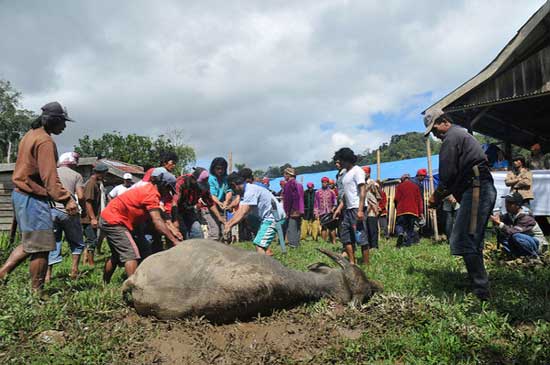
- To legitimate the adat law, the chair of adat leader appoint someone to slaughter a buffalo followed by mantra reciting of the adat leaders.
- The buffalo’s blood is kept in a basin.
- The blood will be used in Moelasi Pale Kasalaa Ngata ceremony after buffalo slaughtering. It is a stage when all participants are obliged to swear the oaths of not to break every single section of the adat law resulted from the meeting. All participants must give evidence that they will not break the adat law by washing their hands using the blood, and stamping their hands on a white cloth. While stamping their hands on the cloth, they swear an oath of not to break the law. This stamping stage is the inhabitants’ symbolic efforts to clean their village from sins and faults.

Stamping their hands on the white cloth and swearing the oath of not to break
every single section of the adat law
Male committee and all participants work together to dice the buffalo meat
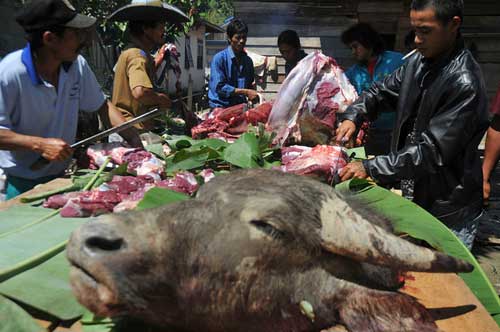
Male committee and all participants are working together to dice the buffalo meat
- Now is the time for female committee to make busy themselves by preparing some foods to be dished up to all attending the meeting
- Finally, when all have been royally dished up with some foods and beverages, the chair of adat leader closes the adat meeting.
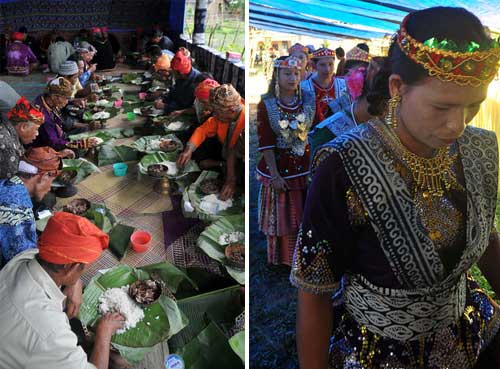
Kapotia Nulibu Ada is ended by a repast (left) and female committee return to the their homes (right)
5. The Prayer and Mantra
Prayer and mantra are recited voraciously by the adat leaders when the buffalo is slaughtered. The mantra reciting ceremony is aimed at embedding sacred values to the adat law. However, there is no written record about the mantra – which uses local language – recited during the ceremony.
6. The Values
In conclusion, Kapotia Nulibu Ada is an adat meeting, which is participated by those living around Lake Lindu, Central Sulawesi Province. It is aimed at formulating the new adat law in maintaining harmony of social lives and preserving the environment using highly values of the society’s local wisdom. Those highly values can be in the form as below:
a. Nature preservation
Kapotia Nulibu Ada is a manifestation of the society’s awareness of the importance of nature preservation. Such a phenomenon, to some extent, shows that the local society, with its own language, is attempting to safeguard their existence amongst the inevitably huge wave of globalization threatening their culture, nature, and environment. Therefore, it is also a preventive action to preserve the nature and environment.
Starting from the above argumentation we know that illegal logging damaging greatly the environment and forest around the lake, is not conducted by the local inhabitants. Forest and environment are their future, thus they will not take action that may damage their future. Consequently, reviving the adat law and giving wider opportunities to the local society can be the best ways to preserve the environment and nature, especially the forest around Lake Lindu.
b. Togetherness
A society is a collection of multifarious characteristics embedding on every single its member. Sometimes, differently conflicting opinions often occur in this heterogenic society. In Kapotia Nulibu Ada, the adat law existing amongst the society is created and implied by them, and likewise, for their benefits. From this we can see the local society’s wisdom in establishing the feeling of closeness or affection for being united with other people and multifarious characteristics.
c. Socio Construction
Kapotia Nulibu Ada can be a means of constructing the ideal society that is dreamed by all people in the world. The meeting to establish the new adat law is a way to “force” every single person of the society to prioritize collective interests rather than emphasizing personal interests. Such an ideal society can only be constructed by some small stages during the adat meting like: the participants who are obliged to wear traditional costumes; the adat leaders who take a sit in the front of the participants; and a royal dish for all society members. Through such the ways, hopefully the highly values borne within the stages of Kapotia Nulibu Ada can be inherited to the next generation from time to time.
d. Belief in the Divine Powers
Several stages in Kapotia Nulibu Ada such as reciting mantras and Moelasi Pale Kasalaa Ngata are efforts to embed sacred values on the resulted sections of the adat law. The local inhabitants believe that breaking the adat law will lead them to calamity. From this we can see that the local inhabitants are still believe in the divine powers.
Ahmad Salehudin (bdy/36/08-08)
Translated by Irfan Nugroho (ter/66/10-08)
References:
- Basri Marzuki, “Cap Darah untuk Lingkungan,” on http://basrimarzuki.multiply.com/photos/album/7, retrieved on August 13th, 2008.
- Basri Marzuki. “Kapotia Nulibu Ada,” on http://basrimarzuki.smugmug.com/gallery/5113094_k63hh#308637662_R3Gei, retrieved on August 7th, 2008.
- Basri Marzuki, “Seekor Kerbau untuk Kelestarian Dataran Lindu,” on http://www.panyingkul.com/view.php?id=885&jenis=kabarkita, retrieved on August 13th, 2008.
- Correspondence via email with Basri Marzuki (basri.marzuki@gmail.com)
- K.J. Veeger, 1993, Realitas Sosial: Refleksi Filsafat Sosial atas Hubungan Individu dan Masyarakat dalam sejarah Cakrawala Sosiologi, Garmedia Pustaka Utama, Jakarta.
- Lorelindu, “Lore Peore Jadi Kecamatan Konservasi,” on http://lorelindu.wordpress.com/2008/01/, retrieved on August 14th, 2008.
- Lorelindu, “Masyarakat Adat Dataran Lindu,” on http://lorelindu.wordpress.com/category/budaya/, retrieved on August 14th, 2008.
- Lorelindu, “Sumpah Adat Masyarakat Adat Lindu,” on http://lorelindu.wordpress.com/2008/06/11/sumpah-adat-masyarakat-adat-lindu/, retrieved on August 14th, 2008.
- Nico Syukur Distar, 1989, Psikologi Agama, Kanisius-BPK Gunung Mulia, Yogyakarta-Jakarta
Photo Credit:
- Basri Marzuki: http://basrimarzuki.smugmug.com/gallery/
- Nikmah Dewi: http://lorelindu.wordpress.com/galeri-foto/
Read : 18.324 time(s).
Insert your comment here :


 Today
Today  Yesterday
  Last week
  Last month