The spread of the Dawan now encompasses almost all sub-districts in Kupang District like Kupang City, Bolok, Sumili, Kelapa Lima, Oespa, Nunkurus, Bipoli, Oetata, Pariti, Kukak, Oehendak, Sulamu, Nauwen Barate, Uwel, Oelbubuk, Kapsali, Soliu, Naikliu, Poanbaum, and Oepoli. Besides, the Dawan‘s diffusion also reaches many sub-districts in Central South Timor District, Central North District, and Oekusi (now Timor Leste) (Mubyarto, et al.; 1991).
The term “dawan” embedded for those settling down in the western part of Timor Island is not actually derived from the local language of Timor Island. It was the Belu people, in the eastern part of the island, who later on embedded this word to those living in the western part of the island, especially in the hinterland (Sawu; 2004). Such a finding is supported by Anton Berkanis, a linguist who is likewise a Dawan native person. Once he undertook a research disclosing that “dawan” is derived from Sanskrit language “rawan” that means “west” (Taum; 2008).
Sawu (2004), however, interprets the word “rawan,” which originally comes from the Malay language, as the barren land with low rain average and widely covered by lime and stone. Consequently, such topographic condition then makes the Dawan people are isolated from each others. Often is found the Dawan prefers calling themselves “Atoni Meto,” the people settling down in a barren land (anis means people, and meto means barren land). Thus, both Atoni Meto and rawan are connotative to Orang Gunung (the highland people), and perhaps it is true because they live in mountainous areas in Timor Island (Mubyarto; 1991).
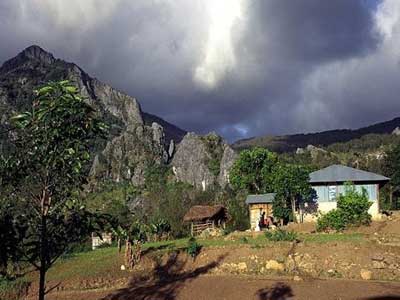
The detail of topographic description in Timor Island comes out of Fox (quoted in Taum; 2008) stating that Timor is just a small island in an outer arc of Lesser Sunda Islands. Its topography ranges from highland to lowland areas that are covered mainly by damp clay, marl, and Permian substances. It enables the land to absorb water during the rainy season, and loosens the rainfall average; while on the dry season, the soil turns hard and crack. Therefore, the Dawan greatly depends their lives on the supply of water from spring in highland areas. They farm the land with crops such as corn, cassava, and rice. To some extent, some research findings unveil that the Dawan opened new lands by cutting and burning forest. Therefore, the Dawan‘s settlements are predominantly located on the slopes of mountainous areas, in eastern hinterland of Timor Island, where the climate is extremely dried up (Mubyarto; 1991).
Willy-nilly, the Dawan people must struggle to survive amidst that critically environmental condition. They, with their traditional cultures, were used to applying some mystical rites to establish harmonious interaction with the nature. According to Van Peursen (1995), the term that may properly represent such a social character is the “mystically traditional character (society)” that believes in the external powers coming out of nature. Hence, a harmonious social intercourse can solely built up from establishing harmonious relations with the nature by accomplishing some mystical rites that involves the belief in myth.
Myth, for this society, can be a means of presenting the deity, which attentively safeguard them, amongst them through symbolic language implied in daily life. Thus myth can also be guidance for every single society member to act properly in society, and to own certain goals in life. Almost the same, Dhavamony (1995) states that myth is a statement of the “real truth” standing above the reality and also a pattern as well as the basis of primitive (traditional) society.
That is what the Dawan believe in so far. They do believe in the existence of a myth on God, the creator, and the holiest creature in the universe. Amongst the Dawan, such a divine concept is shaped out in Uis Neno and Uis Fah.
Uis Neno is God of heavens that is materialized as the sun, while Uis Fah is God of earth materialized as the earth. The Dawan ceaselessly attempts to establish harmonious relations with those two deities because both the sun and earth greatly determine the harmony of the Dawan‘s living spheres, especially on agricultural sector. They send the prayer, usually in the form of adat rites and ceremonies, to these two deities to ask for fertility of their land, sufficient water for irrigating their farming land, and abundant harvest. In case of calamity takes place in their settlements, thus it is perhaps the consequence of their ignorance towards the urgency of establishing harmonious relations with Uis Neno and Uis Fah. (Tuam; 2008, Kieft and Duan; --).
The belief in Uis Neno and Uis Fah then went on due to these days, even when most of them have embraced Christianity. They still actively practice certain adat rites and ceremonies addressed to those deities for certain purposes. The belief has been inveterate way of life for the Dawan. It is reasonable enough since such a tradition has occurred in the society of Dawan people since long time ago, far before the arrival of Christianity in Timor Island (Tuam; 2008).
B. The Devine Concepts of Uis Neno and Uis Fah
The Dawan people believe in more than one deity in their cosmological system but, there are only two supreme deities admitted namely Uis Neno and Uis Fah. Here is the explanation about those two supreme deities presenting amongst the Dawan people up to now
1. Uis Neno
Uis Neno is the supreme deity in the religious system of the Dawan people. “Uis Neno” literally means “tuan hari” (the sun), whose position as the supreme deity. They do glorify the sun as the greatest outer space things in the universe, thus they likewise call this deity as “Raja Langit” (God of Heavens).
In the Dawan language, Uis Neno is parallel closely to “Manas” that means “sun” as well. Manas plays significant role in the universe and is the centre of human being. When the manas rises, thus the human being is there; when it disappears, human being is absent (Sawu; 2004).
For the significant role of Uis Neno or Manas in the humankind, especially for the Dawan people, hence the Dawan depicts Uis Neno as a deity with distinguishing attributes that according to Sawu (2004), there are several attributes embedded by the Dawan about Uis Neno as God of Heavens. The attributes can be in the form as below:
-
Apinat ma Akhalat. “Apinat” can be loosely translated “glowing, shining, and glittering;” while “aklahat” is an advanced level of apinat, smouldering and scorching. The sun, or the Dawan prefer calling Manas as well as Uis Neno, can be glowing, shining, and glittering, but on the other side – in case the Dawan cannot build harmonious relations with their deity – it can be smouldering and scorching that brings calamity for humankind. The Dawan does believe in the divine powers of Uis Neno because any calamity, either flood or dried up, is the consequence of the Dawan‘s disobedience towards the existence of the Deity Uis Neno.
-
Amoet ma Apakaet. Amoet is the term addressed to the powers that is capable of creating everything in the universe, thus it can also be translated as “the creator.” Apakaet refers to the ability to carve, portray, and weave. The attribute may be used properly to describe the ability of the deity Uis Neno to create the universe because it has high sense of art.
-
Alikin ma Apean. The Dawan people believe that Uis Neno is their parents who sow the seed of the Dawan people‘s life in the world. In daily context, the attribute is often related to birds or hens that heedfully hatch out their eggs.
-
Afinit ma Anesit. Afinit means longer and taller, while anesit means ‘more,‘ (bigger or much more) that open to an interpretation that Uis Neno is also capable of coping with and handing out the Dawan people‘s problems. Uis Neno as the supreme deity in the Dawan people‘s divine concept is the creator with distinguishing powers; thus nothing can be compared and equal to Him.
-
Ahaot ma Afatis. This attribute refers to the parental system of Uis Neno. Ahaot pertains to something that is responsible for fulfilling the physical needs of every single His creature in the universe; while Afatis belongs to something that is obliged to take a great care of both physical and spiritual needs of human.
-
Aneot ma Amafot. This attribute is relevant to something who is able to guard, guide, and endow the humankind. By giving and defending its lights to the earth, Uis Neno seems to be capable of both endowing and condemning the Dawan people. Likewise, he owns the privileges to show the right way for gaining harmony in life, and on the contrary, misleading its people by neglecting them in darkness.
2. Uis Fah
The Dawan people also believe in God of earth that takes the form in Uis Fah. Along with Uis Neno, Uis Fah is assumed to have the divine powers as well as Uis Neno, but still, the highest authority is at the hand of Uis Neno. Both are different, but they have reciprocal functions and are inseparable each other. Uis Fah is believed as the main cause of any calamity and unluckiness in the human being in the world, hence the Dawan is willy-nilly able to get Uis Fah‘s sympathy by holding certain adat rites. Likewise, Uis Fah is assumed as the guardian of Pah Nitu (deceased ancestors‘ spirits), which is assumed to settle in forests, corals, springs, and big trees as well as mountainous areas (Taum; 2008).
The existence of Pah Nitu holds significant roles in the human being for its status as an intermediary between the Dawan and both Uis Neno and Uis Fah. Without involving the Pah Nitu, all adat rites organized by the Dawan will not be accepted by both the Uis Neno and Uis Fah. Consequently, calamity will come soon after that (Taum; 2008 and Kieft and Duan;--).
To some extent, some researchers view that the involvement of Pah Nitu in several adat rites is a means of tracing back the Dawan‘s ancestors and ruminating their efforts in sailing over the seas from Malacca to Timor Island for the new land. A famous folklore Sina Mutin Malakkan is one of the evidences for the high respect of the Dawan for their ancestors. The Dawan are completely sure that their ancestors will be very please to know that the presenting Dawan people still greatly respect for the deceased ancestors. As the returns, the ancestors will attentively take care of the present Dawan people and give them abundant harvest by intermediating between the Dawan and Uis Fah (Taum; 2008).
C. Social Implication
As mentioned above that the Dawan people must accomplish some adat rites to build harmonious relations with Uis Neno and Uis Fah. The adat activities can be in the form of giving offerings, usually fruits and crops, and even performing complicatedly solemn ceremonies in certain sacred places (Dhavamony; 1995).
The Dawan commonly holds a number of adat rites as the consequences of their belief in deities ruling over their social life. In this part there will be only two rites to discuss. Those two rites are Hamis Batar and Hatama Manaik, and Fua Pah.
1. Hamis Batar and Hatama Manaik
Hamis Batar ceremony is held to show the Dawan people‘s gratitude to Uis Neno for abundant corn harvest, and headed by an adat leader. “Hamis” literally means “thanks,” while “batar” is the local language for “corn.” The Dawan‘s expression of showing gratitude is habitually shown by offering a number of best corns to Uis Neno by performing Hamis Batar.
Several days prior the day, every single paterfamilias must pick the best and youngest corns from his farm. On the celebration day, those patresfamilias, along with their families, come to the venue bringing their best-and-youngest corns. In the venue, all corns are collected in a place, and the committees then select the one best corn to be put on Troman (a stake on the peak of a stone heap that is used as the pedestal for those corns). Soon after the one best corn has been chosen and the corns have been placed on the heap, the adat leader begins the ceremony by reciting some prayers to Uis Neno so that He would like to bestow the blessing on the corns. The next stage is sowing the corns to the surrounding farming land as the symbol of begging to blessing from God of earth, Uis Fah.
The Hamis Batar ceremony ends, and is followed by the celebration of Batar Babulun ceremony. All the corns‘ stalks are pulled out from the ground in the farming land, and the Dawan bundles them into sheaves to be put on troman. The sheaves will be used to breed the Dawan‘s cows (karau sarin), pigs (fahi ahuk), and as an offering to the adat leader (fatuk).
Comes next after that is the celebration of Batar Fohon, in which corns‘ stalks are cut into 12 parts and given to the adat leader. Then the adat leader then will choose the right moment to hold the main stages of Hamis Batar ceremony.
When the corns‘ stalks had been reaped out then are put in a corn house hane matan, it is burned out. It is tahu hai fire that is used to burn the stalks inside the house. The fire is made by rubbing a piece of red stone to a piece of iron with palm tree powder sowed on it. While the corns‘ stalks are burned out in three hearths, the adat leader recites some prayers asking for blessing from both Uis Neno and Uis Fah.
After all, Hatama Manaik ceremony is held following the end of Hamis Batar ceremony. This is the time when young corns (manaik) are offered to the adat leader as the gratitude and appreciation for becoming the leader of the Dawan society so far (Ganggang; 1994).
2. Fua Pah
Most of adat rites held by the Dawan people are often related to their social living spheres, especially on agricultural sector. As they live in the barren land, they are obliged to hold certain adat rites and to provide offerings as expression of gratitude addressed to Uis Fah. The nature of Uis Fah is destructive since any kind of calamity is predominantly caused by His anger (Taum; 2008). By holding the Fua Pah ceremony, the Dawan takes a great hope so that Uis Fah will not show his destructive nature. They hope that God of earth will prudently give abundant harvest and fertility for the Dawan‘s farming land.
Fua Pah ceremony is a distinguishing tradition in the Dawan‘s agricultural system. At least there are six stages in Fua Pah ceremony that should be accomplished as the consequence of fulfilling the requirements to “tame” Uis Fah. Those stages are:
-
Cutting down the trees in forest (lef nono/tafek hau ana)
-
Burning out the forest (polo nopo/sifo nopo)
-
Cultivating the land with new plants (lef boen no‘o)
-
Growing the plants due to mature (eka ho‘e)
-
The first harvest (tasana mate), and
-
The final harvest (tnibun bola‘if ma aen tauf) (Taum; 2008).
As well as many adat rites in the outside Timor Island, the adat ceremony Uis Fah requires several farm animals as the offerings. However, the ceremony requires only certain livestock that are accepted as sacrifices. Those livestock are cows or buffaloes, hogs, goats, and roosters. Sawu (2004) explains the reasons why the Dawan chooses those animals as offerings. Sawu states that the Dawan choose:
-
Rooster as the offering because roosters are commonly used as offerings in a number of adat ceremonies and socio-religious meetings, not only in Timor Island but also in almost all areas in the Malay Archipelago. Likewise, rooster is the most achievable offering amongst other categories in Fua Pah ceremony.
-
Hogs as the offering because hogs are in the middle category, not too small and not too big in size; and almost achievable in prize by every level of society. Most of the Dawan people breed porkers that are fattened for foods and offerings in certain adat rites such as Fua Pah. They feel ashamed if they cannot provide hogs, as the offerings because it determines one‘s social prestige.
-
Cows as the offerings when certain social groups are going to show and express their own gratitude towards Uis Fah‘s endowment over the groups. However, this category is rarely chosen for economical reason.
Fua Pah ceremony is headed by a prominent person called lasi tonis who has magical powers upon deities‘ endowments. Likewise, a lasi tonis is known for having distinctive abilities in language and literature, especially in oral literature. The Dawan people have been familiar with oral literary tradition since long time ago. That is why; person with extraordinary oral literary skill will automatically occupy prestigious social status in the Dawan society. And more, every single word coming out of a lasi tonis is believed for giving enlightenment in social life. In addition, the oral literature has been a inveterate culture amongst the spiritual life of the Dawan people, especially those living in the hinterland of Timor Island (Taum; 2008).
As well as in other Malay areas, the oral literature in the Dawan society takes form in mantras recited during the celebration of Fua Pah. The mantras below are often recited in Fua Pah ceremony:


 Today
Today  Yesterday
  Last week
  Last month