1. Origin
The majority of Dayak Kanayatn ethnic group settles in two regions in West Kalimantan namely Karimawakng (the origin of Mempawah) and Bangkule Rajakng (the origin of Pahauman). The agrarian life of Dayak Kanayatn people manifests in several unique traditional rituals which are interesting to investigate (Yekti Maunati, 2006). One of them is the rite of welcoming the planting and harvesting season called Nyangahatn.
The origin of Nyangahatn rite is the belief of Dayak Kanayatn people toward their God called Jubata. They believe that Jubata has cherished them an abundant blessing to their farming. Therefore, as an expression of thankfulness and gratitude to Jubata, Dayak Kanayatn people hold the so called Nyangahatn rite (Herman Ivo, 2002).
Nyangahatn is also inspired by the faithfullness of Dayak Kanayatn people to the custom handed down by their ancestors. For Dayak Kanayatn people, the custom is a rule that must be obeyed through generations, as it is explicitly written in their proverb:
“Adat nang dinunak, dinali, dinamputn” (custom existed since the existence of mankind, therefore it is followed and obeyed through generations)
Nyangahatn is generally held in every cycle of rice cultivation, either in the beginning of planting or after harvesting (patahunan). Through this ritual, Dayak Kanayatn people mean to offer their gratitude to Jubata. Moreover, they want to tell Jubata all difficulties they faced in cultivating their farms and ask for good, pest-free and abundant crops. Nyangahatn is usually ended with a simple rite called Naik Dango. This is held annually on April 27 (Johan Weintre’, 2004).
2. Instruments and Time of Performance
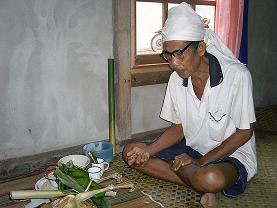
Nyangahatn is led by a special custom functionary who handles rice farming. He is called Tuha Tahutn or Panyangahatn. The ritual is performed somewhere near the ricefield (Pangayu) or at home. The setting of time is a moment before beginning the planting or after harvesting.
The instruments required for this ritual are:
- Offerings of nasi’ dua’ gare’ (rice and salt)
- A prepared betel quid (lime, areca nut, gambier, tobacco and nipa palm cigar)
- Tenkeatn (good sheaf selected from cut down rice plant)
- Inge (rice container)
- Whetstone
- Machete
- Katam or anai-anai (termite)

Sample of offerings
3. Performance Process
The performance of Nyangahatn is generally divided in two stages, the preparation and the execution. In the preparation stage, the ritual is divided in two major processes namely Nyangahatn Manta’ (no animal for sacrifice or the animal has not been slaughtered) and Nyangahatn Masa’ (animal for sacrifice has been slaughtered and cooked).
a. Preparation
This stage includes preparing all instruments and equipment needed for the ritual. All instruments are prepared by the family who holds the ritual assisted by neighbors. Should everything complete, Nyangahatn is ready to run.
b. Execution
Principally, the execution of both Nyangahatn Manta’ and Nyangahatn Masa’ are similar. The execution process of both involve three activities: Mati’ (special prayer), Ngalantekathn (safety prayer) and Mibis (goal prayer).
The rite begins with saying Mati’ (special prayer) by Panyangahatn ( the ritual leader) in front of the offerings. Mati’ aims to let Jubata and Awa Pama (ancestors spirit) know about the family feast. Mati’ is performed the night before the rice cultivation in the next morning.
After saying Mati’ prayer, Panyangahatn applies the rice mixed with tengkawang oil or coconut oil to the forehead of those present. The oil is believed to cure and protect Dayak Kanayatn people from all kinds of illnesses. This stage is then followed by saying Nglantaketn prayer (safety prayer) aims to keep the family and the people involved in the cooking activity safe from any obstacles so that they can cultivate well and benefit from the harvest.
After that, the next stage is saying Nyangahatn Mibis prayer (goal prayer). This prayer aims to ask Jubata to grant all wishes. After Mibis prayer is said, the chicken is slaughtered and its blood is taken as a symbol of sacrifice. The chicken is cleaned up and the intestines are disposed. Then, it is roasted or boiled for everybody to eat.
After saying prayers, people begin to cut down trees and grass at their own field. This activity is carried out by each family or balale (communally). If the ricefield is ready to cultivate, people start to plant and pray that the crops grow well and produce satisfactory yield.
Nyangahatn will be held again when the harvest time comes as the expression of gratitude for the harvest success. Commonly, the ritual is performed merryly and known as Makatn Masi Baharu (eating the newly-harvested rice).
4. Prayer
Of the three prayers said in this ritual, the following is the Mati’ prayer (special prayer) said by Panyangahatn (ritual leader):
“Asak, dua, talu, empat, lima, anam, tujuh... Oh kita’ Jubata yang badiapm kak aik dalam tanah tingi, puhutn ayak, puhutn tingi. Kita’ karamat ai’ tanah nang mampu nunu ai’ sakayu, nyambong sengat. Kami bapinta kami bapadah, ame babadi kak kami talino manusia”.
One, two, three, four, five, six, seven, Jubata who rules the inner water, upper-land, big wooden tree, tall wooden tree. The Ruler of water and earth who may burn the water of a river and bring back life. We ask and announce, please do not give epidemic to mankind.
5. Restrictions and Prohibitions
There are two prohibitions: during and after the rite. During the rite, the participants are not allowed to whistle since it can distract the rite leader. After the rite, Dayak Kanayatn people are not allowed to steal, rob, murder and conduct immoral deeds that could prevent Jubata from granting all the prayers said in the rite.
6. Values
- The value of preserving oral literature and indigenous language. This value is reflected in the prayer and spell said as parts of oral literature that must be preserved. This is important to prevent the indigenous language of Dayak Kanayatn from fading away due to the invasion of Bahasa Indonesia and foreign language.
- The value of gratitude to Jubata. The occupation of majority of Dayak Kanayatn is farmer. In every cultivating season, their only wish is to get abundant harvest. Dayak Kanayatn people understand that the harvest is the gift from God, therefore they express their gratitude by holding Nyangahatn ritual.
- The value of togetherness. Nyangahatn is sometimes held collectively by the villagers. In its preparation, people hold it communally. The fact shows that Dayak Kanayatn people still respect the spirit of togetherness. By this activity, people enforce the solidarity among them.
- Spiritual value. This value is reflected in the various prayers delivered to the God of Dayak Kanayatn people who is believed to have blessed them with abundant blessing. From here, it is obvious that Nyangahatn is not only a tradition but also a opportunity for Dayak Kanayatn people to be closer to God to ask, to tell, and to ask for protection from all misfortunes in life.
- The value of sharing with fellow mankind. This value is obvious in Ngyangahatn celebration after the harvesting time, when almost all farmers cook their first harvest, then there is a banquet. People call it Makatn Nasi Baharu (eating the newly-harvested rice). If the feast is held collectively, the more the rice, the happier the celebration will be.
7. Epilogue
Nyangahatn is a rite held to express gratitude to Jubata for his agricultural blessing to Dayak Kanayatn people. The rite contains several positive values of life. One of them is the value of preserving oral literature in form of prayer and spell said in Nyangahatn rite. Considering that Dayak ethnic group is currently losing its population, this value is worth appreciating and studying, because through prayer and offering people understand their life.
Yusuf Efendi (bdy/11/01-10)
Translation by Apri Widiastuti (trns/07/02-10)
Reference
- Ivo, Herman. Upacara Adat Perladangan Dayak Kanayatn, Kalimantan Barat. Laporan Penelitian. Fakultas Keguruan dan Ilmu Pendidikan. Pontianak: Universitas Tanjungpura, 2002.
- Maunati, Yekti. Identitas Dayak, Komodifikasi dan Politik Kebudayaan. Yogyakarta: LKIS, 2006.
- Weintré, Johan. Beberapa Penggal Kehidupan Dayak Kanayatan. Kekayaan Ritual dan Keanekaragaman Pertanian di Hutan Kalimantan Barat. Makalah Studi Lapangan. Yogyakarta: Universitas Gadjah Mada, 2004.
Internet Source
Picture Source
Read : 20.836 time(s).
Insert your comment here :


 Today
Today  Yesterday
  Last week
  Last month