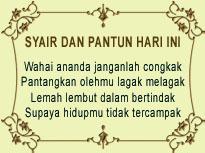
Upah-upah is a traditional ceremony of Rokan Hulu people in Riau Province which aims to bring back tondi into the body. Tondi, as it is believed by the people, is a human mental aspect that affects the spirit and psychological maturity of an individual.
1. Prologue
Upah-upah is a traditional ceremony of Rokan Hulu area, Riau Province. Objective-wise, the traditional ceremony means to return tondi (spirit) into a person or some people’s bodies through songs of motivational and advice-giving words (Irwan Effendi et al., 2008).
Basically, Upah-upah is an acculturation of South Tapanuli and Riau cultures. Rokan Hulu is geographically situated at 00 25’ 20 degree of northern latitude – 010 25’ 41 degree of northern latitude and 1000 02’ 56 degree – 1000 56’ 59 degree of eastern longitude. It is 7.449.85 km2 and quite close to North Sumatra as its northern area borders with South Tapanuli Regency (http://www.riau.go.id/). This closeness has been intensifying people migration in the last decades from South Tapanuli to Pasir Pangarayan. The migration has resulted in an interesting acculturation.
Upah-upah, as a cultural product, is still practiced by the South Tapanuli migrants who have mingled with the local people. They have been able to preserve the traditional ceremony although there are some unique changes in some aspects of either procedure or equipments and materials. However, the main purpose of Riau’s Upah-upah is similar still to that of South Tapanuli’s, which is bringing back tondi into a person’s or people’s bodies given the Upah-upah. This is an evidence for the openness attitude of Malayo-Riau people, as well as Rokan Hulu people in particular, to other culture that has positively affected their personal and group quality.
The term tondi is originally taken from South Tapanuli language, North Sumatra, which is synonymous with some Indonesian words such as spirit, energy, and psychological power. In accordance with that, some experts do have similar opinions about the meaning of tondi. Pajung Bangun (in Koentjaraningrat, 2002) states that tondi is the energy that gives life into a baby. Tondi is energy, power, spirit that keeps spiritual and physical condition of a person balanced, firm, and strong that it could maintain the harmony of the person’s life. Tondi can go out at will and even encounter and unite with evil spirit. In a situation of sudden fear, being attacked by a tiger in the jungle for instance, tondi may leave the body (Persadaan Marga Harahap Dohot Boruna, 1993).
According to Effendi et al. (2008:3), Upah-upah is usually accompanied by a feast, either small or big, and a prayer of safety. However, Upah-upah is only present in some regencies in Riau and North Sumatra, and mostly in the area in which Batak ethnic group reside.
Based on its function and objective, Upah-upah can be divided into four kinds namely:
- Upah-upah for Achievement, which is performed as an expression of gratitude to God after a dream, intention, or wish is achieved. For example, Upah-upah for a person who succeeds at work, graduates from school, or does well in other efforts.
- Upah-upah for Recovering, which is performed to thank God after recovering from an illness. This kind of Upah-upah is commonly carried out for a person that has just restored health from a certain chronic illness.
- Upah-upah for Safety, which is carried out to gratitude God after being saved from a natural disaster or felony. There is, for example, an Upah-upah for people who are saved from river flood.
- Special Upah-upah, which is done when a person is stepping into a certain phase of life. For instance, Upah-upah for circumcision, marriage, or job promotion.
There are procedure, materials, and equipments, which have certain symbols or meanings, required in the ceremony. Each kind of Upah-upah uses the same equipments, materials, and procedure—which will be explained in the next chapter. What differs one kind of Upah-upah to another is the Kata Upah-upah (Upah-upah Words) which are delivered in the form of advices or prayers. Pengantar Upah-upah (the opening speech) and other implementations of the ceremony are relatively similar to one another.
The next part will focus on things important in the performance of Upah-upah. The explanation will be discussed in turn from materials and equipments, procedure, prayers and advices, and values in Special Upah-upah when a person is married off by his/her parents. The Special Upah-upah is known as Upah-upah for Entering a New Phase of Life.
2. Equipments and Materials
Materials used to make Upah-upah offerings relatively vary, depending on the area, tradition, and people who organize and perform the ceremony. Often, there are two Upah-upah ceremonies done in a similar kampong with a similar objective and performer, yet, the materials presented are different (Effendi et al., 2008).
Effendi et al. (2008) states that based on the materials used, Upah-upah ceremony can be divided into three kinds namely Regular Upah-upah, Full Upah-upah, and Fuller Upah-upah. The choosing will hinge on the intention or nazar (vow) and also the ability of the respective person. It will not depend on the purpose or the use of the ceremony because every performance of Upah-upah basically aims at bringing back tondi to the body. The process of calling the tondi can be done by having a Regular Upah-upah as long as the offerings, procedure, and advisory words of Upah-upah are given following the prevailing conventions of the customs and traditions.
There are three kinds of Upah-upah based on the materials used. Here is the explanation (Effendy et al., 2008).
1. Regular Upah-upah
- a toasted chicken
- a toasted chicken liver
- a peeled, boiled chicken egg
- a few of toasted/boiled/fried shrimps
- turmeric-stained raw rice
- turmeric-stained glutinous rice
- vegetables
2. Full Upah-upah
- a toasted chicken
- a toasted chicken liver
- a peeled, boiled chicken egg
- a few of toasted/boiled/fried shrimps
- turmeric-stained rice
- turmeric-stained glutinous rice
- vegetables
- goat head curry
- eatable body parts of the goat
3. Fuller Upah-upah
- a toasted chicken
- a toasted chicken liver
- a boiled chicken egg that have been peeled
- a few of toasted/boiled/fried shrimps
- turmeric-stained rice
- turmeric-stained glutinous rice
- vegetables
- goat head curry
- eatable body parts of the goat
- water-buffalo head curry
- eatable body parts of the water buffalo

A Prepared Dish in a Full Upah-upah
3. Procedure
Effendy et al. (2008) explains about the procedure of Upah-upah, covering a series of steps as follows.
- All attendants, including the Upah-upah reciter, which is called as Si Pengupah, enter the venue. Usually, the people will sit around in circle or rectangular. The ceremony can be held in a house hall or else in a public hall designed for this occasion.
- The person who will be the object of Upah-upah sit in the middle of the people or in between them on the circle, facing them.
- The prepared materials of Upah-upah are covered in clothes and put in front of the person (the object of Upah-upah).
- If the Upah-upah is a part of a big occasion, the process will be led by a master of ceremony. But if it is held in a smaller scale, the leader of the ceremony is the Upah-upah reciter.
- The ceremony is opened by the master of ceremony. Then the host will deliver speech to the attendants, explaining the intention, purpose and reason of the performance of Upah-upah.
- Next to the opening speech is the main agenda, which is the recital of Upah-upah. Si Pengupah will either stand or sit facing the recipient of Upah-upah with the offerings in between them. Si Pengupah may stand or sit beside the recipient in some steps, depending on the space of the hall. While standing, Si Pengupah will lift the tray, plate, or jug containing the Upah-upah offerings above the Upah-upah recipient’s head or in front of him/her. For Full or Fuller Upah-upah, Si Pengupah will only open the tray because the offerings will be too heavy to lift.
- At last, Si Pengupah will recite Upah-upah words.
4. Prayer
The prayer said when giving Upah-upah offerings is in the form of a long poem or verses which are very meaningful, containing literary aesthetic features such as beautiful metaphors, pantuns, and moral messages. Below is an example of a section of a prayer, said by Si Pengupah for the Upah-upah recipient (Effendy et al., 2008).
Bismillahirrahmanirrahim kami ucapkan
Rahmat Allah senantiasa kita pintakan
Menyampaikan niat serta hajat di dalam
Itulah niat mengupa-upa anak menantu dambaan
Sudah terselip di hati ibu dan ayah
Menyampaikan niat melaksanakan Upah-upah
Niat terkandung lamalah sudah
Baru sekarang beroleh izin Allah
Maka pada saat ini ada hajat di dalam hati
Ada niat yang belum terlaksanai
Untuk mengUpah-upah anak menantu kita ini
Akan kita lepas ke lautan hidup tiada bertepi
Supaya mereka tidak melanggar pantang
Supaya mereka tidak terlanda adat
Supaya mereka tidak disia-siakan orang
Upah-upah dilantunkan bekal tak tersukat
Rumpunnya rindang si pohon tebu
Rumpun dedap ditumbuhi benalu
Kaum famili yang duduk bersimpuh
Ampun dan maaf mereka pinta selalu
Batang nipah rapi ditanamkan
Nipah ditanam tambatan perahu
Kata pengupah yang disampaikan
MengUpah-upah anak serta menantu
Nipah ditanam tambatan perahu
Kerabat datang menyepuh bersih perunggu
Mengupah anak serta menantu
Selamatlah nian menempuh hidup baru
...
Nipah ditanam di hari Selasa
Itulah hari yang tepat kata orang tua-tua
Upah-upah dilaksanakan penyambung doa
Itulah doa ayah ibu dan keluarga semua
Nipah ditanam tambatan perahu
Menghadap ke utara arah haluan
Mengupah anak serta menantu
Mengharap tuah dalam penghidupan
...
Ditambatkan ikat simpul tak terbelah
Tangga dipasang penghindar air bah
Kembalikan semangat pulangkan tuah
Keluarga mawaddah akhlakul karimah
Jadi beginilah, adik kami, anak kami
Puteri, menantu, serta cucu kami
Beginilah caranya ayah dan bunda
Menyampaikan hasrat kebesaran jiwa
Memperlihat hati dan kebesaran jiwa
Syukur dan terima kasih tiada berhingga
Harapkan berkah Allah wa Jalla
Mengupah anak menantu yang baru berumah tangga
A’uzubillahi minasysyaitani rajim
Bismillahirrahmanirrahim
La haula wala quwwata illah bil ’azim
Rukunlah nian seperti rumah tangga Nabi Ibrahim
Ikatan kasih bak Nabi Yusuf dan Zulaikha
Ikatan cinta Muhammad dan Siti Aisyah
Turun matondi...Turun matondi...
The section above contains prayers, wishes, and advices. Such aspects as these are also important in an Upah-upah ceremony for a person entering a new phase of life or getting married.
5. Values
There are a lot of values contained in the ceremony of Upah-upah. In addition to the purpose of paulak tondi tu badan (returning tondi to the body), Upah-upah also contains advices, prayers, and wishes. In every speech of Upah-upah delivered by parents, elder figures, and especially Si Pengupah in the occasion of Upah-upah for Entering a New Phase of Life comprises all the values. Below is the explanation of every value and use of the traditional ceremony of Upah-upah (Effendy et al. 2008).
1. Advisory Value
Advices are especially addressed to the recipient of Upah-upah. Besides, the attendants will also listen to the advices and take a lesson from the Upah-upah words.
2. Value of Prayers
Words in Upah-upah are full of prayers to Allah SWT. In the prayers, there are wishes of health, safety, happiness, and success for the recipient of Upah-upah, the family, and the attendants.
3. Value of Keeping Good Relationships
The preparation and performance of Upah-upah ceremony can also maintain good relationships among family members and the rest of people. Meetings, helping each other, collective prayers, eating together and conversations during the ceremony will certainly foster the sense of fraternity among the people.
4. Value of Encouraging the Sense of Gratefulnesss to God
Muslims ought to remember Allah SWT and be grateful of His blessings all the time. In Upah-upah, there is also an effort of encouraging the sense of thankfulness, remembrance, and resignation to Allah SWT.
5. Spirit Revitalization and Elaboration
Upah-upah can be used and understood scientifically as a suggestion or spiritual motivation for a person or a group of people. The implication will be apparent if the recipient(s) really comprehend and feel like a part of the ceremony that they will be motivated in going through the experience of life.
In accordance with the assumptions above, there is already a research proving the positive effect of Upah-upah tradition on married couples. Based on the result of a research conducted by Bahril Hidayat (2006), the Upah-upah traditional ceremony in South Tapanuli also has an important implication on the psychological maturity of married couples.
The research also shows that the traditional ceremony of Mengupa (the term for Upah-upah in the language of Mandailing ethnic group) for married couples can motivate them to be more mature. Given the advices, wishes, and prayers, it can be understood logically—and scientifically as what the research has proven—that people’s spirit can increase. The rising spirit will be likely to result in individual mental maturity. The impact of paulak tondi tu badan, advices, wishes, and prayers as explained above on married couples can be illustrated in general in the following scheme:
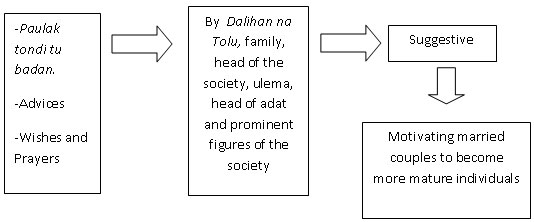
Suggestiveness is the explanation for the process of internalization of prayers, wishes, and advices into the married couples selves. In addition to the incorporation of values contained in the prayers, wishes, and advices, it also motivates the married couples to become more mature people.
6. Epilogue
Upah-upah is one of the traditional ceremonies practiced in Rokan Hulu Regency, Riau Province. Upah-upah ceremony aims to return or call back tondi to the body. The ceremony contains metaphoric expressions of prayers, wishes, and advices to the recipient(s) of Upah-upah. Rokan Hulu people in Riau and most of Batak and Tapanuli people in North Sumatra belive that tondi is a part of the soul that can leave its possessor anytime. Upah-upah is one of the ways to bring it back to the body as well as enhance its positive power for the person(s).
There are many kinds of Upah-upah traditional ceremony. Upah-upah for Entering a New Phase of Life (addressed to a married couple) is performed to build the sense of gratefulness to God and to preserve social and spiritual values of the society. Parents in Rokan Hulu always have a dream, intention, and wish to hold Upah-upah ceremony since their child is still a kid. Those who are able to provide a water buffalo for the offerings could perform Fuller Upah-upah. But for those who are incapable, an egg in a Regular Upah-upah is enough to have a ceremony that is ordered and full of sacredness, advices, and prayers.
All of the ceremonial efforts are certainly performed as an expression of thankfulness to God of the man’s parents as they will have a daughter-in-law. The expectation is that from the wedding until their old time, the couple will be ready to face troubles and difficulties, and be always together in hard times.
As a research has proven, psychological maturity can also be enhanced through the ceremony. The maturity will shape the married couple’s determination in keeping their household. Furthermore, it could also result in harmonic family as well as tolerant and cohesive society. The research’s findings are clear evidence for the use of returning tondi to the body of the married couple that received Upah-upah in the Upah-upah for Entering a New Phase of Life.
By Bahril Hidayat
References
- Irwan Effendi, Baron Lubis, Muslim Nasution, 2008, Upah-upah, tradisi membangkit semangat dalam masyarakat Melayu. Yogyakarta: The Center for Malay Culture Studies and Development in cooperation with Adicita Karya Nusa Publisher.
- Bahril Hidayat, 2006. Tema-tema Psikologis dalam Tradisi Mangupa. Jakarta: Social Psychology Journal of the Faculty of Psychology of the University of Indonesia.
- Koentjaranigrat, 2002, Manusia dan kebudayaan di Indonesia. Jakarta: Djambatan
- Persadaan Marga Harahap Dohot Boruna, 1993. Horja: adat-istiadat dalihan na tolu, musyawarah adat Persadaan Marga Harahap Dohot Anak Boruna di Padang Sidempuan 26-27 Desember 1991. Bandung: PT. Grafiti
Internet sources:
- Wikipedia. Kabupaten Rokan Hulu. http://id.wikipedia.org. (Last updated at 13:55, 13 Februari 2010). Downloaded on Februariy 18, 2010.
- Situs Resmi Pemerintah Propinsi Riau: Profil Kabupaten Rokan Hulu. (last updated: April 16, 2009). http://www.riau.go.id. Downloaded on February 18, 2010.
Source of photo:
- Documents of the Center for Research and Development of Malay Culture (BKPBM)
Read : 32.827 time(s).
Insert your comment here :


 Today
Today  Yesterday
  Last week
  Last month