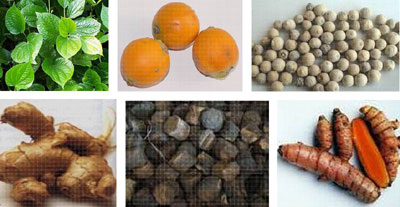
Some ingredients for traditional medication concoctions. Above, left to right, betel vine, areca nut, pepper. Below, gingger, gambier, and turmeric.
Illnesses, according to Acehnese, are classified into two types, those which are caused by supernatural causes and those which are caused by natural causes. Most illnesses which are caused by supernatural causes need handling from a shaman, healer, or a Teungku (Acehnese religious title). Meanwhile, the illnesses that are caused by natural causes are taken care by both medical advisor and traditional medical treatment.
1. Health in Acehnese Perspective
Acehnese have been known for having the culture which is strongly influenced by Islamic culture. This is reflected in Aceh major Moslem population. In addition, the acculturation of both culture in Aceh is expressed in a proverb “Adat ngon Hukum han jeut Cree, Lagee zat ngon siffeut”, which means that the tradition and Islamic canon law are inseparable as though substance and its characters (M. Alamsyah et.al., 1998/1999:53-54).
The acculturation of tradition (culture) and Islam causes the perspective on culture to be synchronized with Islamic perspective, and so are health problems. Aceh culture views the health for Acehnese must agree with the Islamic view on health. Likewise, Islamic explanation on health must be adjusted to Aceh culture.
Islam advises its adherents to always maintain their health and to make efforts to stay out of illnesses. Moreover, in Acehnese perspective, every illness suffered is Allah’s will (Rusdi Sufi & Agus Budi Wibowo, 2006:28).
Related to that perspective, there is a popular proverb which develops in the Acehnese. It says ‘na umu na ubat’ which means if someone is blessed with long life, every illness he suffers will have its remedy. This perspective is in accordance with the Hadith ‘Allah does not create an illness without its remedy.’ (Alamsyah et.al., 1998/1999:54).
According to the causes, Acehnese categorize illnesses into two types namely the ordinary illnesses and donya (worldly) illnesses (Sufi & Wibowo, 2006:28-29). Ordinary illnesses are caused by natural causes which are also recognized in medical field. Whereas wordly illnesses, also known as supernatural illness, are caused by buut donya or a person deed and the devil or meurampot (supernatural creature) (Sufi & Wibowo, 2006:31).
2. Kinds of Illnesses and the Treatment
1. Kinds of illnesses caused by supernatural causes
Acehnese recognize various kinds of illnesses caused by natural causes. The following are some of the examples:
1. Burong or Jitamong Burong
This illness is also referred as Burong Tujoh. It is caused by jiupeukeunong (someone’s deed), by transfering supernatural spirit into someone’s body. The signs of the person who suffers from this illness are: his eyes rove wild and wide open, he speaks continuously and sometimes accompanied by screaming and resisting, his power doubles, and usually, his nails and toenails turn blue or green.
The common treatment by Acehnese is by calling a healer or a teungku (ulema). The therapy method is by saying certain prayers or by meurajah (the healer or teungku casts spells). According to the Acehnese, this illness can never heal if taken to a doctor. Moreover, if it is taken care by someone who is incompetent in it, the chance for recovery is small (Sufi & Wibowo, 2006:31-32 and Alamsyah et.al., 1998/1999:57).
2. Meurampot (possessed by the devil)
Meurampot or possessed by the devil is a kind of illness which Acehnese believe to be caused by the devil’s disturbance to human on the devil’s own will. The signs of the sufferers are: he has high body temperature, he talks in his sleep, he murmurs and laughs uproariously, at times, he faints (Alamsyah et.al., 1998/1999:58).
The common treatment performed by the Acehnese is by calling a healer or a teungku. The treatment method is by saying certain prayers or by meurajah (the healer or teungku casts spells). The technique of using rajah (the spell) is by blowing or spraying it. The materials used in this method are betel leaves which are chewed by the healer or teungku. The juice of the betel leaves is then sprayed the possessed person (Sufi & Wibowo, 2006:32).
3. Keunong Seureubok
Seureubok is a concoction which is made to cause an illness to another person, usually a person someone dislikes. This is done by taking the victim’s part of body or objects that was attached to his body such as the hair or the underwear (Alamsyah et.al., 1998/1999:60).
The object is then burnt and the burnt object is intended as the manifestation of the victim’s body. The ash is mixed with the seureubok (powder may be made of iron, gold and silver).
The victim will feel endless pain or, in Aceh language it is called meurayu-rayu. He cannot be cured by medical treatment. The common therapy for this illness is by the help of a healer or the expert in it (Sufi & Wibowo, 2006:31-33).
4. Jipeu-Ulat
This illness is usually suffered by a woman who are not married until her late age. It is caused by a person’d deed, which in Aceh language, is called jipeuteka (an effort to prevent a woman from finding herself a husband until she reaches her old age, or so as no one proposes her). This illness is also considered to be caused by jipeukeunong, a person action of assigning the devil to ‘block’ the woman, aiming to make her as if something disgusting or jipeu-ulat (the person who is in love with her or who is proposing her sees her as disgusting as worm [in Bahasa Indonesia ulat]) (Alamsyah et.al., 1998/1999:60-61).
The therapy for this illness is usually performed by a healer or a shaman who in Aceh language are called mabh’en or kampong midwife. The therapy is performed stealthily. It goes as follows :
- Bu Leukat Peulemak (sticky rice added with coconut milk)
The hair, nails and torn piece of clothes of the woman, added with some money, are inserted into the Bu Leukat Peulemak.
- It is then wrapped in a handkerchief and rajah (is casted spell) and dipeusa dua (is swayed onto the woman’s body on the count of one to seven). This part of the ritual aims to remove the woman’s bad luck.
- The wrapping is then put on a crowded junction (usually intersection) when there is no one watching and the woman must not see the wrapping for good.
- If someone takes the wrapping then the woman’s bad luck will vanish by itself (Sufi & Wibowo, 2006:34-35).
5. Reuhat
Reuhat is a skin illness which causes itching and is believed to be caused by supernatural spirit (the devil). The indications resemble ringworm (there are wet reuhat and dry reuhat). This illness is actually caused by a concoction which is made of oli, worm hair, ijuk juice (boh janeeng) and other itchy ingredients. All ingredients are gathered in such a way and then intended (peusarat) in a way meat is put in a stem of kalladium leaf until it rots and wormy (Alamsyah et.al., 1998/1999:61).
The therapy to heal the reuhat sufferer is performed by a healer or a shaman who is competent in it. Beside meurajah, the traditional therapy can be done by means of a concoction of various kinds of roots and leaves, such as long bean leaves, pounded areca stone, ripe banana blossom, leaves of klat banana, red roots of coconut tree, corn, orange acid and sulfur. The ingredients are dried in the sun and pounded. Then, the healer or shaman casts spells onto it and apply it to the sufferer’s body (Sufi & Wibowo, 2006:35-36).
2. Kinds of illnesses caused by natural causes
1. Kudee (Scabies)
Kudee is a skin disease which is distinguished into two kinds, kudee buta (dry scabies) which resembles dry teurijo and kudee basah (wet scabies). The medical therapy for this diseases is done by the following methods:
- Salt water mixed with betel vine (anub selasih) and applied to the sufferer’s body.
- Sulfur mixed with coconut oil (minyeuk simplah).
- Gambier crushed and mixed with cooking oil.
- Young areca nut juice, betel leaves, grind turmeric and cooking oil. All ingredients are boiled and, after it is cool, applied to the skin of the sufferer.
- Cempaga (sulfur) soil mixed with women hair oil and then applied to the skin (Sufi & Wibowo, 2006:43 and Alamsyah et.al., 1998/1999:69).
2. Peulawa Caca or Poni
This illness is more popular as smallpox. It is marked with itchy red spots on the skin. In a long period, the red spots will burst and send out liquid. Some medication methods for this illness are:
- Broiler fur dried in afternoon sun for three days then rubbed on the infected part of the body after having been rajah first.
- Roots of momordica charantia pounded and the juice is drunk.
- Para (a plant which resembles rubber) leaves picked from the tree and beaten to the sufferer’s body.
- Gros michel mixed with a little alum and coconut milk, then pounded and drunk (Sufi & Wibowo, 2006:44 and Alamsyah et.al., 1998/1999:70).
3. Teurijo
Teurijo resembles severe ulcer and usually sends out liquid. If the teurijo dries, it shapes like a ringworm. Both dried and wet teurijo are very itchy (Alamsyah et.al., 1998/1999:70).
The treatment for teurijo is by concocting such ingredients as white caraway, 10 peppecorns, and cinnamon. All ingredients are pounded fine and sprinkled on the part that is infected with teurijo (Sufi & Wibowo, 2006:44-45).
4. Batouk (Cough)
Cough is a common illness for most people. Acehnese have several traditional therapy methods for this illness:
- A handful of urot blang leaves (a kind of field grass), 7 ladah (white peppers) are pounded, squeezed and drunk.
- Unripe star fruit chewed with salt and swallowed.
- Dwarf Poinciana (Caesalpinia pulcherrina) leaves squeezed, mixed with sugar at sufficiently, and then the juice is drunk.
- Pepper flour, gingger juice and turmeric juice stirred with honey and egg yolk and drunk.
- Lime juice added with sugar and drunk.
- Young kaffir lime mixed with sugar, then chewed and swallowed.
- Gingger, onion and salt pounded and eaten.
- Dried black tamarind and onion soaked in hot water in the afternoon, then made stay out overnight and drunk in the morning.
Curing cough on children requires such ingredients as 15 cc of honey, 150 cc of fresh water, 10 grams of feoniculum vulgare, 10 grams of cinnamon, 5 grams of nutmeg, and 2,5 grams of dill (abethun graveolens). After all ingredients are boiled, the water is drunk four times a day, a tablespoon each.
If the cough gets serious and leads to TBC, then the concoction should be made of: 7 fried ant-lions, Elaphantopus scaber pounded, kneaded and squeezed for the juice. All ingredients are mixed and the water is given to the sufferer twice a day (Sufi & Wibowo, 2006:46-48 and Alamsyah et.al., 1998/1999:71-73).
5. Saket Ulee (Headache)
This illness is usually caused by weather changes. The medication can be made by concocting traditional ingredients such as:
- A piece of gambier crushed and added with a little water and then applied to the forehead.
- Lime sliced and added with a little water and then applied on the forehead.
- Cinnamon soaked for a while and then ground, mixed with nutmeg and applied to the forehead.
- Young gros michel pulp scraped out and applied to the forehead.
- Kaffir lime, hog plum leaves, coconut water puonded and applied to the head (Sufi & Wibowo, 2006:48 and Alamsyah et.al., 1998/1999:73-74).
6. Sanak (Asthma)
The signs of this illness are breathing problem and pain in the throat. The treatment for this illness is by using such traditional ingredients as:
- Kaffir lime juice and white incense pounded and drunk.
- Cyperus rotundus (cyperusina), fava beans, and white incense are stirred and drunk (Sufi & Wibowo, 2006:49 and Alamsyah et.al., 1998/1999:75).
7. Leumik Booh (Impotent)
The therapy for this illness is by using a concoction which is made of:
- Black-boned fowl egg yolk, honey, suet, lee buu neuleng (rice water), jaitan hitam (black caraway), and radish. All ingredients, except the egg, are boiled and the water is stirred with the yolk and consumed every morning. For faster recovery, the sufferer of this therapy must be prohibited from eating bananas and sour meals. In addition, the sufferer must always eat lamb soup.
- Honey, turmeric, onion and eggs are all stirred and drunk every morning (Sufi & Wibowo, 2006:52-53 and Alamsyah et.al., 1998/1999:77).
8. Sakeet Talo Nyawang or Jitron Kreh (Hernia)
The testicles of the sufferer enlarge and deflated. His genitals is swollen. The traditional concoction to cure this illness consists of:
- Maenteu juice (a kind of sweet orange yet tastes sour, often used to cook sea fish) and salt at sufficiently are mixed and put in a container. The swollen testicles are soaked into it for a while.
- Geutu leaves (a kind of prickly shrub), nutmeg, tiger’s claw leaves, black caraway, bakong (Aceh tobacco) and kaffir lime juice are mixed and applied to the testicles.
- Nutmeg, cinnamon, black caraway, champor, peja bu, and kaffir lime juice are ground, fried and added with castor oil leaves, and then applied to the testicles (Sufi & Wibowo, 2006:54-55 and Alamsyah et.al., 1998/1999:78-80).
9. Keunceng Maneh (Diabetes)
The treatment for this illness can be by means of a concoction which consists of:
- Ngapi nut shell boiled and the water is drunk once a week.
- Fallen ripe areca nuts are fried, pounded fine and mixed with water and drunk three times a week (Sufi & Wibowo, 2006:56 and Alamsyah et.al., 1998/1999:81).
10. Cireit (Diarhea)
The signs of a person who has this illness are upset stomach and watery feces. The treatment is by means of one the following concoctions:
- Guava leaves sprout boiled with water and drunk, or, chewed raw and the juice is swallowed.
- Bananas eaten raw.
- Java plum bark (in Aceh language it is called jambee kleng) boiled and the water is drunk.
- Gambier flour mixed with rice water and drunk (Sufi & Wibowo, 2006:56 and Alamsyah et.al., 1998/1999:81).
11. Tesud Leubo (Hemorrhoids)
The sufferer feels itchy on his behind (anus), especially when defecating and sitting. The treatment for this illness is by making a concoction of such ingredients as:
- Kurah fruit crushed fine, fryer eggs, and coconut oil. Crushed kurah is mixed with the egg yolk and made ferment with coconut oil, and then applied to the ill part.
- Sticky rice, turmeric sprout and fresh pumpkin leaves are pounded and applied to the ill part (Sufi & Wibowo, 2006:62 and Alamsyah et.al., 1998/1999:87).
12. Meuglang (Worm Infestation)
The sufferer experience bloating stomach, frequent hunger and feels weak. The treatment for this illness is by concocting these ingredients:
- Halia (gingger), dry galanga, fenugreek (trigonella foenum-graecum), zedoary, and senna of Mecca leaves (cassia angustifolia). All ingredients are dried, pounded and sifted. The flour resulted from the sifting is dissolved in hot water and drunk twice a day, a teaspoon each.
- Eat as much albizzia (Leucaena glauca) as possible.
- Jangjingki leaves, garlic and jarangeu are mixed and squeezed in (a little) water, and then drunk (Sufi & Wibowo, 2006:63-64 and Alamsyah et.al., 1998/1999:88).
13. Saket Jantong (Heart Disease)
The sufferer feels pain on the left chest and gets shocked easily which, often, causes fainting. The therapy can be done with a concoction of buem leaves boiled and the water is drunk every morning (Sufi & Wibowo, 2006:64 and Alamsyah et.al., 1998/1999:89).
14. High Blood Pressure
The sufferer gets headache, tense nape, and becomes emotionally sensitive. The treatment for this illness is by concocting these ingredients:
- Star fruit leaves and fruits are boiled and the water is drunk.
- Radish boiled and the water is drunk.
- Timun Phang (Aceh cucumber) consumed everyday.
- Young papaya grated and consumed (Sufi & Wibowo, 2006:64-65 and Alamsyah et.al., 1998/1999:89).
15. Anemia
Anemia sufferer shows such signs as pale face and losing appetite. The treatment can be done by concocting these ingredients:
- Garlic cooked, boiled whole milk, 3 ounces of dry ginggers, chili, cinnamon pounded fine, clove flower, and nutmeg. All ingredients are pounded fine and rolled as big as nutmeg, then eaten every morning and before sleeping.
- Gingger, fenugreek, cinnamon, garlic, gambier, nutmeg, clove flower and white caraway. All ingredients are pounded fine. After the dregs is disposed, it is stirred with honey and milk, and shaped round small. It is taken at night before sleeping. The sufferer who takes this medicine must not drink palm juice and coconut juice (Sufi & Wibowo, 2006:65-66 and Alamsyah et.al., 1998/1999:90).
16. Luroh Ouk (Hairfall)
The treatment for hairfall can be done by concocting these methods:
- Tobacco water splashed to the hair, wrap the hair with a towel or cloth for around five minutes and then wash it.
- Chili leaves pounded and rubbed to the head. Usually the head is cut bald first.
- Candlenut is fried, pounded fined and mixed with coconut oil and then applied to the head (Sufi & Wibowo, 2006:69 and Alamsyah et.al., 1998/1999:92-93).
17. Appendicities
The person who has appendicities feels pain on the right stomach. One of the traditional treatments is by concocting several ingredients such as:
Fryer egg, Lannea grandis red sprout, and ijo siket leaves. All ingredients are squeezed with clear water and then drunk.
Pomegranate leaves and ripe giant cavendish squeezed and the juice is drunk.
Hibiscus leaves, garden morning glory leaves and gros michel are all squeezed and drunk.
The treatments are for three days in a row (Sufi & Wibowo, 2006:85-86).
(Tunggul Tauladan/bdy/01/02-2010)
Translation by Apri Widiastuti (trns/28/03-10)
Reference
- Rusdi Sufi & Agus Budi Wibowo, 2006. Pengobatan tradisional di Aceh. Banda Aceh: Badan Perpustakaan Provinsi Nanggroe Aceh Darussalam.
- M. Alamsyah et.al., 1998/1999. Pengobatan tradisonal pada masyarakat pedesaan Provinsi Daerah Istimewa Aceh. Banda Aceh: Departemen Pendidikan dan Kebudayaan; Direktorat Jenderal Kebudayaan; Direktorat Sejarah dan Nilai Tradisional; Proyek Inventarisasi dan Dokumentasi Kebudayaan Daerah.
Photo Source
Read : 30.678 time(s).
Insert your comment here :


 Today
Today  Yesterday
  Last week
  Last month