1. History
This old Malay mosque is estimated to be built in 1604 CE. If the estimation is true, it is now in the age of 4 centuries. The mosque was built in the glorious period of Luwu kingdom. The sultan of Luwu at the time was Datu Payung Luwu XVI Pati Pasaung Toampanangi Sultan Abdullah Matinroe. Historically, when the sultan replaced his father in occupying the throne in 1604 CE, he removed the capital of the kingdom from Patimang to Ware by arguing that Ware laid nearby beach and harbor, so that economical activity could be strictly controlled. Another source argues that the removal was purposed to disseminate words of Islam to the inhabitants of the district. If the last view is accepted, the removal signed the profound influence of Islam in the Luwu kingdom. Indeed, the new capital construction, where the mosque was placed alongside the palace to become one complex, indicated that Islam had strongly exerted in the kingdom. In addition, a large public sphere, called alun-alun, was also built in the kingdom‘s complex. Such capital construction was similar to that of Islamic kingdoms in Java.
As the mosque was named Palopo, the district was then given the same name. Therefore, by 1604 CE the name Palopo replaced the previous name, Ware. The word Palopo was thought to be Bugis and Luwu word that has two meanings. First, the word refers to the kind of traditional snack made of both sugar and glutinous rice. And second, it refers to technique of placing wooden nail at a column of building. The both meanings have relation with the process of constructing the mosque that eventually inspired the people to name it as Palopo.
2. Location
The Tua Palopo mosque lays in Palopo town in south Sulawesi, Indonesia.
3. Measure
The entire Tua Palopo mosque measures 225 square meters in total.
4. Architecture
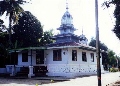
The mosque appears unique architecture that was perhaps influenced by the early Hindu and Buddhist temples in Java. One of the strange building materials was sandstone shaped as thick quadrangle blocks. Additionally, the quadrangle area of the mosque was seemingly influenced also by the temples in Java. At the lowest wall, for example, decoration carved as a stylization of lotus is similar to that of Borobudur temple. The upper wall was decorated with pictures as carved on Hindu and Buddhist temples. This is the only mosque in Indonesia that adopted the construction of temple.
The mosque‘s roof, seen as another element influenced by outsider construction, resembles the roof of Javanese house, called joglo. The roof, called tajug, comprises three tiered pyramidal roof. The upper roof is more radical slanted eaves than the lower, and the highest roof is shaped as pyramid. The first and the second ascending layers are supported by four columns made of cinna gori or cinaduri timber, measuring 90 centimeters in diameter. A blue ceramic pinnacle surmounting the roof is estimated from China.
Another view argues that actually the mosque construction was not influenced by the Javanese, but rather symbolizes local symbolism aspect as to values as the core of pangngadereng in Bugis culture rooted to the philosophy of cosmogony. This view is based on the entire structures of the mosque that consist of three piles resemble panggung house (rumah panggung). Such concept is consistently applied to other parts such as the roof and its adornment that have three piles; supporting columns that have also three piles, namely palangga, alliri posi and soddu; three piles wall interspersed by hem shape; and three piles color on column - green, white and brown - painted from the upper to the lower.
Alongside the aspect above, wara (center) and palili (surrounding the center) are the considerable concept of the mosque architecture, applied in the main column (alliri posi) that is surrounded by four supporting columns. Furthermore, another symbolism aspect that appears in the mosque is seven windows locating on both left and right side of the mosque‘s wall that symbolize the seven days in a week. In each window there are five standing iron lattices that symbolize the number of Islamic prayer in a day and night. In addition, the mosque has seven entrances in a front side, six of which in the form of window that three of which in the right side and others in the left, while one entrance is placed in the middle as the main gate to come inside.
The explanation above shows that the aesthetic concept encompassed within the mosque architecture refers to the system of knowledge, cosmogony and norms upheld by the Bugis society. Moreover, the selected building materials and the designed construction were taken originally from local elements, only the material of wall and mihrab (small room in a mosque where the Muslim leader stands during prayer) in the form of quarry that resembled that of the Hindu temple. In this level, it can be said that the mosque, in one hand, was constructed to be suitable with local element, and in another hand adopted foreign element such as the construction of Hindu temple in Java.
As a conclusion, there are three elements played a central role in shaping the mosque construction: Bugis, Hindu and Islam. This fact is the evidence that the Bugis society was an inclusive society to receive foreign elements in creating some innovations and pushing a process of acculturation. In historical and cultural point of view, both acculturation and innovation are the attempt of avoiding conflict between the local inhabitants who strongly upheld their inherited tradition, called attoriolong, and the outsiders who brought Islam to the region. It is worth noting that actually Islam in Nusantara (Malay Archipelago) was also profoundly influenced by Hindu as a big religion in the region before the coming of Islam. Therefore, the Hindu element also appears in the architecture of Tua Palopo mosque. In such process of acculturation, both concept of design and architecture in Bugis, particularly in Palopo, went through another change.
5. Planning
Both oral and hand-writing data that scatter within the society do not provide enough information as to who the founder was, and how the process of building this mosque conducted.
6. Renovation
The mosque certainly had ever been renovated, but the complete data about its process are still in the process of data collecting.
Source:
- Yulianto Sumalyo. 2006. Arsitektur Mesjid dan Monumen Sejarah Muslim. Yogjakarta: Gadjah Mada University Press.
- www.fsrd.ac.id
Kredit foto: asruldinazis.wordpress.com
Read : 13.606 time(s).
Insert your comment here :


 Today
Today  Yesterday
  Last week
  Last month