Selangor Sultanate
A. The History
Geographically located in the middle of the Malayan Peninsula, Selangor is surrounded by Putrajaya and Kuala Lumpur. Based on the ministerial decree dated on August 27th, 2005, Selangor was awarded as the most advanced city in Malaysia. The award came as the result from the fast growing progress in economy in the region.
Selangor Sultanate was established in 1756 A.D. by a Bugis descent named King Lumu bin Daeng Celak titled Sultan Salehuddin Shah ibni al-Marhum Yamtuan Daeng Celak. In the 15th Century, Selangor was under the occupation of Malacca Sultanate. Following the ruin of Malacca; Johor, Aceh, Siam, and Portuguese competed to colonize Selangor. At this point Sultan Salehuddin played his significant role to release Selangor from Johor`s occupation. Later on, in the 18th Century he established Selangor Sultanate.
Sultan Salehuddin passed away in 1778 A.D., then was succeeded by his son Raja Ibrahim Marhum Saleh titled Sultan Ibrahim Shah. He ruled the sultanate from 1778 to 1826 A.D. At least there were two significant points grappling with the early history of the Sultanate during the tenure of Sultan Ibrahim Shah.

On July 13th, 1784 A.D., the Dutch colonials assigned a number of troops to attack the Sultanate; hence further, the Dutch could successfully conquered Selangor Sultanate. Another important moment was the Great Britain`s intervention in Selangor.
It began with a signing of cooperation between Selangor and Perak that led to a dispute on debt burden. Robert Fullerton, the governor of Pinang Island, then intervene in the dispute acting to be mediator.
Likewise, Sultan Ibrahim Shah also played influential role in creating harmonious relations between the Dutch and Sultan Mahmud Johor, as well as reconciling between Sultan Mahmud with Raja Ali (Yamtuan Muda Riau replacing Raja Haji).

Sultan Ibrahim passed away on October 27th, 1826 A.D., then his son, Raja Muda Selangor, came to succeed the position as Sultan with a title Sultan Muhammad Shah (1826-1857 A.D.). Once an internal dispute took place during the ruling period of Sultan Muhammad Shah. The dispute began when the Selangor people viewed the Sultan was not able to rule some sultans and society leaders who were under the authority of Selangor Sultanate. Consequently, small sultanates such as Kuala Selangor, Kelang, Bernam, Langat, and Lakut tried to separate from Selangor. No matter how such a dispute once happened in the Sultanate, for about 31 years long the Sultan ruled Selangor, he has made some revolutionary steps to enhance Selangor`s economy. One of the programmes was establishing a tin mining factory in Ampang.
Following the death of Sultan Muhammad Shah in 1857 A.D., there was an action to severe from Selangor Sultanate carried out by several highly royal staffers. The separatist action was a consequence of tortured debate over the figure that was appropriate to be the sultan of Selangor. Finally, Sultan Muhammad Shah`s nephew, Sultan Abdul Samad, was declared as the fourth Sultan of Selangor upon unanimity amongst the royal staffers. During the tenure of Sultan Abdul Samad, 1857-1898 A.D., the tin mining factory had been operated; even its products were exported to Selat and China.
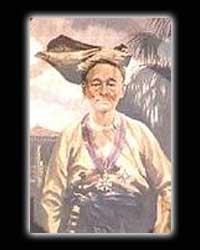
Sultan Abdul Samad
The Fourth Sultan of Selangor
(1857-1898 A.D.)
In addition, Sultan Abdul Samad designated his son-in-law Tengku Dhiauddin ibni Almarhum Sultan Zainal Rashid (Tengku Kudin) as the Vice Yamtuan Selangor in 1868 A.D. for unknown reason. Likewise, he bestowed Langat to Tengku Kudin.
The advanced economical progress happening in Selangor then lured China to establish disclosed-cooperation with certain Selangor`s highly royal staffers. By taking advantages from this cooperation, China could easily gain access to economic resources in Selangor. Consequently, Selangor suffered from critical situation, in which commotion happened in almost all human being spheres. Knowing that news, Great Britain forced Sultan Abdul Samad to accept the arrival of Britain`s Resident in Klang. Through that way Great Britain was expected to be able to intervene the internal affairs of Selangor Sultanate.
At the age of 93 Sultan Abdul Samad passed away, precisely dated on February 6th, 1898 A.D., and was buried in Jugra. Then appeared as the Sultan of Selangor was Raja Muda Sulaiman ibni Almarhum Raja Muda Musa, the grandson of Sultan Abdul Samad. His coronation as the fifth Sultan of Selangor dated on February 17th, 1898 A.D., and he was given titled Sultan Alauddin Sulaiman Shah (1898-1938 A.D.).
Under the rule of Sultan Alauddin Sulaiman, Selangor Sultanate could reach its golden age marked by the fast infrastructure and transportation developments. House building, as the main agenda during his ruling period, was prioritized in Klang. At 40, a ceremony Jubli Emas was organized intended to show people`s respect on him. On March 30th, 1938 A.D. he passed away, and was buried in Klang. To commemorate his merits, he was awarded a honourable title “Marhum Atiqullah.”
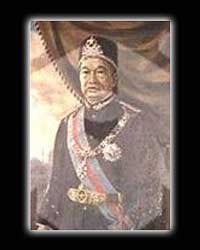
Sultan Alauddin Sulaiman Shah
The Fifth Sultan of Selangor
(1898 – 1938 A.D.)
On April 4th, 1938 A.D., son of Sultan Alauddin Sulaiman Shah was appointed as the sixth Sultan of Selangor Sultanate with a title Sultan Hisamuddin Alam Shah ruling from 1938 to 1942 A.D. However, his reign over the Sultanate could not exist in a long run. Just four years, precisely in 1942 A.D., after being inaugurated as the Sultan, the Japanese colonials gained the control over the Sultanate since almost all Malay kingdoms in the Malayan peninsula had been conquered.
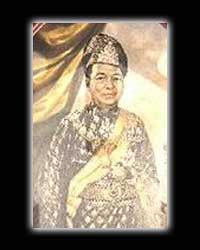
Hisamuddin Alam Shah
The Sixth Sultan of Selangor
(1938-1942 and 1945-1960 A.D.)
The Japanese then commissioned Tengku Musauddin as the seventh Sultan of Selangor with a title Sultan Musa Ghiatuddin Riayat Shah ruling from 1942 to 1945 A.D. He was the elder brother of Sultan Hisamuddin Alam Shah. For such kinship ties, the Japanese forced Sultan Hisamuddin Alam Shah to assist his elder brother, especially in the governmental management.
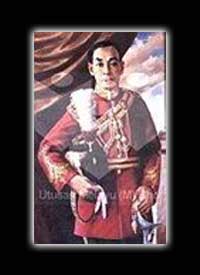
Sultan Musa Ghiatuddin Riayat Shah
The Seventh Sultan of Selangor
(1942-1945 A.D.)
In 1945 A.D., the Japanese could no longer intervene in the Selangor Sultanate since the arrival of Great Britain. With powerful authority over many kingdoms in the Malayan Peninsula, Great Britain restarted intruding the Sultanate`s internal affair; that was by reappointing at Sultan Hisamuddin Alam as the Sultan of Selangor.
Finally, Sultan Hisamuddin was inaugurated as Timbalan Yang Dipertuan Agung Negara Persekutuan Tanah Melayu (vice leader), while position for the first Yang Dipertuan Agung went to Yang Dipertuan Besar Negeri Sembilan, Tuanku Abdul Rahman ibni almarhum Tuanku Muhammad. Further, when Tuanku Abdul Rahman passed away, Sultan Hisamuddin Alam Shah came to appear as the second Yang Dipertuan Agung before he passed away five months later dated on September 1st, 1960 A.D.
The Sultanate`s throne went to the oldest son of Sultan Hisamuddin named Raja Abdul Aziz. He was then becoming the ninth Sultan of Selangor with a title Sultan Salahuddin Abdul Aziz Shah (1960-2001 A.D.). Though Selangor often suffered from advanced progress in almost all sectors, Great Britain`s interference could still be found during the ruling period of Sultan Salahuddin Abdul Aziz. One of Great Britain`s interference was in the establishments of external and internal political affairs.
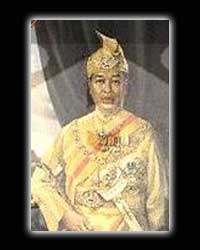
Sultan Salahuddin Abdul Aziz Shah
The Ninth Sultan of Selangor
(1960-2001 A.D.)
In 1986 A.D., Resident Frank Swettenham attempted to unite Selangor with Negeri Sembilan, Pahang, and Perak into the “the Federated Malay States centred in Selangor. The programme just kept growing due in 1948 A.D., when the “the Federated Malay States” was altered to the “the Federation of Malaya,” before it was changed once more to “Persekutuan Malaysia” in 1963 A.D. Consequently, in 1974 A.D. the capital of Malaysia was moved to Kuala Lumpur; no longer in Selangor.
On November 22nd, 2001 A.D., Sultan Salahuddin Abdul Aziz Shah passed away, then was succeeded by his son Tengku Idris Shah as the tenth Sultan of Selangor titled Sultan Sharafuddin Idris Shah (2001 – present).
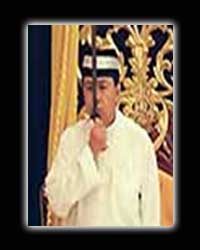
Sultan Sharafuddin Idris Shah
The Tenth Sultan of Selangor
(2001 – present)
B. The Genealogy
Here is the genealogy of Selangor Sultanate`s rulers:
-
Sultan Salehuddin Shah ibni al-Marhum Yamtuan Muda Daeng Celak or known as Raja Lumu bin Daeng Celak (1756-1778 A.D.)
-
Sultan Ibrahim Shah ibni al-Marhum Sultan Salehuddin Shah (1778-1826 A.D.)
-
Sultan Muhammad Shah ibni al-Marhum Sultan Ibrahim Shah (1826-1857 A.D.)
-
Sultan Abdul Samad ibni al-Marhum Raja Abdullah (1857-1898 A.D.)
-
Sultan Alauddin Sulaiman Shah ibni al-Marhum Raja Muda Musa (1898-1938 A.D.)
-
Sultan Hisamuddin Alam Shah ibni al-Marhum Sultan Alauddin Sulaiman Shah (19381942 A.D.)
-
Sultan Musa Ghiathuddin Riayat Shah ibni al-Marhum Sultan Alauddin Sulaiman Shah (19421945 A.D.)
-
Sultan Hisamuddin Alam Shah ibni al-Marhum Sultan Alauddin Sulaiman Shah (19451960 A.D.)
-
Sultan Salahuddin Abdul Aziz Shah ibni al-Marhum Hisamuddin Alam Shah (1960-2001 A.D.)
-
Sultan Sharafuddin Idris Shah ibni al-Marhum Sultan Salehuddin Abdul Aziz Shah (2001 A.D.-…)

C. The Ruling Period
Since first established in 1756 A.D., it means that Selangor Sultanate has persisted for about two a half centuries. During that length of time, the Sultanate often suffered from several glorious ages, especially during the tenure of Sultan Alauddin Sulaiman Shah, who ruled the Sultanate from 1898 A.D. to 1938 A.D. No matter how success in economy, Great Britain`s interferences often made several critical situations in the Sultanate.
D. The Territory
The entire width of Selangor is 7.956 kilometre squares with nine districts:
1. Hulu Selangor, which is headed by Majlis Daerah Hulu Selangor
2. Hulu Langat, which comprises:
-
Majlis Perbandaran Kajang, covering Langat and Kajang
-
Majlis Perbandaran Ampang Jaya, covering Ampang and Hulu Klang
3. Gombak, which is governed by Majlis Perbendaran Selayang
4. Kuala Selangor, which is governed by Majlis Daerah Kuala Selangor
5. Kuala Langat, which is governed by Majlis Daerah Kuala Langat
6. Klang, which is governed by Majlis Perbendaran Klang
7. Petaling, which comprises:
-
Majlis Bendaraya Petaling Jaya, governing Petaling Jaya
-
Majlis Badaraya Subang Jaya, governing Subang Jaya, Puchong, Serdang, USJ, and seri Kembangan
-
Majlis Bandaraya Shah Alam, governing Shah Alam and Sungai Buloh
8. Sabak Bernam, which is governed by Majlis Daerah Sabak Bernam
9. Sepang, which is governed by Majlis Perbendaran Sepang

E. The Governmental Structure
Selangor Sultanate implies principle “parliamentary democracy,” which is likewise implied by other states in Malaysia. Sultan is the supreme power over the authoritative government in Selangor Sultanate. The position as sultan is inherited from generation to generation in the royal family. The Sultan is assisted by Yang Dipertuan Besar/Agung.
Since 1967 A.D., Selangor has owned its national anthem “Duli Yang Maha Mulia” (His Royal Highness), but none of us knows who wrote the lyric. The music was composed by Saiful Bahri. Below is the lyric of the anthem:
Duli Yang Maha Mulia
Selamat di atas takhta
Allah lanjutkan usia Tuanku
Rakyat mohon restu bawah Duli Tuanku
Bahagia selama-lamanya
Aman dan sentosa
Duli Yang Maha Mulia
The English translation for the above lyric is below:
His Royal Highness
Safe on His throne
May Allah grant you long life
The people ask for your blessings
Forever fortunate
Peace and serenity
His Royal Highness

F. Socio-Cultural Life
In the process of data collecting
Happy Susanto (sej/44/04-08)
Translated by Irfan Nugroho (ter/87/12-08)
References:
-
“Identiti Selangor”, dalam ms.wikipedia.org/wiki/Identiti_Selangor, diakses tanggal 3 April 2008.
-
“Salasilah kesultanan Selangor Mulai 1756”, dalam www.selangor.gov.my/main.php?Content=vertsectiondetails&VsItemID= 4&VertSectionID=5&CurLocation=44&Page=1, diakses tanggal 4 April 2008.
-
Yusoff bin Haji Hashim, Prof. Dato` Dr. Mohd. 2005. “Negeri Selangor, Kesinambungan dan Perubahan Sebuah Kesultanan Melayu Malaysia”, dalam Prosiding Seminar Antarbangsa Kesultanan Melayu Nusantara: Sejarah dan Warisan, Kuantan, Pahang Darul Makmur, 8-11 Mei.
-
Photo credit:
- www.virtualtourist.com
- Dr Farish Ahmad-Noor (Badrol Hisham Ahmad-Noor)
Senior Fellow for the Contemporary Islam Programme;
S. Rajaratnam School of International Studies (RSIS),
Nanyang Technological University (NTU),
Block S4, Level B4, Nanyang Avenue,
Singapore 639798
Read : 35.252 time(s).
Insert your comment here :


 Today
Today  Yesterday
  Last week
  Last month