Thursday, 3 September 2026 |Thursday, 20 Rab. Awal 1448 H
Online Visitors : 1.553
Today
:
25.340
Yesterday
:
31.992
Last week
:
32.264.566
Last month
:
43.463.948
You are visitor number 105.216.314 Since 01 Muharam 1428 ( January 20, 2007 )
AGENDA
No data available
News
04 agustus 2010 04:26
Local Tradition Helps in Conserving Biodiversity
Sanur, Indonesia - Participants of the ongoing international biodiversity meeting have learned from local Balinese that local traditions can play a significant role in maintaining natural biodiversity.
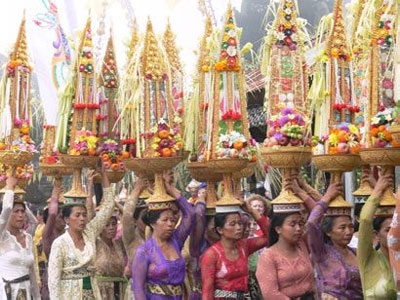
In the panel session on "Living with Nature: Lessons from Bali", participants learned that local communities on the island are encouraged to preserve local flora that is commonly used for religious ceremonies.
The session was held as part of the international meeting of the Association for Tropical Biology and Conservation, coinciding with a workshop held by the Center for International Forestry Research in Sanur.
Among the plants are a the keruing, a large tree used for timber. The plant's fruit, shaped like a pair of wings, is one of the main elements in the offerings used for blessing new buildings and cremations.
"Keruing grows in the native forest of the WestBaliNational Park. It is one of the big tree species commonly found there," said I Gusti Made Tantra, former head of the provincial forestry agency.
"The plant is a dominant species in the Sangeh natural tourism park, and is also found in Kuwum forest in Bedugul," he said, adding that the species covers over 10-hectares in Sangeh and 3-hectares in Kuwum.
The plant is commonly found in gardens as well, and is always associated with temples, he added.
He said Balinese people have carried out conservation efforts on this plant and managed to prevent any logging and settlement encroachment attempts because they are aware the plant needs to be preserved for religious purposes.
This, he said, is in contrast with the people of other Indonesian islands where the tree is found, including Sumatra, Kalimantan and Papua.
"In those places, the trees are felled illegally to be used for building materials."
"But in Bali, the conservation efforts on this plant are going well. People have managed to safeguard the forests and prevent thefts. Nobody dares cut down these trees," Tantra said.
The Balinese belief of Tri Hita Karana, that is, the harmonious relation between man and God, among people, as well as between people and nature, is also a key to preserve the natural environment, he said.
Fany Brotcorne from the Belgian National Foundation for Scientific Research said the Balinese people's efforts to maintain sacredness of forests have managed to increase the population of long-tailed macaques in Padangtegal, Ubud.
She conducted research on the species from last September up until this month. Her research indicates that there was an increase in the species' population density in the sacred monkey forest.
"In 1992, there were only 17 individual macaques per hectare, and last year, the number had increased to 25 individuals per hectare," she said.
Based on the research, she concluded there was a substantial demographic growth and increased annual growth rate over time, amid high human pressures.
Other flora preserved for religious use is the endemic bamboo plant. The plant is not only used for religious purposes, but also for housing, said Ida Bagus Ardiyasa, a bamboo researcher from the Eka Karya botanical garden in Bedugul.
He said there are five species of bamboo endemic to Bali, all of which are preserved by local communities.


 Today
Today  Yesterday
  Last week
  Last month