Thursday, 30 April 2026 |Thursday, 13 Dzulqaidah 1447 H
Online Visitors : 1.435
Today
:
24.468
Yesterday
:
22.835
Last week
:
169.256
Last month
:
101.098.282
You are visitor number 105.216.314 Since 01 Muharam 1428 ( January 20, 2007 )
AGENDA
No data available
News
19 juli 2008 04:40
Unifying Javanese and Malay through Togog and Belung
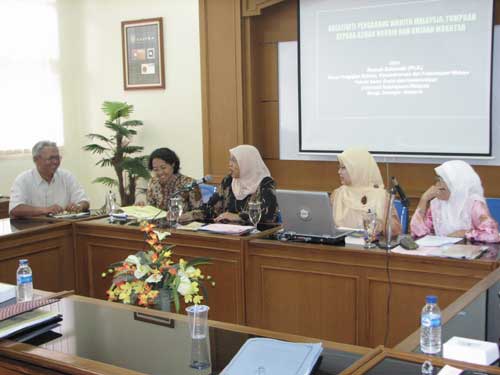
Yogyakarta, MelayuOnline.com- Misinterpretation towards Javanese and Malay as two separated cultures still exists among the common society. However, taking a look at its history, there will be more similar factors that may unify them rather than separate them. Those factors which may be able to unify Javanese and Malay are traditional arts, literatures, and customary rites. That is the conclusion of “Triune International Workshop, UGM-UNS-UKM on Malay-Javanese Intellectual History” held on Thursday (17/7) in the Faculty of Cultural Sciences at Gadjah Mada University, Yogyakarta.
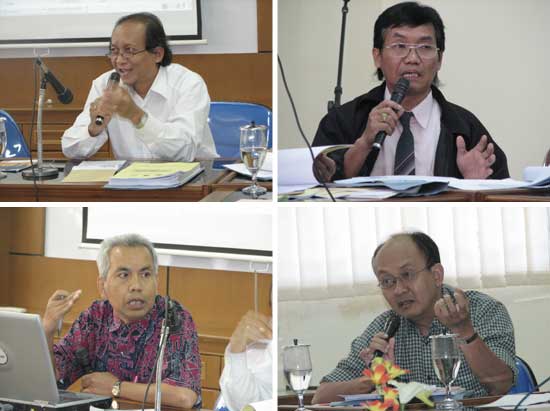
Came as the speakers for the first session were Prof. Madya. Dr. Hanapi Dolla (UKM), Prof. Dr. Heddy Shri Ahimsa-Putra, M.A., M.Phil. (UGM), Drs. Hendrokumoro M.Hum (UGM), Drs. Manu J. Widyaseputra (UNS). While tn the second session, the speakers were Dr. Rosnah Baharudin (UKM), Dra. Murtini, M.S., (UNS), Dr. Misran Rokimin (UKM), and Dr. Mawar Shafei (UKM).
Prof. Hanapi, in the first session conveyed the close relationship between Javanese and Malay has been existing since long time. In Kelantan, some customary rites taking place there indicate the acculturation of Javanese and Malay.
Hanapi gave some real examples of the acculturation between Javanese and Malay cultures in Kelantan. On some customary rites such as Mai Peteri, Makyong dance, Menora and shadow puppet performance, we will see Javanese cultural motifs, shapes, and spirit which are integrated into Malay culture.
Similarly, Drs. Manu explicated the integration of Javanese and Malay cultures in literature such as Hikayat Sri Rama and Serat Kandhaning Ringgit Purwa. In the character of Javanese‘s shadow puppet figure named Togog and Belung, we will find such facts.
Togog is a figure on Javanese shadow puppets representing Javanese culture from his Javanese dialect. Belung, with his Malay dialect, may represent Malay culture.
Based on the figures of Togog and Belung, Manu concluded that intercultural communication between Javanese and Malay has been extant for a long time ago proven by the discovery of Malay cultural heritages which are kept well in Jogjakarta Palace.
In the opposite to the former speakers, Imam Sutarjo viewed the similarity between Javanese and Malay based on the mindset and social intercourse of Javanese and Malay. Javanese are famous as a society that highly shoulders social solidarity and fraternization in their daily livings. Such values may also be found among the Malay societies.
In-line with Imam Sutarjo, Prof. Heddy remarked, “Similarly to the Javanese people, Malay people likewise highly respect fraternization and social solidarity. Such similarities indicate that the influential interaction between Javanese and Malay has been living since hundred years ago.”
However, this full professor on anthropology at Gadjah Mada University also delivered that there are slight differences between Javanese and Malay caused by the existence of “social integration spirit” among the Javanese and Malay people.
Social integration spirit which is available among the Malay people is the key concept to keep their fraternization and social solidarity. Ending his lecture, Prof. Heddy said that the presence of Malay social integration spirit can be found on their daily expressions which include “budi” within such as menanam budi, membalas budi, menerima budi, menanggung budi, and kedapatan budi.

 Today
Today  Yesterday
  Last week
  Last month