Saturday, 13 June 2026 |Saturday, 27 Dzulhijah 1447 H
Online Visitors : 0
Today
:
5.756
Yesterday
:
18.545
Last week
:
227.151
Last month
:
9.252.016
You are visitor number 105.216.314 Since 01 Muharam 1428 ( January 20, 2007 )
AGENDA
No data available
News
13 agustus 2008 06:34
MelayuOnline.com on Metro TV
E-Culture: Cultural lifestyle in digital era
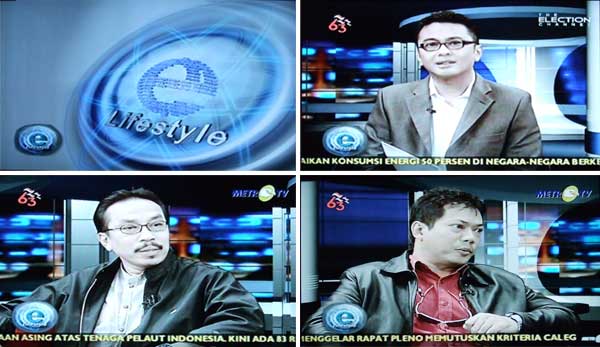
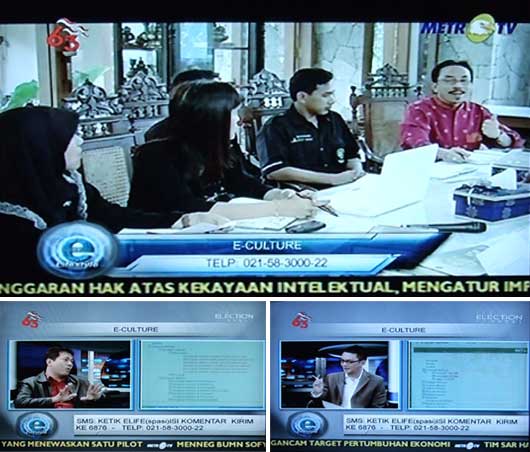
Jakarta, MelayuOnline.com- MelayuOnline.com begins to be exposed by the broader public now. After being exposed by the biggest newspaper in Indonesia – KOMPAS – on August 8th, 2008, MelayuOnline.com was screened by a news channel television from Jakarta, Metro TV. On August 10th, E-Lifestyle program on Metro TV presented the Head of MelayuOnline.com – Mahyudin Al Mudra, and the Head of the Center for Southeast Asian Social Studies – Aris Arif Mundayat – to be interviewed live on TV.
The interview was driven to an interesting topic dealing with E-Culture. “Along the fast advancement of information and communication technology, E-culture has become an inseparable aspect in our societies. Hence, E-culture can be interpreted as a cultural preservation utilizing information and communication technology,” Mahyudin said.
MelayuOnline.com – under the management of the Center for Research and Development of Malay Culture (BKPBM) – as an online medium concerning on Malay culture ceaselessly attempts to preserve, to document, and to publish Malay cultural heritage scattering over in the world in non-traditional way. All programmes are aimed at establishing the new Malay society, which is familiar with information and communication technology media. However, the biggest problem is the limited data resources for consequence of the less attention from Malay people to preserve their own cultural heritage
MelayuOnline.com – under the management of the Center for Research and Development of Malay Culture (BKPBM) – as an online medium concerning on Malay culture ceaselessly attempts to preserve, to document, and to publish Malay cultural heritage scattering over in the world in non-traditional way. All programmes are aimed at establishing the new Malay society, which is familiar with information and communication technology media. However, the biggest problem is the limited data resources for consequence of the less attention from Malay people to preserve their own cultural heritage.
According to Mundayat, E-culture is replacing gradually traditional culture, which tends to be stagnant. Consequently, it may shape a new culture for the result of multiculturalism in cyberspace. Along the time, “pop culture” coming out of the combination between “high culture” – in royal family – and “low culture” – amongst citizen – will outlast crossing the edge for its capability in adjusting to and fulfilling the needs of people in the present. (Tuti Nonka)

 Today
Today  Yesterday
  Last week
  Last month