Friday, 30 October 2026 |Friday, 18 Jum. Awal 1448 H
Online Visitors : 0
Today
:
3.251
Yesterday
:
35.617
Last week
:
9.404
Last month
:
45.610.426
You are visitor number 105.216.314 Since 01 Muharam 1428 ( January 20, 2007 )
AGENDA
No data available
News
14 agustus 2008 07:10
The Role of ICT in Cultural Preservation
Yogyakarta, MelayuOnline.com- The role of information and communication technology (ICT) in preserving and disseminating indigenous knowledge is an important sphere to be utilized continuously. It is necessary to prevent either bad or good impacts of the globalization. Therefore, the awareness of preserving and developing cultural heritage amongst society should be encouraged by all people.
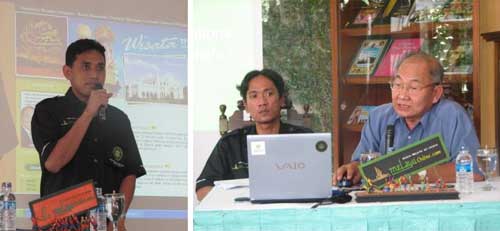
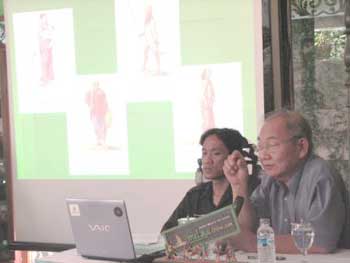
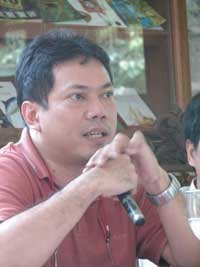
Such assessment above appeared in a discussion “The Role of ICT in Preserving and Disseminating Indigenous Knowledge,” in the meeting room of Balai Pinang Lima – the office building of the Center for Research and Development of Malay Culture (BKPBM) on Saturday (9/8/08). Came as the keynote speaker was Prof. Ding Choo Ming – a Malay cultural observer at the Institute of Malay World and Civilization, National University of Malaysia. Came also two investigators were Dr. Aris Arif Mundayat – the Director of Center for Southeast Asian Social Studies (PSSAT) – and Mardhani Riasetiawan, SE., M.Ak – an information and communication technology observer at GadjahMadaUniversity, Yogyakarta. Some academicians, researchers, and students from several universities in Yogyakarta, also enthusiastically participated in the discussion.
The discussion was begun by a speech of Nursaed Ali Rido representing Mahyudin Al Mudra – the Head of MelayuOnline.com – who was having a live interview on Metro TV. Irfan Afifi, who was designated as the moderator, opened the session by giving some small jokes before Ding Choo Ming started the discussion.
In that occasion Ding Choo Ming conveyed that Malay cultural studies utilizing ICT media should be viewed from the perspective of cultural preservation, not merely from the perspective of “cultural homogenization” as what the moderator said. Institutions concerning on Malay cultural studies must actively encourage surrounding people to carry out cultural preservation and development through ICT. Likewise, Ding Choo Ming told the participants that the awareness of Malaysian government in cultural preservation is still low. “Malaysian government gave only empty promises to us about supporting the development of MalayCivilization.com‘s project.
The numbers of definitions on Malay culture are merely relied on the argumentation that culture is a result of human thinking. Further, Ding Choo Ming remarked that such cultural materialization has not been capable of establishing Malay civilization amongst society.
BKPBM has been applying the ICT in preserving and disseminating Malay culture. Therefore, Ding Choo Ming salutes Mahudin Al Mudra‘s efforts to guide surrounding societies and develop Malay culture through MelayuOnline.com.
Responding Ding Choo Ming‘s presentation, the first investigator – Mardhani Riasetiawan – explicated the role of ICT in advancing and spreading cultural information. He considered BKPBM‘s cyber portals – MelayuOnline.com, MalayTourism.com, and RajaAliHaji.com – are the breakthrough in cultural preservation and development. He suggested MelayuOnline.com to use “easy” language so that people in cyberspace will be more familiar with MelayuOnline.com.
Fast advancement of ICT is able to pass through geographical boundaries and to accelerate the process of cultural dissemination and preservation. The use of ICT for such efforts becomes more intensive in-line with the fast current wave of the third era – an era when cyberspace dominates almost all human being spheres.
Aris Arif Mundayat, who was appointed as the second investigator, argues that the emergence of “indigenous knowledge” is aimed at countering the modernization. “Modern science has manipulating our nature and culture to a condition where moralistic values are gradually eradicated,” Mundayat said. “In the modern knowledge, the only measurable facts that are utilized as the bases to compile modern theory. That is the principle of positivism,” he added.
The emergence of “indigenous knowledge” concept hopefully can draw back the moralistic values in culture and nature to be utilized as the bases to create the new theory in knowledge. This concept has widened up breaking through the assessment of good-bad and prohibition-suggestion. Therefore, the development of indigenous knowledge may break through the great influence of political issues.
Closing his presentation, Mundayat conveyed his idea about uniting and sharing cultures to all people in the world such what MelayuOnline.com and MalayCivilization.com do. It can make appear the new paradigm of Malay culture based on Malay people‘s mindset. Unfortunately, Mundayat did not explicate the mindset of Malay people at the time.
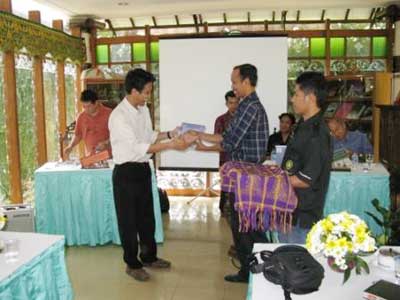
After question-answer session, BKPBM gave some souvenirs in the forms of books on Malay culture to the speakers. (TH/brt/01/08-08)


 Today
 Yesterday
 Last week
 Last month