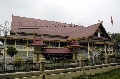
Al-Anwar Mosque, Lampung
1. The History
Muhammad Saleh bin Karaeng was an ulama and warrior of Bone Sultanate in South Sulawesi, Indonesia. During his period, in the 19th century, the Bone Sultanate was occupied by the Dutch colonialism. In such circumstance, Muhammad Saleh and his followers stood opposing the colonialists. However, modern and destructive weapons of the colonialists successfully defeated Muhammad Saleh‘s insurgence, and he became a fugitive of the enemy. Muhammad Saleh therefore roamed throughout Nusantara (Malay Archipelago) to keep himself from the colonialist‘s threat of punishment. Later on, Muhammad Saleh and his followers arrived in southern seashore of Sumatera Island, called today as Lampung. It is estimated that they were the first group from Bugis who migrated to Lampung. The group then established surau (small mosque) in 1839 C.E. used as a center of Muslim activities. Other religious figures involved in the construction of the surau were Daeng Sawijaya, Tumenggung Muhammad Ali and Penghulu Besar Muhammad Said. Over following years, the surau became the center of prayers and delivering Islamic teaching to fishermen, traders and local inhabitants.
In 1883, Krakatau volcano erupted terrifyingly that destroyed the surrounding area including the area where the surau sat. That small building shattered into pieces. Five years after the disaster, Daeng Sawijaya met some rich merchants from Palembang, Banten and Bugis discussing about reconstruction plan of the broken surau. The meeting recommended to build a permanent mosque which was eventually named al-Anwar, means lighting mosque.
In the period of Indonesian independence struggle, the al-Anwar mosque constituted a central place where religious figures and intellectuals such as Alamsjah Ratuperwiranegara, Kapten Subroto, KH. Nawawi and KH. Toha met and arranged war strategies opposing the colonialist. Such function ran until the Indonesians attained their freedom, and the colonialist totally went out from Indonesian Islands.
As the oldest mosque in Lampung, the mosque preserves several ancient legacies, some of which are two cannons bequeathed by Portuguese, old book of Qur‘anic interpretation in the age of two centuries, 200 Islamic books and old large sacred earthenware bowl for water. The last legacy is perceived as sacred because historically it was used by ulama for breaking the Ramadan fast. Another sacred legacy, old well called Sumur Seribu Doa, located behind the mosque. Based on the local belief, the well has never been drying until today, and its water could heal various diseases.
2. The Location
Al-Anwar mosque lays on Malahayati Street, South Teluk Betung, Bandar Lampung, Indonesia. Today the street becomes a trading center in Bandar Lampung.
3. The Measure
In the time of its establishment, in 1893 C.E., the mosque was very simple. After the volcanic eruption in 1883, the mosque was reconstructed to be larger and permanent. Today it measures 1050 square meters in total, stands on 6.500 square meters, and can accommodate 2.000 worshippers.
4. The Architecture
The main building of the al-Anwar mosque is supported by six columns with height about 8 meters. The number of the columns symbolizes six basic principles of Islamic faith. According to local history, the columns were structured without using cement, but using albumen and lime mortal instead. Other data about the architecture of this mosque are still in the process of data collecting.
5. The Planning
Until this present day, the mosque architect is still unknown. One opinion thought that it was designed collectively by those who involved in the first construction.
6. The Renovation
The mosque had ever been renovated for several times. After the independence of Indonesia, renovations were held twice: in 1962 and in 1997. Initially the mosque merely accommodated maximum 400 worshippers. After the renovation held in 1962, the mosque can accommodate 2.000 worshippers. In the meantime, the renovation added verandahs at south, north and east side. The last renovation, in 1997, needed 400 millions Rupiah.
Source : Abdul Baqir Zein. 1999. Masjid Masjid Bersejarah di Indonesia. Jakarta: Gema Insani Press. Read : 10.934 time(s).
Comment of "al anwar mosque lampung"
20 Sep 2011.
Darah aceh 
smg semangat juang ACEH tak terkalahkan,ACEH pantang mundur.MERDEKA |
Insert your comment here :


 Today
Today  Yesterday
  Last week
  Last month