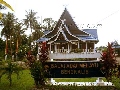
Agung Temple
The Agung Temple stands 5 meters above sea level, in Sungai Malang village, the sub district of Amuntai Tengah, Hulu Sungai Utara district, South Kalimantan province, Indonesia. The temple is thought to be built by Hindus as it is inherited site of Negaradipa Kingdom established in 1438. In the same period, there was Majapahit Kingdom in Java. It is believed that the temple was the origin of Banjar Kingdom whose glory attained in the 14th century.
The temple was firstly found by S. Muller, a European, who had visited many ancient sites in three tributaries of Sungai Barito (Barito River) in the early 19th century. Muller based his investigation on Hikayat Banjar text to trace Empu Jatmika (the founder of the Agung Temple) who had walked along Sungai Mahariban (Mahariban River) edge to a place named Candi Agung (Agung Temple). Unfortunately, the story does not clearly mention where the location is. Meanwhile other sources do not provide any information about the origin of Candi Agung. Both the Chinese chronicle owned by Tang Dynasty (618-906 C.E) and Ming Dynasty (1368-1643 C.E) merely mentioned a place namely Bandjermasin.
The Agung Temple is thought to be constructed since 740 years ago. In 1997, the Archeological Center of Banjarmasin held an investigation on Muller‘s work by using radiocarbon calendar (C14), a specific method utilized for determining age of an ancient site. In 1998, the result of the investigation was published in Berita Penelitian Arkeologi or BPA (Archeological Research News) to announce that the Agung Temple was built in 728 C.E or in the early 18th century. It is worth noting that the investigation wrote a different result with the story mentioned by the Hikayat Banjar. Based on such a scientific investigation, the temple was established long before the 9th century.
The temple‘s building materials are rock and timber. The construction is supported by ironwood column with a technique of ‘kalang sunduk‘ or building which is erected on poles, constructed on river or marsh. Such a technique was chosen to avoid the temple from the water.
The Agung Temple is one of interesting tourism places in South Kalimantan. Some visited it merely for relaxation. And some came as pilgrimage tourists to visit a historical grave sitting within the temple‘s area.
References :
- Nurhadi Rangkuti, “Candi Rawa di Kalimantan”, Kompas, 21 September 2005.
- Banjarmasin Post, 28 Agustus 2006.
- Media Indonesia Online (www.mediaindo.co.id), 24 Maret 2006.
- www.seasite.niu.edu
- www.wisatanet.com
Credit photo : id.wikipedia.org Read : 11.901 time(s).
Insert your comment here :


 Today
Today  Yesterday
  Last week
  Last month