1. The History
People visiting the Mausoleum of Sultan Bolkiah will discover the elegance of the tomb that may represent the incredible powers of Sultan Bolkiah in the past when he was ruling Brunei Kingdom. Under his reign, Brunei Kingdom reached its golden age.
The tomb shows us about the figure of Sultan Bolkiah which is famous as a pious Muslim with charismatic leadership style. The epitaph tells some stories relating to the last minutes of the sultan and his romantic epic with his consort.
a. The Biography
Sultan Bolkiah is the fifth sultan of Brunei Kingdom ruling from 1485 A.D. to 1524 A.D. While Sultan Sharif Ali is well-known as an Islamic missionary in Brunei and Sultan Hasan who led Brunei to reach its prosperity, Sultan Bolkiah is the sultan of Brunei who was able to expand the territories of Brunei Kingdom.
Under the rule of Sultan Bolkiah, the Brunei Kingdom‘s territory encompassed the region of Borneo Island, Palawan Island, Sulu, Balayan, Mindoro, Bonbon, Balabak, Balambangan, Bangi, Mantani, and Saludang. The glory of Brunei Kingdom was reached when Malacca Kingdom surrendered to Portuguese in 1511 A.D. He took over Islamic government in Malacca and moved it to Brunei. Sultan Bolkiah was a figure who loves wandering abroad by sailing through the Archipelago waters for trading and establishing diplomatic relations. Therefore, it was normal that Brunei Kingdom was known by other kingdoms at the time.
The sultan‘s glory, powers, tenure, love, and his wandering will not be forgotten by Brunei people. They create a song entitled Syair Tuan Nahkoda telling about the romantic epic around the death of the sultan. In addition, the sultan‘s title “tuan nahkoda” or “nahkoda ragam” (the singing captain) were given for the sultan‘s hobby to sail across the Archipelgo. The story around the death of the sultan was begun from the sultan‘s hobby in sailing.
b. The Death
The story around the death of Sultan Bolkiah was begun from his journey from another country to the sultan‘s homeland, Brunei, along with his new wife, Puteri Laila Menchanai. No one knows the reason why the Sultan passed away. There is an assessment that the sultan‘s wife stabbed the sultan with a golden needle – which was usually used to embroider.
Putri Laila Menchanai did not tell the royal family of Brunei Kingdom about the death of her husband but on the contrary, she tried to conceal the news cunningly. No evidence shows the reason why she concealed the sultan‘s death from Brunei royal family even when the dead body of the sultan began decaying.
However, the incident about the sultan‘s death later on came to the sixth Sultan of Brunei Kingdom, Sultan Abdul Kahar. Unfortunately, when Sultan Abdul Kahar heard that news, Puteri Laila contemplated suicide before revealing the mystery of sultan Bolkiah‘s death.
A historian from Netherland states that Sultan Bolkiah deceased after a misunderstanding between him and his consort‘s friend occurred. But, once more, there is no data revealing that mystery as well.
Another argumentation around the death of Sultan Bolkiah comes from a Brunei historian named Pengiran Haji Tengah bin Pengiran Muhammad bin Pengiran Jumat bin Pengiran Pemancha Pengiran Muhammad Daud. He argues that the death of Sultan Bolkiah was a consequence of his marriage with a daughter of Raja Daratan Bini – a queen ruling Daratan Bini Island who had the supernatural powers. Amongst the local inhabitants of Daratan Bini Island, there is a folklore saying that all men coming to the island should settle the island and marry the girls over there.
No one was brave to marry Raja Daratan Bini unless those proposing her are brave enough to grapple against her until the last blood. Consequently, whomever were fighting against her, they will die on the next day. Sultan Bolkiah‘s arrival at Daratan Bini Island was not aimed at fighting against the queen. The figure of Sultan Bolkiah could make Raja Daratan Bini, who was famous as a cruel queen, become a normally stunning woman. Thus, Sultan Bolkiah was awarded an iron-bar that later on was used to hammer “Keris Si Naga” (the Dragon Kris) – the symbol of Brunei Sultan‘s powers.
Some Arabian travellers believe that the existence of Daratan Bini Island is not merely a fairy tale. It is real. Muhammad Zakaria Al Qazwini tells that Daratan Bini Island is an island surrounded by 700 islands and ruled by the only one queen namely Raja Daratan Bini. Another traveller, Musa ibnu Mubarak Al Sirafi, declared that he ever met the queen who was sitting on a golden throne and surrounded by 4000 ladies-in-waiting.
Likewise, Datu Ray Ibrahim from Magindanao, the Philippines, states that folklore in the Philippines is almost the same as the story of Daratan Bini Island. “About 500 years ago, a queen named Urdhuha held the powers upon Pengasinan region,” he said.
Antonio Fegetta, an Italian scholar who was assigned to accompany and assist Ferdinand Magella, calls Pengasinan region as Acoloro Island proven by a historical record from Ibnu Batuta in 1355 A.D. In this record, Puteri Urdhuha was a skilful heroine possessing numerous warrior fleets.
Based on the story above, we know that Puteri Laila Menchanai was a daughter of Puteri Urdhuha. The name of Laila Menchanai itself was commonly used amongst the royal family in Suluk and Magindanao, the Philippines. Hence, it can be concluded that Puteri Laila Menchanai really owned supernatural power even though Sultan Bolkiah was able to tame her without physical contact.
Finally, if the story above is true, we may also determine the death of sultan Bolkiah is a consequence of his marriage with Raja Daratan Bini who had supernatural power. Sultan Bolkiah might be one of Raja Daratan Bini‘s victims.
2. The Location
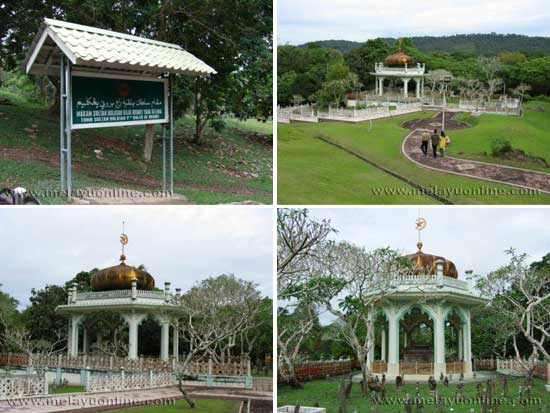
The Mausoleum of Sultan Bolkiah lies in Kota Baru, Bandar Seri Begawan, nearby Brunei National Museum.
3. The Description
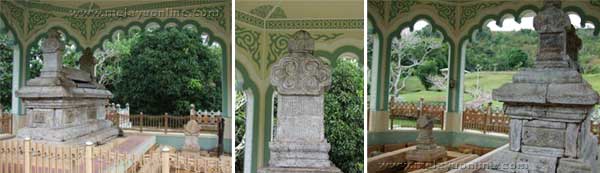
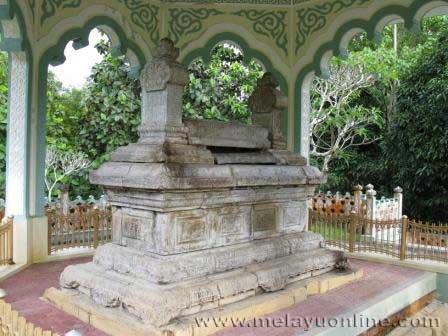
The Mausoleum of Sultan Bolkiah was built by Sultan Abdul Kahar aimed at commemorating the sultan‘s merits for Brunei Darussalam. It was made of stone that is beautifully carved with an Arabic calligraphy. The tomb lies beneath a small shelter to protect it from the sun and rain. Its side is finely carved an Arabic calligraphy that was made by a Javanese.
There are two gravestones on the tomb, one on the head and another one on the foot. The date embedded on the tomb is 9 Ramadhan 930 H (July 11th, 1524 A.D.).
The Mausoleum of Sultan Bokiah lies next to the tomb of Puteri Laila Menchanai. However, the tomb of Puteri Laila Menchanai has only one tombstone on it. Therefore, the tombs of Sultan Bolkiah and Puteri Laila Menchanai are commonly called “Makam Selarong Bernisan Tiga.” In addition, the Mausoleum of Sultan Bolkiah suffered a refurbishment on July 10th, 1968 A.D.
4. The Social Value
Many tourists, either domestic or local, come to the graveyard for pilgrimage after visiting Brunei Museum. Most of them are curious about knowing the remaining glory of Sultan Bolkiah in Brunei Darussalam.
The tomb tells us particular stories about the glory of Brunei Kingdom under the rule of Sultan Bolkiah. Under the tenure of Sultan Bolkiah Brunei Kingdom reached its golden age, which can still be viewed from the prosperous Brunei people.
At least there are three moral messages that can be drawn from the figure of Sultan Bolkiah:
1. Sultan Bolkiah‘s achievement in expanding the Brunei Kingdom‘s territory without war
2. Sultan Bolkiah‘s success in developing and spreading Islam in the entire Brunei Darussalam and in the Philippines as well
3. Sultan Bolkiah‘s hobby to wandering abroad is a useful method to know other countries‘ civilization and then imply them in our country.
This is a simple description on the mausoleum of Sultan Bolkiah. Though the surrounding area of the graveyard is totally quiet, the location delivers us the remaining glory of Sultan Bolkiah in the past which can be exemplary behaviour for us in the present.
Nanum Sofia (sej/03/07-08)
Translated by Irfan Nugroho (ter/35/08-08)
References:
Al-Sufri, Haji Awang Mohd. Jamil. 1997. Tarsilah Brunei II: Zaman Kegemilangan dan Kemasyhuran. Bandar Seri Begawan, Brunei: Pusat Sejarah Brunei, Kementrian Kebudayaan, Belia dan Sukan.
___________, dkk. 1992. Daulat. Bandar Seri Begawan, Brunei: Jabatan Pusat Sejarah, Kementrian Kebudayaan Belia dan Sukan.
Pusat Sejarah Brunei. “Info Sejarah: Peristiwa dan Tempat Bersejarah.” The Government of Brunei Darussalam Official website: www.history-centre.gov.bn/peristiwa.htm. Retrieved on July 22nd, 2008.
Pusat Sejarah Brunei. 2006. “Info Sejarah: Sultan-sultan Brunei.” The Government of Brunei Darussalam Official website: www.history-centre.gov.bn /sultanbrunei.htm. Retrieved on July 22nd, 2008.
Brunei Museums Department. 2002. Sultan Bolkiah Mausoleum. The Government of Brunei Darussalam Official website: www.museums.gov.bn/Bolkiah.htm. Retrieved on July 23rd, 2008.
Photo Credit: The Center for Research and Development of Malay Culture.
Read : 48.075 time(s).
Insert your comment here :


 Today
Today  Yesterday
  Last week
  Last month